
Online stores depend on customer trust. A supply chain or shipping crisis places that trust under pressure. Delayed deliveries, missing products, stock shortages, and inconsistent updates affect customer expectations. Reputation changes quickly when communication fails or customer concerns remain unanswered. Understanding how these situations develop helps businesses prepare accurate responses and protect long-term credibility.
What is an online store’s reputation during a supply chain or shipping crisis?
An online store’s reputation during a supply chain or shipping crisis reflects customer confidence based on delivery reliability, communication quality, order fulfilment accuracy, and problem resolution. Public perception changes through reviews, social media discussions, customer service experiences, and repeat purchasing behaviour over time.
An online store’s reputation is the public perception of its reliability and customer experience.
A supply chain is the network that moves products from manufacturers to customers.
A shipping crisis is an operational disruption that delays or prevents deliveries. Examples include port congestion, warehouse closures, transport strikes, customs delays, severe weather, and carrier capacity shortages.
Customers evaluate businesses based on outcomes rather than operational causes. When orders arrive late or information becomes inconsistent, confidence decreases regardless of where the disruption begins.
For example:
- A clothing retailer experiences warehouse delays during seasonal demand.
- An electronics seller faces international customs inspections.
- A furniture business encounters container shipping congestion.
Each situation affects customer perception differently depending on communication and service quality.
Why do shipping delays affect customer trust?
Shipping delays reduce customer trust because promised expectations remain unmet. Customers compare estimated delivery dates with actual performance. Confidence declines when updates stop, delivery dates change repeatedly, or businesses fail to explain operational disruptions using accurate and timely information consistently.
Trust develops through predictable experiences.
Customers expect:
- Accurate delivery estimates
- Transparent order tracking
- Fast customer support
- Consistent communication
When these expectations break down, customers begin questioning the retailer’s reliability.
How expectations influence reputation
Most customers plan purchases around expected delivery dates.
Examples include:
- Birthday gifts
- Business equipment
- School supplies
- Household essentials
Late deliveries disrupt personal schedules as well as purchasing confidence.
Customers often remember the experience more clearly than the original product.
Why communication matters
Clear updates reduce uncertainty.
Businesses that explain delays using factual information help customers understand the situation.
Silence creates confusion.
Confusion increases complaints.
Complaints become public through review platforms and social media discussions.
How does a supply chain disruption spread across customer experience?
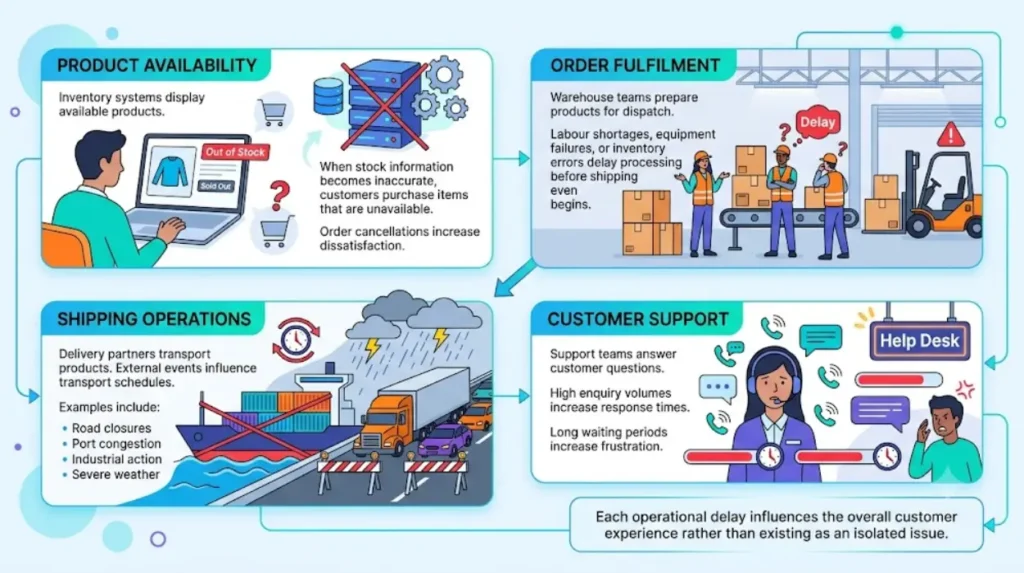
Supply chain disruptions affect multiple customer touchpoints simultaneously. Inventory accuracy, payment processing, fulfilment operations, shipping schedules, customer support, and product availability become interconnected. Problems appearing in one operational stage quickly influence every later stage of the purchasing journey for customers.
A customer journey contains several connected stages.
Product availability
Inventory systems display available products.
When stock information becomes inaccurate, customers purchase items that are unavailable.
Order cancellations increase dissatisfaction.
Order fulfilment
Warehouse teams prepare products for dispatch.
Labour shortages, equipment failures, or inventory errors delay processing before shipping even begins.
Shipping operations
Delivery partners transport products.
External events influence transport schedules.
Examples include:
- Road closures
- Port congestion
- Industrial action
- Severe weather
Customer support
Support teams answer customer questions.
High enquiry volumes increase response times.
Long waiting periods increase frustration.
Each operational delay influences the overall customer experience rather than existing as an isolated issue.
Which reputation signals change first during a crisis?
Public reputation changes appear quickly through measurable indicators. Customer reviews, refund requests, complaint volumes, social media discussions, customer service tickets, cancellation rates, and repeat purchase frequency provide early evidence that customer confidence is declining across different communication channels.
Businesses monitor reputation using measurable indicators.
Customer reviews
Review platforms often receive immediate feedback after delivery problems.
Examples include:
- Delivery delays
- Missing parcels
- Damaged products
- Incorrect items
Negative reviews influence future purchasing decisions.
Social media conversations
Customers frequently share delivery experiences publicly.
Posts spread rapidly when multiple customers report similar problems.
Public discussions increase visibility beyond existing customers.
Refund and cancellation requests
Higher refund requests indicate declining confidence.
Customers losing trust often cancel future orders instead of waiting.
Customer support metrics
Support systems record:
- Ticket numbers
- First response times
- Resolution times
- Complaint categories
These metrics reveal operational pressure before financial performance changes significantly.
How do customer reviews influence future sales after shipping problems?
Customer reviews shape purchasing decisions because they describe real customer experiences. Large volumes of negative reviews reduce buyer confidence, increase comparison shopping, influence search visibility, and lower conversion rates until customer satisfaction improves through consistently reliable operational performance again.
Online reviews function as public evidence of customer experience.
Prospective customers compare ratings before purchasing.
Examples include reviews discussing:
- Delivery accuracy
- Packaging quality
- Customer service
- Return experiences
Consistent negative themes influence buyer confidence more than isolated complaints.
Search visibility
Search engines evaluate user-generated content alongside website information.
Large numbers of recent negative reviews influence how customers perceive search results.
Repeat customers
Existing customers often forgive isolated problems.
Repeated operational failures reduce repeat purchasing.
Customer retention becomes more difficult after prolonged service disruption.
What role does communication play during a supply chain crisis?
Communication explains operational facts, delivery expectations, and recovery progress using consistent information. Accurate updates reduce uncertainty, support informed customer decisions, prevent conflicting messages, and improve overall confidence during periods of operational disruption affecting order fulfilment and delivery schedules.
Communication provides clarity.
Customers value information that answers practical questions.
Essential communication topics
Effective updates explain:
- Current operational status
- Expected delivery timelines
- Order tracking availability
- Refund procedures
- Stock availability
Every communication channel requires consistent information.
Consistency across channels
Customers interact through:
- Live chat
- Website notices
- Social media
- Customer support
Conflicting information creates additional confusion.
Consistent messaging supports customer understanding throughout the disruption.
Readers seeking practical communication planning can explore:
Crisis Communication Frameworks for structured response processes.
How do different industries experience reputation damage differently?
Different retail sectors experience different customer expectations because product urgency, purchasing frequency, and replacement options vary. Reputation effects depend on delivery importance, product availability, customer reliance, and service expectations within each commercial sector across the United Kingdom.
Different products create different customer expectations.
Fashion retailers
Customers expect seasonal availability.
Late deliveries reduce product relevance after promotional periods.
Electronics retailers
Customers often purchase products for work or education.
Delivery delays interrupt planned activities.
Grocery retailers
Fresh products require strict delivery timing.
Missed delivery windows reduce customer confidence quickly.
Home improvement retailers
Construction schedules depend on material availability.
Late deliveries delay wider projects.
Each sector experiences different operational pressures, although customer trust remains the common outcome.
How can businesses measure reputation recovery after a shipping crisis?
Reputation recovery becomes visible through improving customer feedback, lower complaint volumes, higher repeat purchases, better review ratings, stronger customer satisfaction scores, reduced refund requests, and consistent delivery performance maintained across future operational periods after disruption ends successfully.
Recovery requires measurable evidence.
Businesses compare operational data before, during, and after disruption.
Useful performance indicators
Common measurements include:
- Average review rating
- Net customer complaints
- Delivery success rate
- Average response time
- Repeat purchase rate
- Customer satisfaction surveys
Improvement across several indicators demonstrates increasing customer confidence.
Long-term monitoring
Recovery continues after operational issues end.
Customers observe future performance before confidence fully returns.
Consistent reliability strengthens reputation over time.
Readers interested in operational decision-making after understanding crisis impacts can later explore:
Secure PR Distribution for information about structured distribution approaches during business communications.
What lessons do supply chain and shipping crises teach online retailers?
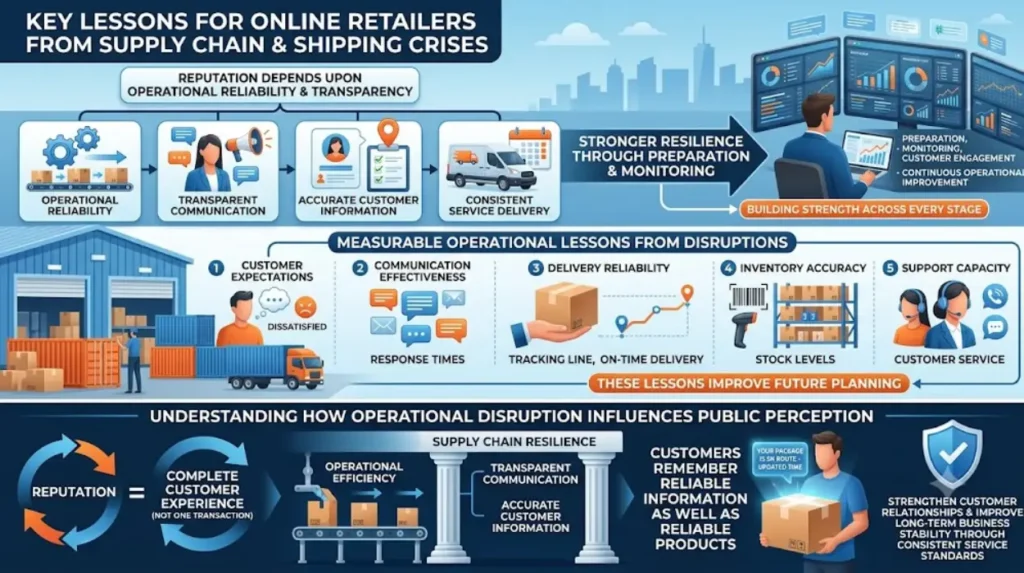
Supply chain and shipping crises demonstrate that reputation depends upon operational reliability, transparent communication, accurate customer information, and consistent service delivery. Businesses that understand these relationships build stronger resilience through preparation, monitoring, customer engagement, and continuous operational improvement across every stage.
Every disruption produces measurable operational lessons.
Businesses gain insight into:
- Customer expectations
- Communication effectiveness
- Delivery reliability
- Inventory accuracy
- Support capacity
These lessons improve future planning.
Explore More Expert Insights:
How Lifestyle and Consumer Journalists Filter Through Hundreds of Product Pitches Daily
Why Continuous Press Coverage is Vital for E-commerce Stores Facing Sales Slumps
Reputation reflects the complete customer experience rather than a single transaction.
Supply chain resilience combines operational efficiency with transparent communication and accurate customer information. Customers remember whether businesses delivered reliable information as well as reliable products. Understanding how operational disruption influences public perception enables retailers to evaluate risks, strengthen customer relationships, and improve long-term business stability through consistent service standards.