
Research reports have become a measurable source of qualified business leads for UK organisations. A structured research campaign creates original data, attracts media coverage, supports content marketing, strengthens sales conversations, and generates demand across multiple channels. This case study explains how research functions as a lead generation engine, how attribution works over six months, and how organisations measure commercial outcomes from research-driven campaigns.
How does research generate qualified leads over six months?
Research generates qualified leads by producing original data, attracting relevant audiences, supporting content distribution, and creating measurable buyer interactions. A structured six-month attribution model connects every research touchpoint with enquiries, sales opportunities, revenue, and long-term marketing performance across multiple digital and offline channels.
Original research is data collected through surveys, interviews, market analysis, or industry datasets. The resulting report becomes a reusable business asset rather than a one-time publication.
A six-month campaign extends the value of one research report through continuous promotion. Instead of relying on a single launch, marketing teams publish new content, share statistics, engage journalists, support sales teams, and measure performance throughout the campaign lifecycle.
Typical lead generation assets include:
- Research reports
- Executive summaries
- Infographics
- Industry articles
- Webinar presentations
- Sales presentations
- Email campaigns
- Social media content
For example, a UK technology company publishes a report based on responses from 1,500 IT decision-makers. The report supports media outreach, LinkedIn campaigns, webinar registrations, and enterprise sales meetings over six months.
Businesses planning wider distribution strategies can also review:
How to Promote a UK Research Report Across Earned, Owned and Paid Channels.
Why does original research outperform standard marketing content?
Original data provides unique information unavailable elsewhere.
Journalists reference exclusive statistics.
Buyers use benchmark data during purchasing decisions.
Sales teams use research findings to demonstrate industry expertise.
Search engines recognise original information as valuable content.
Each interaction contributes to measurable lead attribution.
What does this UK attribution case study demonstrate?
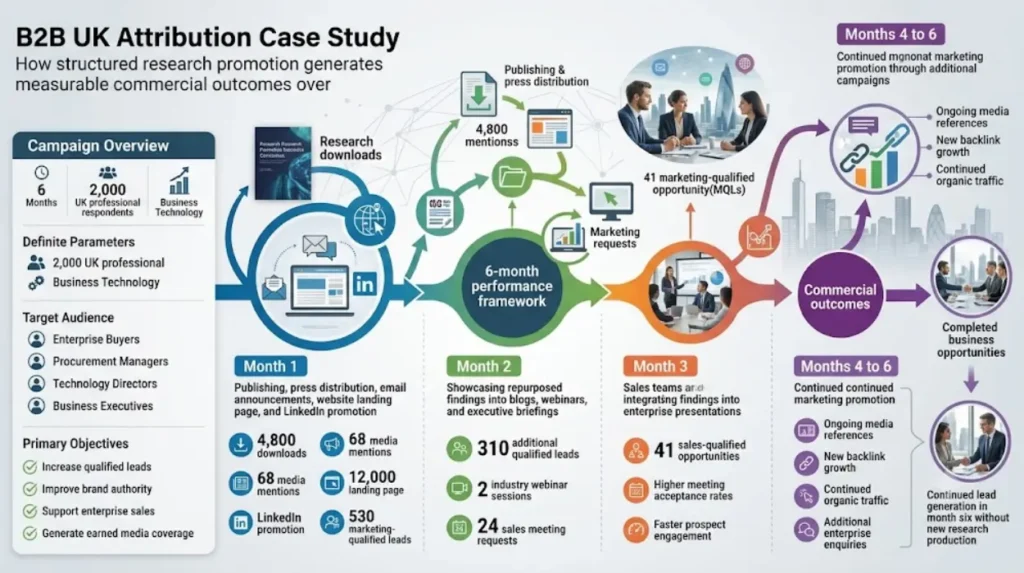
This case study demonstrates how structured research promotion generates measurable commercial outcomes through multiple marketing channels. Six months of attribution connects research downloads, media exposure, website engagement, marketing-qualified leads, sales-qualified leads, and completed business opportunities into one performance framework.
The example below represents a typical B2B UK research campaign.
Campaign overview
Campaign duration: 6 months
Research respondents: 2,000 UK professionals
Industry: Business technology
Target audience:
- Enterprise buyers
- Procurement managers
- Technology directors
- Business executives
Primary campaign objectives:
- Increase qualified leads
- Improve brand authority
- Support enterprise sales
- Generate earned media coverage
Month 1: Research launch
Activities included:
- Publishing the research report
- Press distribution
- Email announcements
- Website landing page
- LinkedIn promotion
Results:
- 4,800 report downloads
- 68 media mentions
- 12,000 landing page visits
- 530 marketing-qualified leads
Month 2
The organisation repurposed research findings into blogs, webinars, and executive briefings.
Results:
- 310 additional qualified leads
- 2 industry webinar sessions
- 24 sales meeting requests
Month 3
Sales teams integrated research findings into enterprise presentations.
Results:
- 41 sales-qualified opportunities
- Higher meeting acceptance rates
- Faster prospect engagement
Months 4 to 6
Marketing continued promoting the report through additional campaigns.
Results:
- Ongoing media references
- New backlink growth
- Continued organic traffic
- Additional enterprise enquiries
By month six, the report continued generating leads without requiring new research production.
Which attribution model measures research performance accurately?
An attribution model assigns measurable value to every buyer interaction before conversion. A six-month attribution framework combines first-touch, multi-touch, and revenue attribution to identify how research contributes to qualified leads, sales pipeline development, customer acquisition, and marketing return on investment.
Attribution is the process of connecting marketing activities with business outcomes.
Research campaigns involve multiple buyer interactions.
A buyer often:
- Reads a news article.
- Visits the research landing page.
- Downloads the report.
- Registers for a webinar.
- Speaks with sales.
- Requests a proposal.
- Becomes a customer.
Each interaction receives measurable attribution.
First-touch attribution
First-touch attribution identifies where the customer journey started.
Example:
A visitor discovers the research through a national business publication before downloading the report.
Multi-touch attribution
Multi-touch attribution measures every meaningful interaction.
Example:
The buyer:
- Reads media coverage
- Downloads the report
- Opens three emails
- Attends one webinar
- Schedules a product demonstration
Each interaction contributes to conversion.
Revenue attribution
Revenue attribution connects marketing activity with closed business.
Example:
A £180,000 enterprise contract originated from research-generated leads.
The organisation attributes measurable revenue back to the original report.
Which metrics prove research delivers commercial value?
Commercial performance depends on measurable business metrics rather than publication volume. Organisations evaluate lead quality, conversion efficiency, revenue contribution, customer acquisition costs, media visibility, and long-term organic search performance throughout the campaign lifecycle to demonstrate research investment returns clearly and consistently.
Important performance indicators include:
Lead metrics
- Report downloads
- Form completions
- Email subscribers
- Marketing-qualified leads
- Sales-qualified leads
Example:
6,400 report downloads
940 marketing-qualified leads
168 sales-qualified opportunities
Sales metrics
- Sales meetings
- Opportunity value
- Proposal requests
- Closed revenue
- Average deal size
Example:
53 enterprise proposals
17 completed contracts
£2.8 million sales pipeline
Marketing metrics
- Organic traffic
- Backlinks
- Media mentions
- Referral traffic
- Social engagement
Example:
112 media publications
390 referring domains
41% increase in organic search traffic
Cost metrics
- Cost per lead
- Cost per acquisition
- Marketing return on investment
Research provides measurable financial outcomes when every campaign activity connects with attribution reporting.
How does Times Intelligence transform research into measurable pipeline growth?
Times Intelligence manages research production, publication, distribution, promotion, and attribution reporting through an integrated process. Clients receive structured campaign execution, measurable reporting, enterprise-focused distribution, and continuous optimisation that converts research assets into long-term lead generation opportunities across the United Kingdom.
Research alone does not generate sustained commercial performance.
The complete process includes:
- Research planning
- Survey management
- Data analysis
- Professional report production
- Press distribution
- Media outreach
- Content repurposing
- Attribution reporting
Each stage supports measurable business objectives.
Clients also benefit from campaign planning that aligns research promotion with earned, owned, and paid channels.
Integrated campaign execution
Times Intelligence coordinates every campaign stage.
Activities include:
- Research design
- Questionnaire development
- Data collection
- Editorial production
- Media targeting
- Digital promotion
- Performance reporting
This unified workflow reduces operational complexity and improves reporting consistency.
Enterprise-focused reporting
Decision-makers require commercial evidence.
Reporting includes:
- Lead attribution
- Campaign reach
- Media performance
- Website engagement
- Pipeline contribution
- Revenue attribution
This reporting framework supports marketing directors, sales leaders, and executive teams.
Why do enterprise buyers respond to research-driven marketing?

Enterprise buyers evaluate evidence before purchasing decisions. Independent research provides benchmark data, industry insights, measurable trends, and credible statistics that strengthen commercial discussions, improve buyer confidence, and support procurement processes across complex business purchasing environments throughout the United Kingdom.
Enterprise purchasing involves multiple stakeholders.
Decision-makers evaluate:
- Industry benchmarks
- Market trends
- Independent evidence
- Operational performance
- Future planning
Research supports each evaluation stage.
For example, a procurement director reviewing cybersecurity suppliers values benchmark data collected from 2,500 UK businesses more than general marketing claims.
Research strengthens credibility during procurement discussions.
Organisations seeking additional insight into enterprise buying behaviour can also review:
From Blog to Boardroom as part of their broader demand generation strategy.
How can organisations maximise return from a research campaign?
Maximum research value comes from continuous promotion, structured attribution, consistent reporting, and long-term content reuse. Organisations that treat research as a strategic business asset generate sustained visibility, qualified leads, stronger enterprise engagement, and measurable commercial performance beyond the original publication date.
Successful campaigns follow a repeatable process.
Plan research around business objectives
Research questions align with commercial goals.
Examples include:
- Market expansion
- Product awareness
- Enterprise lead generation
- Brand authority
Publish multiple content formats
One report supports numerous assets.
Examples include:
- Executive summaries
- Articles
- Infographics
- Podcasts
- Webinars
- Sales presentations
Measure every interaction
Track:
- Downloads
- Media coverage
- Website visits
- Lead quality
- Sales progression
- Revenue contribution
Continuous measurement improves future campaigns.
Partner with an experienced research provider
Professional research partners deliver consistent methodology, high-quality reporting, strategic distribution, and detailed attribution.
Explore More Expert Insights:
How Times Intelligence Produces, Publishes and Distributes UK Research Reports
Full-Service Research Reports vs DIY: A Cost and Quality Comparison for UK Teams
Times Intelligence provides end-to-end research production, UK-focused promotion, and six-month attribution reporting that enables organisations to measure how research contributes directly to pipeline growth, enterprise opportunities, and commercial revenue. Businesses ready to turn research into a predictable lead generation engine can engage with Times Intelligence to plan, distribute, and measure their next research campaign.