
Enterprise buyers rely on evidence before making purchasing decisions. A standard blog post explains ideas, but a research report presents verified information, structured analysis, and measurable findings. Across the United Kingdom, businesses publish original reports to establish expertise, support commercial conversations, and provide decision-makers with reliable data that informs procurement and strategic planning.
Research reports differ from promotional content. They combine quantitative data, qualitative insights, industry analysis, and documented methodology. Enterprise stakeholders use these documents because they answer business questions with evidence rather than marketing claims.
Why do UK brands turn blog content into research reports?
UK brands transform educational blog content into research reports because enterprise buyers expect structured evidence, transparent methodology, measurable findings, and documented sources. Research reports provide greater credibility, stronger commercial relevance, and broader organisational value than standalone informational articles across purchasing processes.
A blog introduces a topic. A research report investigates it through data collection and analysis.
For example, a cybersecurity blog explains ransomware trends. A cybersecurity research report measures ransomware attacks across 500 UK organisations, categorises industries, analyses financial losses, and identifies long-term patterns.
Enterprise buyers compare suppliers using documented evidence. Reports provide that evidence in a format suitable for executive review.
What makes a report different from a blog?
A blog focuses on education or commentary.
A research report includes:
- Research objectives
- Methodology
- Sample size
- Data collection
- Statistical findings
- Charts and tables
- Key conclusions
- References
These elements increase transparency and make information easier to evaluate.
Why does structured evidence matter?
Enterprise procurement teams assess risk before approving suppliers.
Evidence reduces uncertainty by presenting measurable findings instead of unsupported statements.
Documented research supports informed commercial discussions across finance, procurement, operations, technology, and executive leadership.
How do enterprise buyers evaluate research reports?
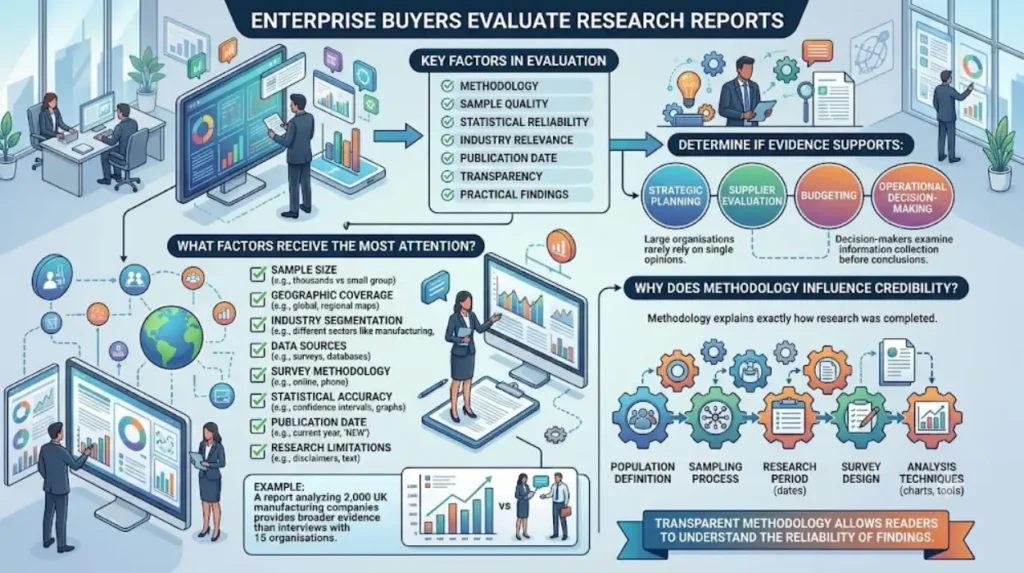
Enterprise buyers evaluate research reports by examining methodology, sample quality, statistical reliability, industry relevance, publication date, transparency, and practical findings. These criteria determine whether reported evidence supports strategic planning, supplier evaluation, budgeting, and operational decision-making within large organisations effectively.
Large organisations rarely rely on single opinions.
Decision-makers examine how information was collected before accepting conclusions.
What factors receive the most attention?
Enterprise buyers typically review:
- Sample size
- Geographic coverage
- Industry segmentation
- Data sources
- Survey methodology
- Statistical accuracy
- Publication date
- Research limitations
For example, a report analysing 2,000 UK manufacturing companies provides broader evidence than interviews with 15 organisations.
Why does methodology influence credibility?
Methodology explains exactly how research was completed.
It identifies:
- Population
- Sampling process
- Research period
- Survey design
- Analysis techniques
Transparent methodology allows readers to understand the reliability of findings.
What information makes a research report valuable to enterprise organisations?
Research reports become valuable when they answer commercial questions using measurable evidence, industry benchmarks, historical comparisons, and practical interpretation. Enterprise organisations use these insights to compare markets, understand trends, identify risks, and evaluate investment opportunities with confidence.
Business decisions involve measurable outcomes.
Reports help organisations understand those outcomes using verified information.
Which data types receive the highest attention?
Common data categories include:
- Market growth
- Customer behaviour
- Technology adoption
- Regulatory developments
- Investment activity
- Operational efficiency
- Workforce trends
- Purchasing behaviour
For example, a logistics report comparing delivery costs across England, Scotland, Wales, and Northern Ireland helps operations teams benchmark regional performance.
Why do benchmarks matter?
Benchmarks provide context.
A company learns more from discovering that customer retention equals 81% while the industry average equals 74% than from seeing its own figure alone.
Comparative analysis improves interpretation.
How do research reports move from marketing teams to executive leadership?
Research reports move through multiple organisational departments because different stakeholders evaluate separate business priorities. Marketing teams generate awareness, sales teams share evidence, procurement teams assess credibility, and executives review strategic implications before commercial decisions progress further internally.
Enterprise purchasing rarely involves one person.
Information moves across departments before contracts receive approval.
Which teams use research reports?
Marketing teams use reports to educate audiences.
Sales teams use reports during commercial discussions.
Procurement teams evaluate supporting evidence.
Finance teams assess commercial implications.
Executive leaders examine strategic findings.
This internal movement increases the practical value of well-structured research.
Why do reports remain useful after publication?
Research reports remain relevant because multiple departments access the same document for different purposes.
One report supports awareness, evaluation, planning, budgeting, and supplier comparison.
How does original research strengthen organisational credibility?
Original research strengthens organisational credibility because independently collected evidence demonstrates subject expertise through measurable findings instead of promotional messaging. Decision-makers recognise transparent data collection, documented analysis, and consistent reporting as indicators of professional knowledge within specific industries and markets.
Original research contributes new information.
It expands knowledge instead of repeating existing publications.
What qualifies as original research?
Original research includes activities such as:
- National surveys
- Industry benchmarking
- Market analysis
- Consumer research
- Business confidence studies
- Economic modelling
For example, surveying 1,500 UK retail managers about inventory planning creates original evidence.
Why does uniqueness matter?
Unique findings receive greater attention because they introduce information unavailable elsewhere.
Decision-makers value new evidence when evaluating changing markets.
What role does data visualisation play in enterprise reporting?
Data visualisation improves enterprise reporting by presenting complex findings through charts, tables, maps, and graphs that simplify interpretation. Visual summaries help executives identify trends, compare performance, understand relationships, and review evidence efficiently during strategic discussions and formal presentations.
Executives review large volumes of information.
Visual presentation accelerates understanding.
Which visual formats appear most often?
Common formats include:
- Bar charts
- Line graphs
- Heat maps
- Geographic maps
- Pie charts
- Comparison tables
- Trend timelines
Each format communicates a different relationship within the data.
Why do visuals improve comprehension?
Charts summarise numerical findings more efficiently than long paragraphs.
A graph showing five years of revenue growth communicates historical performance immediately.
Supporting explanations then provide detailed interpretation.
How do research reports support long enterprise buying cycles?

Research reports support extended enterprise buying cycles because they remain relevant throughout awareness, evaluation, budgeting, procurement, approval, and implementation stages. Reliable evidence helps stakeholders revisit consistent information whenever purchasing discussions continue over several months within complex organisations.
Enterprise purchasing often lasts several months.
Multiple reviews occur before contracts receive approval.
Why do buyers revisit reports?
Decision-makers return to reports because they contain documented evidence.
The same report supports:
- Initial research
- Internal presentations
- Budget planning
- Procurement review
- Executive approval
Reliable documentation reduces repeated information gathering.
How does long-term relevance benefit organisations?
Reports continue delivering value after publication through repeated internal use.
Historical findings also support future benchmarking.
Which industries in the UK rely heavily on research reports?
Many UK industries rely on research reports because regulated markets, competitive sectors, and investment-driven organisations require measurable evidence before strategic decisions. Industry reports support planning, compliance, forecasting, procurement, and performance benchmarking across numerous commercial environments consistently.
Research serves many sectors.
Different industries collect different forms of evidence.
Which sectors publish reports regularly?
Examples include:
- Financial services
- Healthcare
- Construction
- Manufacturing
- Retail
- Technology
- Education
- Energy
For example, healthcare organisations publish patient outcome research, while construction firms analyse infrastructure investment trends.
Why do industries publish reports annually?
Annual publication enables year-on-year comparison.
Consistent reporting identifies long-term trends, market shifts, and operational improvements.
Explore More Expert Insights:
Why Surveys and Data Studies Now Win More UK Media Coverage Than Press Releases
The UK Digital Economy Grew 13.7% in Real Terms: Who Is Publishing That Story?
How can organisations maximise the long-term value of a research report?
Organisations maximise research report value by maintaining accurate datasets, updating findings regularly, presenting transparent methodology, and ensuring information remains relevant for future comparison. Well-maintained reports continue supporting analysis, benchmarking, and organisational knowledge over extended periods effectively.
Research creates long-term business knowledge.
Its value increases when information remains organised and comparable.
What extends report usefulness?
Several practices improve longevity:
- Annual updates
- Consistent methodology
- Standardised metrics
- Historical comparisons
- Clearly documented assumptions
- Transparent references
These practices enable organisations to compare findings over time.
How does ongoing research improve understanding?
Repeated studies reveal change.
For example, annual workforce reports identify employment patterns across multiple years instead of presenting isolated observations.
Organisations analysing report promotion strategies can explore:
How to Promote UK Research Reports to understand distribution approaches across earned, owned, and paid channels.
Those studying measurable commercial outcomes can explore:
UK Research Attribution Case Study to examine how research contributes to lead generation and long-term business performance.
Research reports occupy a different role from blog content within enterprise decision-making. Blogs introduce ideas, while reports validate those ideas through structured evidence, transparent methodology, measurable findings, and documented analysis.
Enterprise buyers evaluate reports using clear criteria that include data quality, methodology, relevance, and statistical reliability. These documents move across departments, support lengthy purchasing processes, provide benchmarking information, and contribute to informed strategic planning.
As organisations continue relying on evidence-based decision-making, research reports remain an important source of structured knowledge for enterprise buyers throughout the United Kingdom.