Businesses in the United Kingdom increasingly use original research to earn media coverage, improve search visibility, support sales conversations, and strengthen industry authority. A research report delivers evidence that journalists, buyers, analysts, and AI search systems reference because it contains structured, verifiable information.
Times Intelligence provides an end-to-end process that covers research production, report publishing, and strategic distribution. Instead of managing multiple suppliers, organisations receive one coordinated workflow that transforms an idea into a published research asset with measurable reach.
Businesses comparing different research approaches can also explore:
Commissioning vs Conducting before selecting the most suitable production model.
What does Times Intelligence do when producing UK research reports?
Times Intelligence manages the complete lifecycle of a UK research report. The process includes research planning, survey design, data collection, analysis, report writing, publication, media distribution, and performance reporting. Every stage follows a structured workflow designed for business communication and media visibility.
Research production starts with defining a clear objective. The report answers a business question that matters to a specific audience.
Examples include:
- Consumer spending behaviour
- SME technology adoption
- UK recruitment trends
- Sustainability reporting
- Financial confidence among households
Each topic receives a structured research plan before data collection begins.
Research planning
The planning stage defines:
- Research objectives
- Target audience
- Sample size
- Geographic coverage
- Industry sectors
- Timeline
- Publication goals
A defined scope prevents unnecessary data collection and keeps the report focused.
Data collection
Times Intelligence gathers information through recognised research methods.
Examples include:
- Consumer surveys
- Business surveys
- Industry questionnaires
- Public datasets
- Government statistics
- Market databases
Primary and secondary research remain clearly separated throughout the project.
Data analysis
Collected data passes through structured analysis.
The process identifies:
- Trends
- Comparisons
- Percentages
- Rankings
- Demographic differences
- Industry benchmarks
The findings become the foundation of the report narrative.
How does Times Intelligence publish research reports?
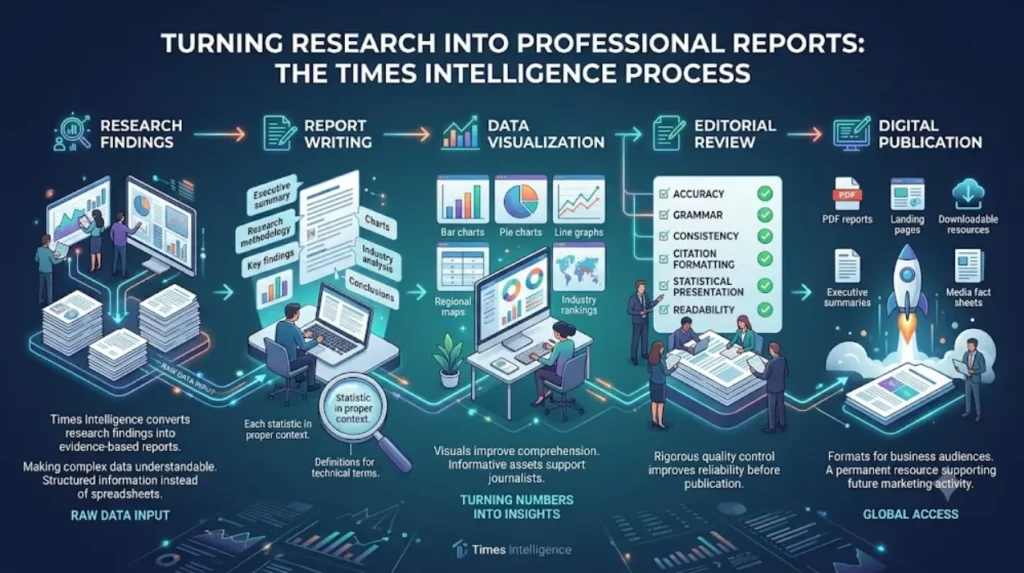
Times Intelligence converts research findings into professionally structured reports that communicate evidence clearly. The publication process includes editorial writing, data visualisation, design, formatting, quality assurance, and digital publishing for long-term accessibility and media referencing.
Publishing focuses on making research understandable.
Complex datasets become structured information instead of spreadsheets.
Report writing
Each report includes defined sections such as:
- Executive summary
- Research methodology
- Key findings
- Charts
- Industry analysis
- Conclusions
Every statistic appears within its proper context.
Definitions accompany technical terminology where necessary.
Data visualisation
Visual presentation improves comprehension.
Examples include:
- Bar charts
- Pie charts
- Line graphs
- Comparison tables
- Regional maps
- Industry rankings
Visual assets also support journalists preparing news stories.
Editorial review
Every report undergoes editorial checks for:
- Accuracy
- Grammar
- Consistency
- Citation formatting
- Statistical presentation
- Readability
Quality control improves reliability before publication.
Digital publication
Reports publish in formats suitable for business audiences.
Typical outputs include:
- PDF reports
- Landing pages
- Downloadable resources
- Executive summaries
- Media fact sheets
Publishing creates a permanent resource that supports future marketing activity.
How does Times Intelligence distribute UK research reports?
Times Intelligence distributes research reports through coordinated media, digital, and industry channels. Distribution increases visibility among journalists, businesses, decision-makers, and search engines while extending the commercial value of the original research beyond publication day.
Publishing alone does not generate visibility.
Distribution places research in front of relevant audiences.
Media distribution
Research findings become newsworthy stories.
Distribution targets include:
- National newspapers
- Regional publications
- Trade publications
- Industry magazines
- Business news websites
Survey statistics often become headlines because they provide original evidence.
Businesses seeking background information about why research attracts journalists can review:
Digital distribution
Digital channels expand report reach.
Examples include:
- Company websites
- Newsrooms
- Email campaigns
- LinkedIn publications
- Industry newsletters
Each publication reinforces report visibility.
Search optimisation
Research reports contain structured information.
Examples include:
- Clear headings
- Entity definitions
- Supporting statistics
- Methodology sections
- Question-based formatting
These elements improve discoverability in both traditional search engines and AI-powered search experiences.
Performance reporting
Distribution results remain measurable.
Businesses receive reporting that includes metrics such as:
- Media placements
- Publication reach
- Referral traffic
- Downloads
- Coverage summaries
- Engagement statistics
Performance data supports future research planning.
What stages are included in the complete research report workflow?
Times Intelligence follows a defined production workflow that moves from planning to measurement. Every stage has a specific purpose, ensuring consistency, editorial quality, and efficient delivery while reducing delays caused by fragmented suppliers or disconnected processes.
The workflow follows sequential stages.
Stage 1: Discovery
The project begins with:
- Business objectives
- Audience identification
- Industry analysis
- Research goals
Clear objectives guide every later decision.
Stage 2: Research design
This stage defines:
- Question design
- Sample requirements
- Methodology
- Data sources
The methodology becomes part of the published report.
Stage 3: Fieldwork
Research data is collected according to the agreed methodology.
Examples include online surveys, business panels, and structured questionnaires.
Stage 4: Analysis
Researchers review responses, identify significant findings, calculate percentages, and organise insights into meaningful themes.
Stage 5: Report production
Editors, designers, and analysts collaborate to create the finished publication.
Charts, commentary, and methodology combine into one structured report.
Stage 6: Publication
The report becomes publicly available through digital publishing channels.
Supporting assets accompany the launch.
Stage 7: Distribution
Media outreach and digital promotion increase report exposure across relevant audiences.
Stage 8: Measurement
Coverage and engagement metrics demonstrate campaign performance.
The complete workflow produces one coordinated research asset instead of disconnected deliverables.
Why do businesses choose Times Intelligence for UK research reports?
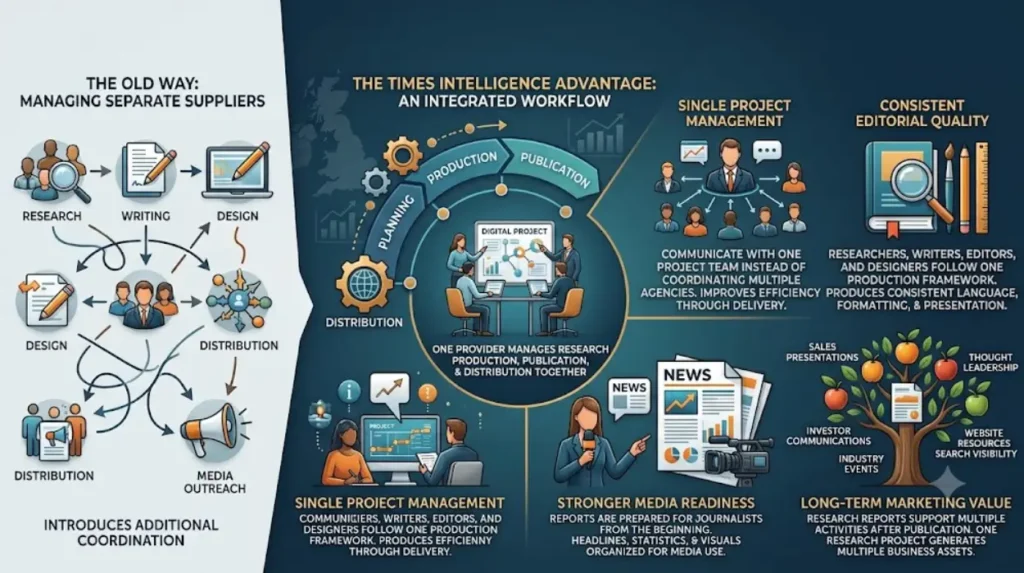
Businesses choose Times Intelligence because one provider manages research production, publication, and distribution together. This integrated approach improves consistency, reduces project management complexity, shortens delivery timelines, and creates research assets designed for long-term commercial use.
Managing separate suppliers often introduces additional coordination.
An integrated workflow keeps research consistent from planning through distribution.
Single project management
Businesses communicate with one project team instead of coordinating multiple agencies.
This improves efficiency throughout delivery.
Consistent editorial quality
Researchers, writers, editors, and designers follow one production framework.
This produces consistent language, formatting, and presentation.
Stronger media readiness
Reports are prepared for journalists from the beginning.
Headlines, statistics, and supporting visuals are organised for media use.
Long-term marketing value
Research reports support multiple activities after publication.
Examples include:
- Sales presentations
- Investor communications
- Industry events
- Thought leadership
- Website resources
- Search visibility
One research project generates multiple business assets.
Which organisations benefit from professionally produced research reports?
Research reports support organisations that rely on evidence-based communication. Businesses, charities, trade associations, technology companies, financial firms, and professional service providers use original research to strengthen credibility and increase market visibility across the United Kingdom.
Many sectors publish research regularly.
Examples include:
Financial services
Banks, investment firms, and insurance companies publish reports about consumer confidence, savings behaviour, and economic trends.
Technology companies
Software providers produce reports covering artificial intelligence, cybersecurity, cloud adoption, and digital transformation.
Professional services
Law firms, accountants, and consultancies publish industry benchmark reports for business audiences.
Healthcare organisations
Healthcare providers publish workforce studies, patient surveys, and service demand reports.
Trade associations
Industry associations release annual reports covering market trends, member activity, and sector performance.
Each report supports communication with stakeholders, media, and decision-makers.
How can businesses start a UK research report project with Times Intelligence?
Businesses begin by defining objectives, selecting a research topic, identifying the target audience, and agreeing the preferred publication outcome. Times Intelligence then manages production, publication, distribution, and reporting through one coordinated research programme with defined milestones.
The first step identifies the business objective.
Typical objectives include:
- Generating media coverage
- Producing industry benchmarks
- Supporting lead generation
- Demonstrating market expertise
- Publishing annual research
- Launching new market insights
The project team then develops the research methodology and production schedule.
Throughout delivery, businesses receive structured updates covering research progress, report development, publication planning, and distribution preparation.
Explore More Expert Insights:
Full-Service Research Reports vs DIY: A Cost and Quality Comparison for UK Teams
Why B2B Brands That Publish Annual UK Reports See 28% Higher Renewal Rates
Once published, the completed report becomes a long-term business asset that supports public relations, digital marketing, sales enablement, and search visibility.
For organisations ready to invest in original research rather than standalone campaigns, Times Intelligence provides an integrated service covering production, publication, and UK-wide distribution through one coordinated workflow.