Understanding purchase intent before a customer completes a transaction helps marketers improve targeting, messaging, and campaign efficiency. Audience insight metrics reveal behavioural patterns that indicate readiness to buy. In the UK market, these metrics help brands identify high-intent audiences and allocate marketing budgets more effectively.
What are audience insight metrics that predict purchase intent?
Audience insight metrics are measurable behavioural signals that indicate a consumer’s likelihood of making a purchase. These metrics track engagement patterns, content consumption, research activity, and decision-stage behaviour. When analysed together, they provide a reliable view of buyer readiness before a transaction occurs.
Purchase intent refers to the probability that a consumer will take a buying action. Traditional demographic targeting focuses on age, location, or income. Audience insight metrics focus on behaviour.
As audience behaviour becomes more fragmented, broad targeting delivers weaker results.
This trend is explored in:
The Death of the Average UK Reader.
Why are behavioural metrics more valuable than demographic data?
Demographic data describes who a person is. Behavioural data shows what a person is doing.
A 35-year-old professional and a 35-year-old student may share demographic characteristics but display completely different purchasing behaviours. Behavioural metrics reveal these differences.
Which audience insight metric shows active research behaviour?
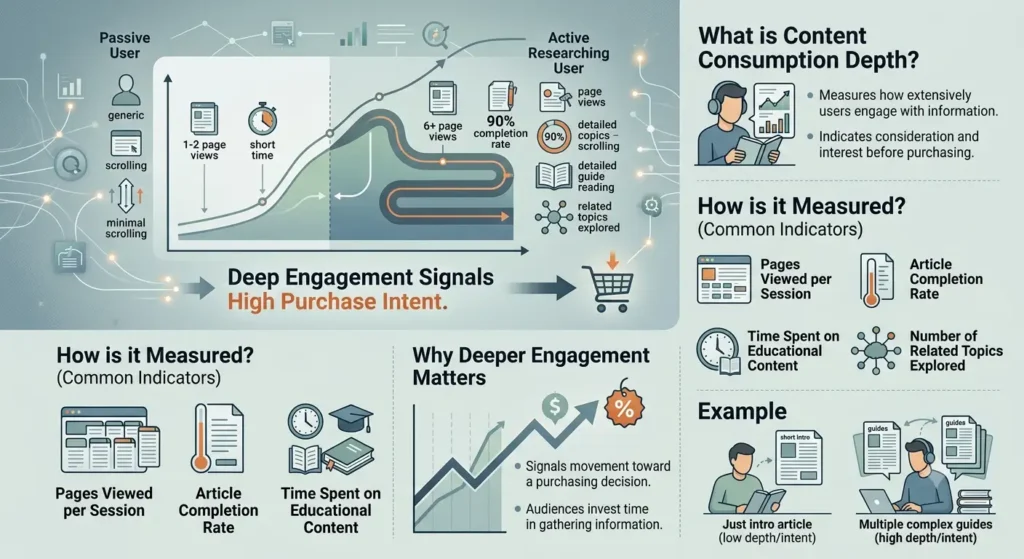
Content consumption depth measures how extensively users engage with information before making a purchase decision. Higher engagement with detailed content indicates stronger purchase consideration and increased interest in a product, service, or category.
Consumers rarely purchase immediately after first exposure. Most complete a research journey.
How is content consumption depth measured?
Common indicators include:
- Pages viewed per session
- Article completion rate
- Time spent on educational content
- Number of related topics explored
For example, a user reading one short article about home insurance displays lower intent than a user reading six detailed guides about policy comparisons, claims procedures, and pricing.
Why does deeper engagement matter?
High-engagement audiences invest time in gathering information. This behaviour signals movement toward a purchasing decision.
How does repeat visitation indicate purchase intent?
Repeat visitation measures how often users return to the same content category, website, or topic. Multiple visits within a short period indicate ongoing evaluation and stronger buying interest compared with one-time visits.
Many UK consumers complete several research sessions before purchasing.
What patterns indicate strong intent?
Key indicators include:
- Three or more visits within 30 days
- Consistent engagement with the same topic
- Return visits after comparison content
A consumer researching mortgage options over multiple sessions demonstrates higher purchase intent than someone visiting once.
How does repeat visitation improve targeting?
Repeated engagement helps marketers identify audiences that remain actively involved in a buying journey.
Why is category engagement frequency an important metric?
Category engagement frequency measures how often users interact with content related to a specific industry, product type, or purchasing category. High frequency indicates sustained interest and increased likelihood of future conversion activity.
Frequency reveals commitment to a topic.
What does category engagement reveal?
Regular interaction with content categories such as:
- Automotive
- Travel
- Financial services
- Consumer technology
demonstrates ongoing interest.
For example, a user consuming automotive content daily for several weeks shows stronger intent than a user who views a single article.
How is frequency different from reach?
Reach measures audience size.
Frequency measures audience involvement.
Purchase intent correlates more strongly with involvement than exposure.
How does comparison content engagement predict buying decisions?
Comparison content engagement identifies users actively evaluating alternatives. Consumers reviewing comparisons, rankings, reviews, and feature analyses often occupy later stages of the purchase journey and demonstrate stronger commercial intent.
Comparison activity represents a significant step toward decision-making.
What content types signal comparison behaviour?
Examples include:
- Product comparisons
- Service evaluations
- Pricing comparisons
- Feature breakdowns
- Buyer guides
A consumer comparing broadband providers demonstrates stronger intent than one reading a general article about internet technology.
Why is comparison behaviour valuable?
Comparison activity narrows options.
Consumers move from awareness into evaluation, which is closer to conversion.
What role does audience recency play in purchase intent prediction?
Audience recency measures how recently a user interacted with relevant content. Recent engagement provides stronger intent signals because buying interest remains active and decision-making momentum remains high.
Recency is one of the most reliable indicators of immediate interest.
How is recency evaluated?
Common measurement periods include:
- Last 24 hours
- Last 7 days
- Last 14 days
- Last 30 days
Users engaging with a category yesterday typically display stronger intent than users who engaged three months earlier.
Why does timing matter?
Consumer needs change rapidly.
Recent activity reflects current priorities rather than historical interests.
How does cross-platform engagement strengthen intent signals?
Cross-platform engagement measures audience interaction across multiple channels, devices, and media environments. Consistent activity across platforms indicates sustained interest and stronger commitment to a purchasing decision.
Modern UK consumers rarely remain on one channel.
What channels contribute to cross-platform engagement?
Examples include:
- News websites
- Search engines
- Mobile applications
- Video platforms
- Social media platforms
A consumer researching electric vehicles through articles, videos, and comparison tools demonstrates stronger intent than someone using only one source.
Why is cross-platform analysis important?
Fragmented attention creates incomplete audience views.
Cross-platform measurement connects behavioural signals into a unified customer journey.
Why is conversion-path progression a powerful intent metric?
Conversion-path progression tracks movement through predefined stages of the buying journey. Users advancing through multiple stages demonstrate increasing commitment and a stronger likelihood of completing a purchase.
Purchase decisions occur through a sequence of actions.
What stages indicate progression?
Typical stages include:
Awareness
Consumers discover a topic or category.
Research
Consumers gather detailed information.
Evaluation
Consumers compare alternatives.
Decision
Consumers assess final options.
Conversion
Consumers complete a purchase or enquiry.
A user reaching the evaluation stage displays significantly stronger intent than a user remaining in awareness.
How can marketers use progression data?
Progression metrics help identify audiences that require different messaging and content types at different stages.
How do these seven metrics work together?
The most accurate purchase intent predictions occur when multiple audience insight metrics are analysed collectively. Combining engagement, frequency, recency, comparison behaviour, and journey progression creates a comprehensive view of buyer readiness.

No single metric provides a complete picture.
A user who:
- Visits repeatedly
- Consumes detailed content
- Engages with comparison articles
- Interacts across multiple platforms
- Shows recent activity
- Progresses through buying stages
demonstrates significantly higher purchase intent than a user displaying only one of these behaviours.
Why is a combined approach more effective?
Multiple behavioural signals reduce uncertainty.
Patterns become clearer when metrics reinforce one another.
This approach allows marketers to prioritise audiences based on demonstrated intent rather than assumptions.
How are organisations using audience insight metrics in the UK?
UK organisations use audience insight metrics to improve audience segmentation, campaign relevance, content strategy, and media planning. Behavioural signals enable more accurate targeting than broad demographic assumptions alone.
Audience insight analysis supports:
- Marketing efficiency
- Budget allocation
- Content personalisation
- Audience segmentation
- Campaign optimisation
Many organisations also evaluate solutions that combine audience intelligence with media environments. The outcomes associated with these approaches are discussed in:
Why Advertisers Using News Audience Data See 3× Better Campaign Relevance Scores.
Which industries benefit most?
High-value sectors frequently using intent metrics include:
- Financial services
- Property
- Automotive
- Travel
- Telecommunications
- Technology
These industries often involve extended research periods and multiple decision stages.
Dive Deeper With Our Expert Guides:
Custom Audience Insight Reports: How They Are Built and What Brands Receive
What 10 UK News Site Audiences Look Like by Industry, Age and Intent Stage
Audience insight metrics provide measurable indicators of consumer readiness before a sale occurs. Content consumption depth, repeat visitation, category engagement frequency, comparison content engagement, audience recency, cross-platform engagement, and conversion-path progression each reveal important behavioural signals. When analysed together, these seven metrics create a detailed picture of purchase intent, helping UK organisations understand audience behaviour with greater accuracy and relevance.