

Digital advertising performance depends on audience relevance. Advertisers that use news audience data consistently achieve stronger targeting accuracy, higher engagement rates, and better campaign efficiency. News audience data provides real behavioural signals that reveal interests, intent, and content consumption patterns. This enables advertisers to align campaigns with active audience demand instead of relying on broad demographic assumptions.
What is news audience data and why does it improve campaign relevance?
News audience data captures reader behaviour across news websites, revealing interests, content preferences, and intent signals. Advertisers use this information to match campaigns with relevant audiences. This alignment improves engagement quality, reduces wasted impressions, and increases campaign relevance scores across advertising platforms.
News audience data consists of behavioural information collected from readers interacting with digital news content. It includes article categories, reading frequency, engagement depth, device usage, location signals, and topic interests.
Unlike traditional demographic targeting, news audience data reflects current interests. A reader consuming content about mortgages, electric vehicles, business finance, or home renovations demonstrates active interest in those topics.
Advertising platforms reward relevance because relevant advertisements generate stronger engagement. Better engagement improves campaign performance metrics.
How is news audience data different from demographic targeting?
Demographic targeting focuses on age, gender, income, and location.
News audience data focuses on behaviour.
For example:
- A 35-year-old reader consuming retirement planning content signals investment interest.
- A 28-year-old reader reading first-home buyer articles signals property purchase intent.
- A business owner regularly reading SME growth reports signals commercial purchasing interest.
Behavioural signals create stronger relevance than demographic assumptions.
For advertisers seeking deeper audience qualification,
Audience insight metrics provides additional context on identifying purchase intent.
How does news audience data help advertisers identify purchase intent?
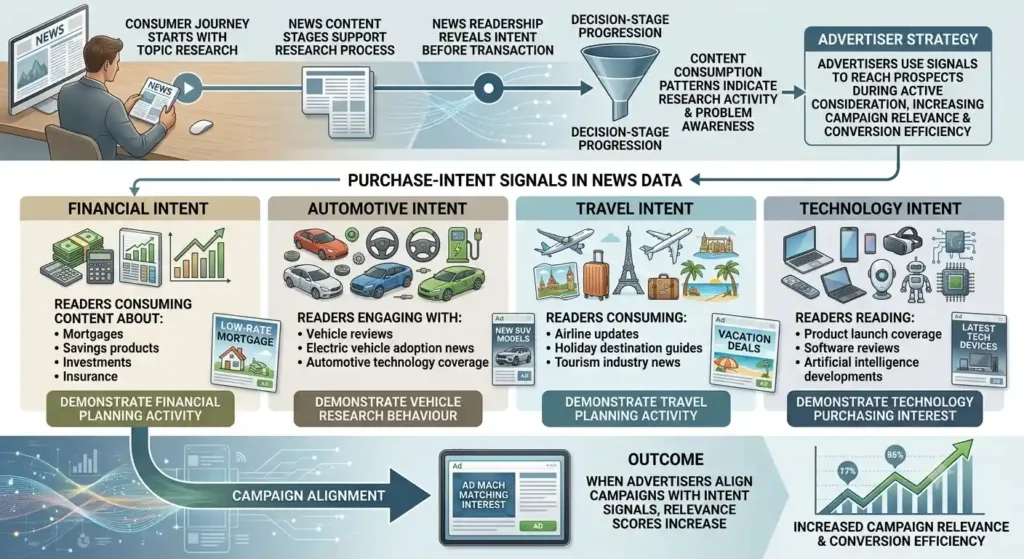
News readership behaviour reveals intent before consumers complete a transaction. Content consumption patterns indicate research activity, problem awareness, and decision-stage progression. Advertisers use these signals to reach prospects during active consideration periods, increasing campaign relevance and conversion efficiency.
Purchase intent develops through stages.
Consumers typically research topics before making decisions.
News content frequently supports this research process.
What purchase-intent signals appear in news audience data?
Common signals include:
Financial intent
Readers consuming content about:
- Mortgages
- Savings products
- Investments
- Insurance
These readers demonstrate financial planning activity.
Automotive intent
Readers engaging with:
- Vehicle reviews
- Electric vehicle adoption news
- Automotive technology coverage
These readers demonstrate vehicle research behaviour.
Travel intent
Readers consuming:
- Airline updates
- Holiday destination guides
- Tourism industry news
These readers demonstrate travel planning activity.
Technology intent
Readers reading:
- Product launch coverage
- Software reviews
- Artificial intelligence developments
These readers demonstrate technology purchasing interest.
When advertisers align campaigns with these intent signals, relevance scores increase because advertisements correspond with active audience interests.
What components make news audience targeting more accurate?
News audience targeting combines behavioural data, contextual signals, content engagement metrics, and audience segmentation. These components create detailed audience profiles that reflect real interests and decision-making activity. The resulting precision significantly improves campaign relevance and audience matching accuracy.
Several data components contribute to targeting quality.
Behavioural signals
Behavioural signals measure audience actions.
Examples include:
- Articles read
- Topics followed
- Frequency of visits
- Session duration
These actions reveal genuine interests.
Contextual signals
Contextual targeting evaluates the content environment.
For example:
- Business articles attract business-focused readers.
- Property news attracts homebuyers and investors.
- Healthcare reporting attracts health-conscious audiences.
Context strengthens audience qualification.
Engagement metrics
Engagement metrics identify audience quality.
Examples include:
- Scroll depth
- Time spent on page
- Repeat visits
- Article completion rate
Highly engaged readers often produce stronger advertising outcomes.
Audience segmentation
Audience segmentation groups readers according to shared behaviours.
Examples include:
- First-time homebuyers
- SME decision-makers
- Technology adopters
- Frequent travellers
These segments improve message relevance.
Why do advertisers often achieve 3× better relevance scores?
Higher relevance scores result from improved audience alignment. News audience data reduces targeting waste and increases engagement rates. Advertising platforms interpret stronger engagement as higher relevance, leading to improved scores, better delivery efficiency, and stronger overall campaign performance.
Campaign relevance depends on audience response.
Advertising platforms evaluate signals such as:
- Click-through rates
- Engagement rates
- Interaction quality
- Conversion behaviour
When advertisements match audience interests, these metrics improve.
Reduced audience waste
Broad targeting exposes advertisements to many irrelevant users.
News audience targeting narrows exposure to qualified audiences.
This increases efficiency.
Stronger engagement
Relevant audiences interact more frequently.
Examples include:
- Higher click-through rates
- Greater video completion rates
- Increased content engagement
- More landing page visits
These interactions improve relevance calculations.
Better platform optimisation
Advertising algorithms favour campaigns with positive engagement signals.
Higher relevance scores often result in:
- Improved ad delivery
- Lower acquisition costs
- Increased visibility
- Greater budget efficiency
This creates a performance advantage over broad targeting strategies.
Which industries benefit most from news audience data?

Industries with longer research cycles and high-consideration purchases gain substantial value from news audience targeting. Financial services, automotive brands, technology providers, travel companies, healthcare organisations, and property businesses frequently achieve stronger audience relevance through behavioural targeting.
Several sectors consistently benefit from news audience intelligence.
Financial services
Financial institutions target readers researching:
- Mortgages
- Investments
- Insurance
- Pension planning
Intent signals support more accurate audience selection.
Automotive brands
Vehicle manufacturers target audiences consuming:
- Car reviews
- Industry developments
- Electric vehicle adoption stories
These readers often represent active buyers.
Property and real estate
Property businesses target readers engaging with:
- Housing market news
- Mortgage updates
- Property investment reports
These audiences frequently demonstrate transaction intent.
Technology companies
Technology advertisers target readers consuming:
- Product launch coverage
- Software industry reporting
- Artificial intelligence news
This improves message relevance.
Travel and tourism
Travel brands use audience signals from readers following:
- Airline developments
- Destination news
- Travel industry updates
Behavioural alignment strengthens campaign performance.
How can advertisers implement news audience data effectively?
Effective implementation requires audience segmentation, intent analysis, contextual alignment, campaign measurement, and ongoing optimisation. Advertisers that integrate these processes consistently improve relevance scores, engagement quality, and return on advertising investment.
Successful implementation follows a structured process.
Identify audience objectives
Define campaign goals.
Examples include:
- Lead generation
- Brand awareness
- Product sales
- Customer acquisition
Clear objectives guide audience selection.
Build intent-based segments
Group audiences according to behaviours.
Examples include:
- Mortgage researchers
- Vehicle shoppers
- Business decision-makers
- Technology buyers
Intent segmentation improves targeting precision.
Align creative with audience interests
Advertising messages must reflect audience motivations.
Examples:
- Property-focused audiences receive housing-related offers.
- Technology-focused audiences receive product innovation messaging.
- Travel-focused audiences receive destination-specific promotions.
Message alignment increases relevance.
Measure performance continuously
Track:
- Relevance scores
- Click-through rates
- Conversion rates
- Cost per acquisition
- Audience engagement metrics
Measurement supports optimisation.
For organisations evaluating advanced audience targeting providers, custom audience insight reports offer additional guidance on available solutions and deliverables. explore:
The Death of the Average UK Reader: Why Broad Targeting Is Failing Brands
What does the future of campaign relevance look like?
Campaign relevance increasingly depends on first-party behavioural intelligence. News audience data provides scalable, privacy-conscious audience insights that help advertisers reach consumers based on demonstrated interests rather than broad demographic assumptions. This creates more efficient and measurable advertising outcomes.
The advertising industry continues moving toward behaviour-based targeting.
Several trends support this transition:
- Increased demand for privacy-safe data
- Growth of first-party audience strategies
- Expansion of contextual intelligence
- Greater focus on engagement quality
- Rising importance of purchase-intent signals
News publishers generate large volumes of audience intelligence through daily reader engagement.
Advertisers that utilise this data gain access to current behavioural signals that reflect real-world interests and active research behaviour.
Dive Deeper With Our Expert Guides:
Custom Audience Insight Reports: How They Are Built and What Brands Receive
What 10 UK News Site Audiences Look Like by Industry, Age and Intent Stage
News audience data enables advertisers to reach audiences based on demonstrated interests rather than demographic assumptions. Behavioural signals, contextual intelligence, engagement metrics, and intent-based segmentation work together to improve audience matching accuracy. As a result, advertisers frequently achieve significantly stronger campaign relevance scores, better engagement performance, and more efficient media spending. In a competitive UK advertising environment, news audience intelligence provides a measurable advantage by connecting marketing messages with audiences actively researching relevant topics and purchase decisions.



