Audience insights services collect, analyse, and interpret consumer behaviour data. UK brands invest in these services to understand audience interests, purchase intent, media consumption habits, and campaign performance. The result is more accurate targeting, improved marketing efficiency, and stronger commercial outcomes across digital channels.
Audience insights services transform raw data into actionable intelligence. They combine information from website activity, media engagement, customer databases, advertising platforms, and market research sources.
An audience insight is a verified finding about consumer behaviour. Examples include identifying the content categories most likely to generate conversions, understanding how different age groups engage with campaigns, and measuring the impact of media exposure on purchase decisions.
For many UK organisations, audience insights support decisions across marketing, product development, media planning, customer experience, and sales operations.
What data sources are commonly analysed?
Audience insights providers typically analyse:
- Website behaviour data
- Search behaviour data
- Social media engagement
- News audience consumption patterns
- CRM records
- Customer surveys
- Advertising campaign data
- Third-party market intelligence
Brands that already track engagement metrics often combine these findings with:
Understanding Dwell Time, Scroll Depth and Click Patterns on UK News Properties to gain deeper behavioural understanding.
How much do UK brands typically invest in audience insights services?
UK brands typically invest between £2,000 and £100,000+ annually depending on project scope, data volume, reporting requirements, and strategic objectives. Small businesses usually purchase focused research projects, while enterprise organisations invest in ongoing intelligence programmes.
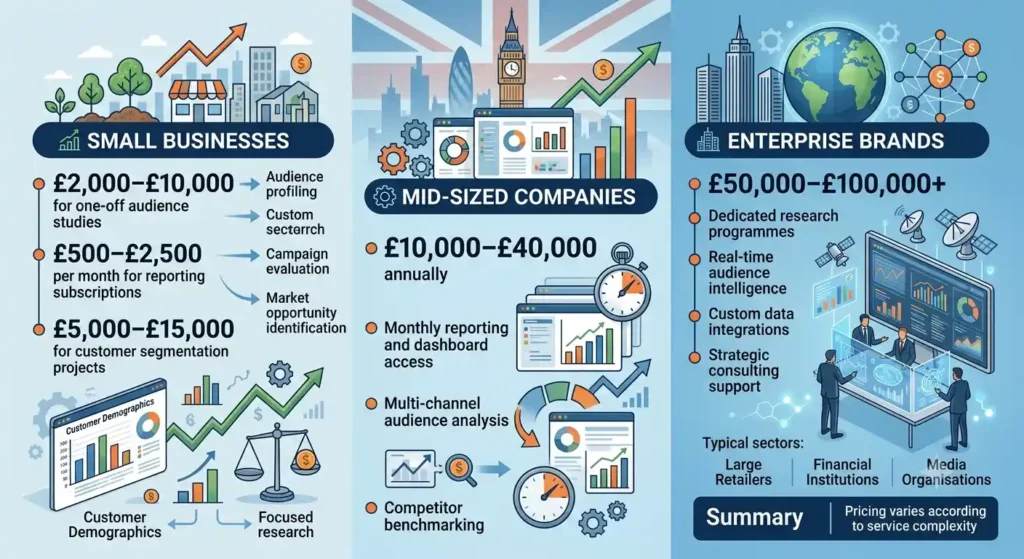
Pricing varies according to service complexity.
What do small businesses typically spend?
Small businesses generally invest:
- £2,000–£10,000 for one-off audience studies
- £500–£2,500 per month for reporting subscriptions
- £5,000–£15,000 for customer segmentation projects
These services focus on audience profiling, campaign evaluation, and market opportunity identification.
What do mid-sized companies typically spend?
Mid-market organisations commonly invest:
- £10,000–£40,000 annually
- Monthly reporting and dashboard access
- Multi-channel audience analysis
- Competitor benchmarking
The objective is continuous audience understanding rather than periodic research.
What do enterprise brands typically spend?
Enterprise organisations often allocate:
- £50,000–£100,000+
- Dedicated research programmes
- Real-time audience intelligence
- Custom data integrations
- Strategic consulting support
Large retailers, financial institutions, and media organisations frequently operate audience insight programmes throughout the year.
What factors influence audience insights service pricing?
Audience insights pricing depends on data complexity, reporting frequency, audience size, research methodology, integration requirements, and strategic consulting needs. Each factor directly affects the resources required to collect, process, analyse, and deliver meaningful findings.
Different projects require different levels of investment.
How does data volume affect pricing?
Analysing one website differs significantly from analysing millions of interactions across multiple channels.
Larger datasets require:
- More processing power
- Additional data cleaning
- Advanced analytics
- Greater quality assurance
As data volume increases, project costs increase accordingly.
How does reporting frequency affect pricing?
One-time reports cost less than ongoing intelligence programmes.
Common reporting models include:
- Single project reports
- Monthly reporting
- Quarterly strategic reviews
- Real-time dashboards
Continuous reporting requires ongoing monitoring and analysis.
How do custom requirements affect costs?
Custom audience modelling, predictive analytics, and industry-specific reporting require specialised expertise.
Examples include:
- Retail purchase prediction
- Financial services audience segmentation
- Healthcare engagement analysis
- Automotive consumer journey mapping
These advanced services command higher pricing due to increased analytical complexity.
What services are included in audience insights packages?
Most audience insights packages include audience segmentation, behavioural analysis, campaign measurement, reporting dashboards, market research, and strategic recommendations. Premium packages often include predictive modelling and custom consulting support.
The exact deliverables vary by provider.
Audience segmentation
Audience segmentation identifies groups with shared characteristics.
Examples include:
- Frequent purchasers
- High-value customers
- News readers
- Technology enthusiasts
- Luxury consumers
Segmentation improves targeting precision.
Behavioural analysis
Behavioural analysis examines how consumers interact with content and platforms.
Key metrics include:
- Page engagement
- Content consumption
- Conversion pathways
- Device preferences
- Purchase journeys
Campaign effectiveness measurement
Campaign measurement evaluates performance against objectives.
Typical outputs include:
- Reach analysis
- Engagement analysis
- Conversion tracking
- Brand lift measurement
- Return on advertising spend assessment
What business outcomes do brands receive from audience insights investments?
Brands receive measurable improvements in targeting accuracy, campaign relevance, conversion rates, customer retention, and marketing efficiency. Audience insights reduce decision-making uncertainty and improve resource allocation across marketing activities.
The strongest results occur when insights directly influence business decisions.
Improved audience targeting
Audience intelligence helps brands identify the most valuable customer groups.
Benefits include:
- Reduced wasted advertising spend
- Higher engagement rates
- Better lead quality
- Improved customer acquisition
Better content performance
Content strategies improve when based on verified audience behaviour.
Brands learn:
- Which topics generate engagement
- Which formats drive action
- Which channels deliver results
This leads to stronger content effectiveness.
Higher marketing efficiency
Marketing teams allocate budgets more effectively when audience behaviour is clearly understood.
Benefits include:
- Lower acquisition costs
- Better media planning
- Stronger campaign optimisation
- Improved return on investment
How do audience insights support modern media and advertising strategies?
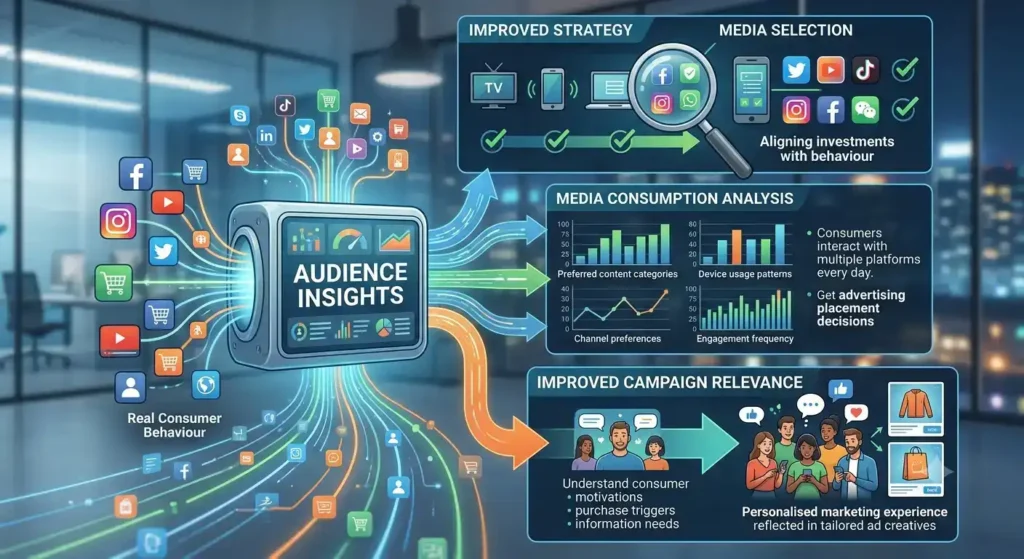
Audience insights enable brands to align advertising investments with real consumer behaviour. This improves media selection, audience targeting, creative development, and campaign measurement across digital and traditional channels.
Media planning increasingly relies on behavioural intelligence.
Why is media consumption analysis important?
Consumers interact with multiple platforms daily.
Audience insights reveal:
- Preferred content categories
- Device usage patterns
- Channel preferences
- Engagement frequency
These findings guide advertising placement decisions.
How does audience intelligence improve campaign relevance?
Relevant campaigns reflect genuine audience interests.
Audience insights help brands understand:
- Consumer motivations
- Purchase triggers
- Content preferences
- Information needs
This produces more personalised marketing experiences.
Brands evaluating emerging traffic opportunities often complement audience research with:
Why AI Referral Traffic Has Higher Purchase Intent Than Organic UK Search to understand changing discovery behaviours.
How should UK brands evaluate audience insights providers?
UK brands should assess methodology transparency, data quality, reporting capabilities, industry expertise, privacy compliance, and measurable business outcomes before selecting an audience insights partner. Evaluation criteria directly affect insight reliability and long-term value.
A structured assessment process improves provider selection.
What questions should buyers ask?
Key questions include:
- What data sources are used?
- How is data validated?
- What reporting formats are available?
- How often are insights updated?
- What privacy standards are followed?
- What measurable outcomes have clients achieved?
Clear answers indicate service maturity.
Why does methodology matter?
Reliable insights require robust methodology.
Important factors include:
- Sample quality
- Data accuracy
- Statistical validity
- Consistent measurement frameworks
Strong methodologies produce trustworthy business intelligence.
What reporting capabilities are essential?
Effective reporting converts data into action.
Useful reporting features include:
- Interactive dashboards
- Executive summaries
- Trend analysis
- Audience segmentation reports
- Campaign performance tracking
Decision-makers require information that supports practical action.
What is the typical return on investment from audience insights services?
The return on investment from audience insights services comes through improved targeting, reduced advertising waste, increased conversion rates, and stronger customer retention. Brands that integrate insights into strategic decision-making consistently achieve greater marketing efficiency and commercial performance.
ROI measurement focuses on business outcomes rather than data collection alone.
Dive Deeper With Our Expert Guides:
From Data to Decision: How UK Brands Use Audience Insights to Plan Full-Year Buys
Why Advertisers Using News Audience Data See 3× Better Campaign Relevance Scores
Common indicators include:
- Higher conversion rates
- Lower customer acquisition costs
- Increased customer lifetime value
- Improved campaign relevance
- Better budget allocation
Audience insights services provide value when findings directly influence business decisions. For UK brands operating in increasingly competitive markets, investment decisions are strongest when supported by verified audience intelligence, measurable behavioural data, and continuous performance analysis.