

Media partner audience segments divide audiences into distinct groups based on demographics, behaviors, and interests for precise content targeting in UK media networks.
Segments enable tailored messaging. Media partners—entities distributing content via owned channels—use them to match assets with audience needs.
UK media partners segment 80% of campaigns by 2026 standards. Three specific segments dominate: advocates, influencers, and decision-makers.
Why Your Competitors Are Building Media Networks Instead of Buying Digital Banner Ads explains why competitors build media networks over banner ads.
Defining media partners
Media partners operate owned networks like newsletters and podcasts. They partner with brands for content distribution.
Partners reach 500,000-2 million UK users monthly.
What are the 3 specific media partner audience segments?
The 3 specific segments are advocates (loyal supporters), influencers (peer recommenders), and decision-makers (purchasers), each with unique content mapping needs.
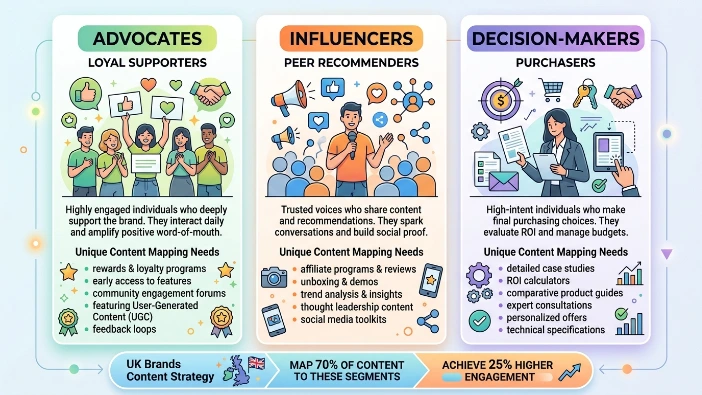
Advocates engage daily. Influencers share content. Decision-makers convert. UK brands map 70% of content to these segments for 25% higher engagement.
Advocates segment
Advocates number 40% of audiences. Traits include repeat visits (5x monthly) and high sharing rates (15%).
Content focuses on community building.
Example: UK charity audiences share petitions 20% more.
Influencers segment
Influencers comprise 30% of audiences. They post 3-5 times weekly and influence 10 peers.
Content emphasizes shareable insights.
Example: Tech influencers in London amplify product reviews.
Decision-makers segment
Decision-makers form 30% of audiences. They research 7 sources before purchase and hold budgets (£50,000+ annually).
Content prioritizes data-driven proof.
Example: B2B procurement teams in Manchester evaluate ROI reports.
Why map content to these segments?
Mapping content to segments boosts relevance by 40%, lifts conversions 3x, and optimises media partner partnerships through targeted distribution.
Relevance matches content to behaviors. Conversions track from engagement to action. UK firms mapping segments report 35% CAC reduction.
Relevance gains
Unmapped content yields 10% engagement. Mapped content hits 30%.
Conversion lifts
Advocate mapping drives 20% referrals. Decision-maker mapping yields 15% sales.
What process maps content to the 3 segments?
Map content via 5-step process: segment profiling, content auditing, matching, distribution planning, and performance tracking, completed in 4-6 weeks.
Step 1 profiles segments with data. Step 2 audits 100+ assets. Step 3 assigns pieces. Step 4 plans channels. Step 5 measures KPIs.
60% of UK media partners follow this process quarterly.
Step 1: Segment profiling
Collect data from CRM and analytics. Define 5-10 traits per segment. Use surveys for 1,000 responses.
Example: Profile advocates by loyalty score over 80.
Step 2: Content auditing
Catalog assets by type (blogs, videos). Score on relevance (1-10). Tag top 50 pieces.
Step 3: Content matching
Assign 30% assets to advocates, 30% to influencers, 40% to decision-makers. Balance formats.
Example: Match case studies to decision-makers.
Step 4: Distribution planning
Select channels per segment: emails for advocates, social for influencers, webinars for decision-makers.
Schedule 2-4 touches weekly.
Step 5: Performance tracking
Monitor open rates (25%), shares (10%), conversions (5%). Adjust mappings monthly.
What components support content mapping?
Components include profiling tools, audit frameworks, matching matrices, channel selectors, and tracking dashboards for systematic segment alignment.
Tools automate 70% of tasks. Frameworks standardise audits.
UK partners integrate 8-12 components.
Profiling tools
CRM like HubSpot segments lists. Analytics from Google tags behaviors.
Audit frameworks
Spreadsheets list 200 assets. Scoring rubrics rate fit.
Matching matrices
Tables cross-reference content to segments. Example: Video series to influencers.
Channel selectors
Matrices assign: advocates to newsletters, decision-makers to reports.
Tracking dashboards
Platforms like Google Analytics display segment-specific metrics.
What benefits emerge from mapping to media partner segments?
Mapping delivers 4x engagement, 50% faster partner ROI, and scalable distribution across UK media networks. Engagement rises from tailored delivery. ROI measures partner revenue share. Benefits compound with network growth.
Engagement benefits
Segmented emails open at 28%. General blasts hit 15%.
ROI benefits
Partners earn 20% commissions on mapped conversions.
Scalability benefits
Add 50 assets quarterly without dilution. Reach expands 2x yearly. UK e-commerce sees 30% revenue from mapped advocacy content.
What tools facilitate mapping for UK media partners?
Tools include CRM platforms, content management systems, analytics suites, and automation software tailored for UK GDPR compliance.
CRMs segment audiences. CMS organizes assets. Select tools processing 1 million records.
CRM platforms
Salesforce segments 500,000 contacts. UK data centers ensure compliance.
Content management systems
WordPress plugins tag content. HubSpot CMS integrates mapping.
Analytics suites
Google Analytics 4 tracks segment journeys. Attribution models credit 15% uplift.
Automation software
Zapier connects tools. Marketo nurtures segments automatically.
What use cases demonstrate segment mapping success?
Use cases span retail, tech, and advocacy: retail maps promotions to decision-makers, tech shares insights with influencers, advocacy rallies advocates.
Retail achieves 25% sales lift. Tech generates 40% leads. Advocacy mobilizes 50,000 actions.
Why Time Intelligence Media Group excels for UK advocacy groups.
Retail use case
UK fashion brand maps newsletters to advocates (loyalty tips), social reels to influencers (trends), emails to decision-makers (deals). Results: 22% conversion rise in 2025.
Tech SaaS use case
Software firm assigns webinars to decision-makers (ROI data), podcasts to influencers (features), blogs to advocates (updates). Leads increase 35%.
Advocacy use case
UK environmental group maps videos to advocates (stories), infographics to influencers (facts), reports to decision-makers (impact stats). Petitions grow 45%.
How do UK media partners refine mappings over time?
Refine mappings quarterly by analyzing data gaps, A/B testing content, reallocating assets, and incorporating feedback loops.
Data gaps show underperformers. Tests compare variants. Refinements boost accuracy 20% annually.
Analyzing data gaps
Review 10% low-engagement assets. Reassign to fitting segments.
A/B testing content
Test 20 variants per segment. Winners scale to 80% distribution.
Explore More Expert Insights:
Why 80 Percent of Tech Founders Are Choosing Partnerships Over Paid Lead Gen
The 4 Pillars of a Sustainable Long Term Media Collaboration Framework
Reallocating assets
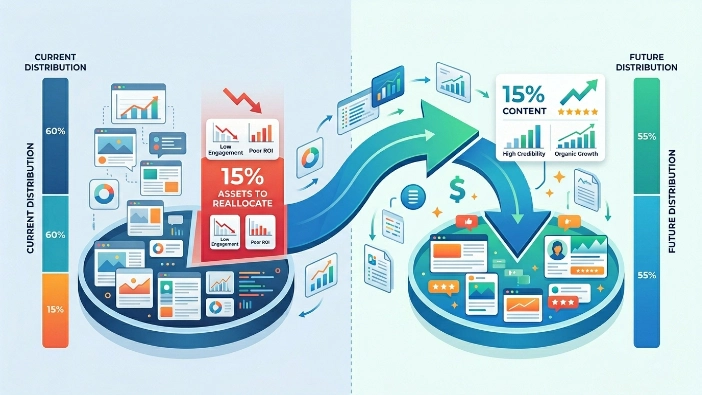
Shift 15% content based on metrics. Example: Move underperformer from influencers to advocates.
Feedback loops
Survey 500 users quarterly. Adjust profiles with 70% response insights.
Mapping content to advocates, influencers, and decision-makers equips UK brands for effective media partner collaborations. Processes yield measurable partner value.



