
A third-party research report is an independent, data-backed document created by an unbiased market research entity. B2B buyers in the UK use these reports to verify vendor claims, assess product capabilities, and validate long-term financial investments before purchasing.
Third-party research reports operate as objective evaluations within the B2B buying process. Unlike vendor-created marketing materials, such as promotional brochures or white papers, independent research reports utilize standardized methodologies, empirical data collection, and neutral statistical analysis. Independent analyst firms, specialized research institutions, and industry intelligence agencies author these documents to provide impartial market context.
UK purchasing committees rely on these documents to establish baseline trust during early-stage procurement cycles. The primary structure of an independent research report includes market sizing estimates, competitive benchmarking matrices, technical capability evaluations, and end-user satisfaction metrics. By removing commercial bias from the information-gathering phase, buyers isolate factual performance indicators from sales messaging.
Key categories of third-party research reports include:
- Market Intelligence Overviews: Analysis of macroeconomic trends, regulatory shifts, and regional sector growth across the United Kingdom.
- Vendor Benchmarking Matrices: Comparative assessments evaluating multiple service providers or software products against uniform criteria.
- Technical Evaluation Audits: Deep-dive technical reviews assessing product security, interoperability, and architecture standard compliance.
- Customer Sentiment Surveys: Statistical aggregations of direct user feedback regarding implementation times, reliability, and ongoing support.
Why Do 7 in 10 UK Buyers Rely on External Market Data?
Seven in ten UK buyers rely on external market data because independent verification eliminates vendor bias, shortens internal risk assessments, and provides objective evidence required by financial directors, compliance officers, and executive stakeholders during complex corporate procurement.
The decision-making process within modern UK enterprises involves multiple internal stakeholders. Purchasing committees typically include finance directors, chief information security officers (CISOs), procurement specialists, and department heads. Each stakeholder requires objective validation before approving capital expenditure. Independent data provides a neutral baseline that aligns these diverse corporate interests.
Data saturation presents a significant obstacle for business decision-makers. Internal marketing departments generate vast quantities of vendor content, which often creates information overload rather than clarity. External market data distorts marketing noise by applying rigorous methodologies to measure real-world performance, operational reliability, and total cost of ownership (TCO).
Independent data also addresses specific commercial challenges present in the UK marketplace:
Mitigating Cognitive Bias
Vendor sales presentations present best-case scenarios and curated customer testimonials. Independent reports highlight operational constraints, implementation challenges, and integration prerequisites. This objective perspective prevents buyers from overestimating product capabilities.
Accelerating Executive Sign-Off
Finance teams prioritize measurable risk reduction. Presenting audited metrics from an independent research entity gives procurement teams the formal evidence required to justify budgetary allocations without prolonged debate.
Managing Regulatory and Compliance Standards
UK enterprises operate under strict regulatory frameworks, such as the General Data Protection Regulation (GDPR) and Financial Conduct Authority (FCA) directives. Third-party evaluations verify whether products meet these statutory requirements before contract execution.
How Does Independent Verification Reduce Risk for UK Procurement Teams?
Independent verification reduces risk for UK procurement teams by auditing technical claims, evaluating long-term vendor viability, establishing market pricing benchmarks, and identifying potential deployment failures before organizations commit financial capital to binding long-term commercial contracts.
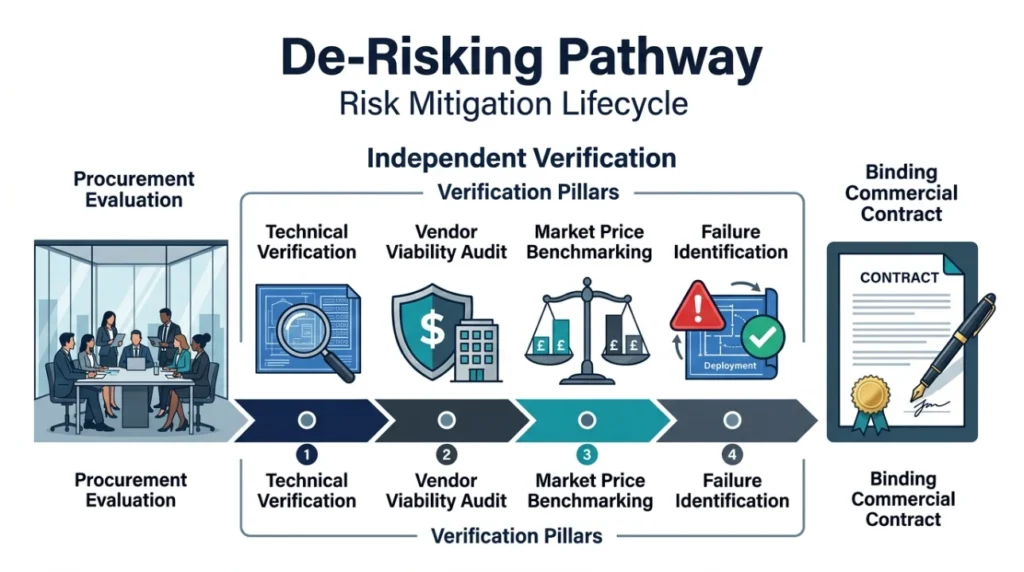
Procurement risk manifests in four distinct areas: financial loss, operational disruption, compliance failure, and strategic misstep. Buying organizations use external research to build risk mitigation models for each category.
Financial Risk Reduction
Commercial contracts involve substantial capital commitments, implementation fees, and ongoing maintenance costs. Independent reports analyze real-world total cost of ownership across multi-year lifecycles. They expose hidden operational expenses, software licensing complexities, and post-implementation support fees. UK buyers utilize this empirical cost data to negotiate realistic contract terms and avoid budget overruns.
Operational and Integration Risk Reduction
Deploying new technology or enterprise services disrupts established workflows. Third-party researchers survey existing software users to measure average deployment timelines, system integration hurdles, and software downtime metrics. For example, a UK logistics enterprise evaluating enterprise resource planning (ERP) software uses user-based deployment data to estimate actual downtime during integration.
Regulatory and Legal Safeguards
UK buyers face strict legal liabilities regarding data processing, security infrastructure, and environmental standards. Independent security research reports verify whether software vendors maintain compliance with standards such as ISO/IEC 27001, Cyber Essentials Plus, and SOC 2 Type II. This third-party verification protects procurement officers from non-compliance penalties under UK law.
Explore More Expert Insights:
How Fintech Companies Acquire Users Using Banner Ads
How Finance Brands Promote Credit Cards Using Display Campaigns
What Key Components Make a Research Report Trustworthy to Buyers?
A research report achieves high trust levels when it contains transparent methodology disclosures, rigorous data sample sizes, objective analytical frameworks, conflict-of-interest disclaimers, and verifiable primary data gathered directly from verified enterprise software end-users.
Trust relies on scientific rigor and structural transparency. UK procurement specialists scrutinize the following core elements before accepting research findings as authoritative:
Transparent Methodology
Trustworthy reports publish their data collection frameworks in full detail. The document must define respondent qualification criteria, survey administration methods, statistical margin of error, and analytical weighting models. Reports lacking clear methodologies are classified as marketing collateral and dismissed by enterprise buyers.
Sample Size and Demographic Relevance
Statistical validity requires sufficient sample sizes drawn from relevant corporate environments. A reliable UK research report specifies sample characteristics, including target organization revenue, industry vertical distribution, and respondent job roles. For example, survey results derived from 500 UK-based IT directors carry significantly more weight than global surveys with undefined respondent profiles.
Analyst Independence and Funding Disclosure
Full commercial disclosure is essential for analytical authority. Trustworthy reports explicitly state whether the research was vendor-sponsored or independently funded. When vendors fund research projects, credible research organizations maintain strict firewalls between corporate sponsors and analytical outcomes to prevent data manipulation.
Verification of Respondent Identity
Data integrity depends on respondent authenticity. Leading research bodies employ multi-step verification processes to ensure that survey participants are genuine corporate decision-makers with hands-on experience using the evaluated products or services.
How Do Buyers Use Third-Party Reports Throughout the Purchasing Journey?
Buyers use third-party reports to structure vendor longlists during problem identification, evaluate specific capabilities during solution comparison, negotiate contract terms during vendor selection, and justify capital expenditures to executive boards before final deal approval.
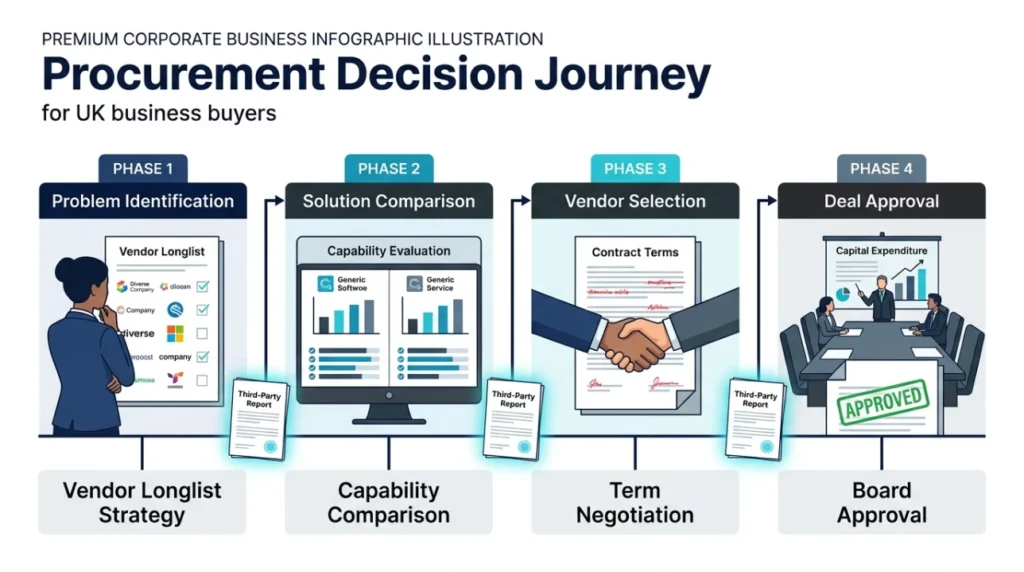
The UK B2B buying process follows a structured trajectory. External research serves specific, strategic functions at each stage of this journey.
1. Problem Identification and Scope Definition
During the initial purchasing phase, organizations identify operational inefficiencies or technology gaps. Buyers consult market intelligence overviews to understand macro trends, benchmark current internal performance against industry averages, and determine necessary system requirements.
2. Market Mapping and Vendor Longlisting
Once requirements are established, buyers face hundreds of potential vendors in categories like software, logistics, and professional services. Third-party market landscape maps group providers by market share, technical specialization, and organizational size. Buyers use these classifications to build a manageable longlist of relevant vendors.
3. Rigorous Shortlisting and Solution Comparison
During the evaluation phase, procurement teams consult vendor benchmarking matrices. Buyers analyze feature-by-feature comparisons, system performance scores, and user satisfaction rankings. Understanding building UK buyer trust requires analyzing how neutral data accelerates these comparison frameworks by replacing vendor sales claims with verified performance metrics.
4. Contract Negotiation and Final Approval
In the final purchasing stage, procurement teams use third-party cost benchmarks during pricing negotiations. Buyers cite independent market data to counter inflated vendor pricing, negotiate service level agreements (SLAs), and secure favorable payment structures. Finally, the procurement team submits the research report alongside the business case to secure board approval. Enterprise decision-makers review third-party research reports to obtain final validation before signing binding agreements.
What Types of Research Reports Deliver the Highest Value to Enterprise Buyers?
Comparative benchmarking matrices, quantitative customer satisfaction audits, market trend forecasts, and detailed total cost of ownership calculators deliver the highest commercial value to enterprise buyers seeking objective, actionable purchasing insights.
Different purchasing scenarios require specific research formats. UK buyers select report types based on their current stage in the procurement lifecycle and the complexity of the underlying transaction.
Comparative Benchmarking Matrices
Comparative matrices place competing vendors within a uniform grid based on technical capability, market execution, and strategic vision. These visuals allow buyers to compare enterprise software platforms side-by-side. Organizations evaluate relative strengths across standardized metrics, such as system scalability, API connectivity, and customer support response times.
Quantitative Customer Satisfaction Audits
Customer satisfaction audits isolate user experience metrics from corporate marketing. These reports gather structured feedback from verified enterprise buyers who actively use the product or service. Key metrics include implementation duration, ease of administration, software stability, and account management effectiveness.
Market Trend and Regulatory Forecasts
Macroeconomic research reports analyze upcoming shifts in legislation, technology standards, and economic conditions within the United Kingdom. For example, a research report detailing upcoming UK environmental reporting mandates enables corporate Sustainability Officers to purchase compliant software platforms well ahead of statutory deadlines.
Total Cost of Ownership (TCO) and ROI Frameworks
TCO reports provide financial models that detail all direct and indirect expenses associated with a business purchase. These reports calculate long-term costs, including software licensing fees, infrastructure upgrades, staff training hours, and ongoing maintenance requirements. Financial directors use these models to calculate exact pay-back periods and expected return on investment.
Summary of Buyer Trust and Third-Party Research
Third-party research reports serve as an essential operational framework for UK B2B procurement. By providing unbiased data, audited performance metrics, and verified user sentiment, independent research eliminates commercial uncertainty from complex purchasing decisions.
UK buyers utilize these reports to satisfy strict governance requirements, align internal executive stakeholders, mitigate financial and operational risk, and negotiate optimal contract terms. As corporate technology systems and service delivery models increase in complexity, reliance on independent research reports remains a foundational standard for enterprise purchasing across the United Kingdom.