News coverage means independent editorial reporting about a product launch across relevant UK media outlets, giving the announcement public visibility through journalists, publications, search results, and audiences that follow specific industries or regions.
A product launch is the public introduction of a new product, service, feature, or major product update. News coverage is the editorial attention generated when a publication reports on that launch as a news event.
UK product launch coverage can appear in national newspapers, regional publications, business media, technology outlets, consumer publications, trade journals, and specialist websites. Examples include coverage of a fintech platform in financial media, a new software product in technology publications, or a consumer product in retail and lifestyle media.
News coverage differs from advertising. Advertising is paid media placement controlled by the advertiser. Editorial coverage is produced according to a publication’s news criteria, audience relevance, editorial standards, and available reporting resources.
For product launches, the distinction matters because editorial coverage places the launch within a broader news context.
Why does news coverage matter for product launches in the UK?
News coverage gives a product launch wider public visibility, establishes an accessible record of the announcement, and connects the product with relevant UK audiences through editorial publications, search engines, industry discussions, and news discovery systems.
A product launch often starts with information controlled by the organisation introducing the product. News coverage adds an external information layer. Journalists and publications decide which aspects of the launch deserve attention.
This creates several forms of visibility.
Public awareness
Coverage introduces the product to people who do not already follow the organisation. A technology publication, for example, reaches an audience interested in software developments without requiring those readers to visit the company’s website first.
Search visibility
Published news articles create additional indexed pages containing the product name, organisation, launch date, category, and relevant terminology. These pages contribute to the wider information environment surrounding the launch.
Third-party context
Editorial articles present product information within a publication’s established content environment. The article becomes a separate source that search engines and readers can discover.
Market recognition
Coverage across relevant publications increases the number of places where a product launch appears in the UK information ecosystem. Repeated references also establish consistent terminology around the product.
How does UK news coverage develop after a product launch announcement?
UK product launch coverage develops through a sequence that starts with a news announcement, continues through editorial assessment and publication, and expands through search discovery, audience sharing, follow-up reporting, and additional references.
The process begins when launch information becomes available to journalists or publications. The information normally includes the product name, launch date, category, purpose, key specifications, organisation, spokesperson details, and supporting evidence.
1. Launch information becomes available
The initial announcement establishes the factual basis for coverage. Clear information helps publications understand what changed and why the event qualifies as news.
2. Journalists assess relevance
Editors and journalists assess factors such as audience interest, timing, novelty, market relevance, geography, sector importance, and available evidence.
A new electric vehicle, for example, has different editorial relevance for an automotive publication than for a regional business publication.
3. Publications create coverage
A publication converts relevant launch information into an editorial article. The resulting article has its own headline, URL, publication date, structure, and editorial context.
4. Search engines discover the article
Search engines crawl published pages and add relevant information to their indexes. Product names and launch details then become discoverable through branded and non-branded searches.
5. Readers and other sources discover the coverage
Readers access articles through search, news platforms, publication websites, social sharing, newsletters, and other distribution channels.
The coverage can then become part of the wider information record surrounding the product.
What information makes a product launch newsworthy?
A product launch becomes more relevant to news audiences when it contains a clear development, measurable market impact, identifiable audience value, credible evidence, and specific information that distinguishes the launch from routine business activity.
Newsworthiness describes the characteristics that make an event suitable for editorial attention.
For product launches, common newsworthy elements include:
- A genuinely new product or service
- A significant product update
- Entry into a new UK market
- A measurable customer or business impact
- New technology or technical capability
- A major partnership connected to the launch
- New investment supporting product development
- Regulatory approval or certification
- A significant environmental or operational change
- Research supporting the product’s development
Specific evidence improves clarity. A launch announcement stating that a platform supports 50,000 users provides more concrete information than a statement describing the platform as having a “large customer base.”
The same principle applies to market claims. A defined launch date, number of locations, product specifications, pricing information, or customer statistics gives journalists identifiable facts for editorial evaluation.
Which UK publications cover product launches?
UK product launches receive coverage across national, regional, business, technology, consumer, trade, and specialist publications, with each category serving different audiences and applying different editorial criteria to product-related announcements.
Publication type determines the audience surrounding a product story.
National news publications
National publications reach broad UK audiences. Product coverage in this environment focuses on developments with substantial consumer, economic, political, technological, or social relevance.
Regional publications
Regional publications focus on defined geographical communities. A product launch connected to Manchester, Birmingham, Edinburgh, Cardiff, Glasgow, Bristol, or another UK location has local relevance when the launch creates a measurable regional connection.
Examples include local employment, a new facility, regional investment, local partnerships, or services introduced to residents.
Business publications
Business media focuses on commercial developments. Product launches receive attention when they relate to investment, growth, employment, market expansion, technology, or corporate strategy.
Technology publications
Technology media focuses on software, hardware, artificial intelligence, cybersecurity, cloud services, consumer technology, and related technical developments.
Trade publications
Trade media serves specific professional sectors. Examples include construction, healthcare, finance, retail, manufacturing, logistics, energy, and hospitality publications.
A specialist product often gains stronger contextual relevance in trade media because the publication’s audience already understands the sector.
How does product launch coverage affect search visibility?
Product launch coverage expands the number of indexed references associated with a product, creating additional search entry points through publication pages, product terminology, company names, launch details, industry phrases, and related news queries.
Search visibility depends on how information is discovered, indexed, interpreted, and displayed.
A product launch creates an initial set of entities and relationships. These include the organisation, product, category, location, launch date, executives, technologies, customers, and market.
News coverage creates additional documents containing some of these entities.
For example, a UK cybersecurity product launch can generate pages containing terms such as:
- Product name
- Cybersecurity software
- UK cybersecurity market
- Data protection
- Threat detection
- Company name
- Product launch date
Each published article becomes part of the broader searchable information environment.
News coverage does not guarantee a particular ranking position. Search visibility depends on relevance, authority, indexing, query intent, competition, content quality, technical accessibility, and search engine systems.
What role does timing play in UK product launch coverage?
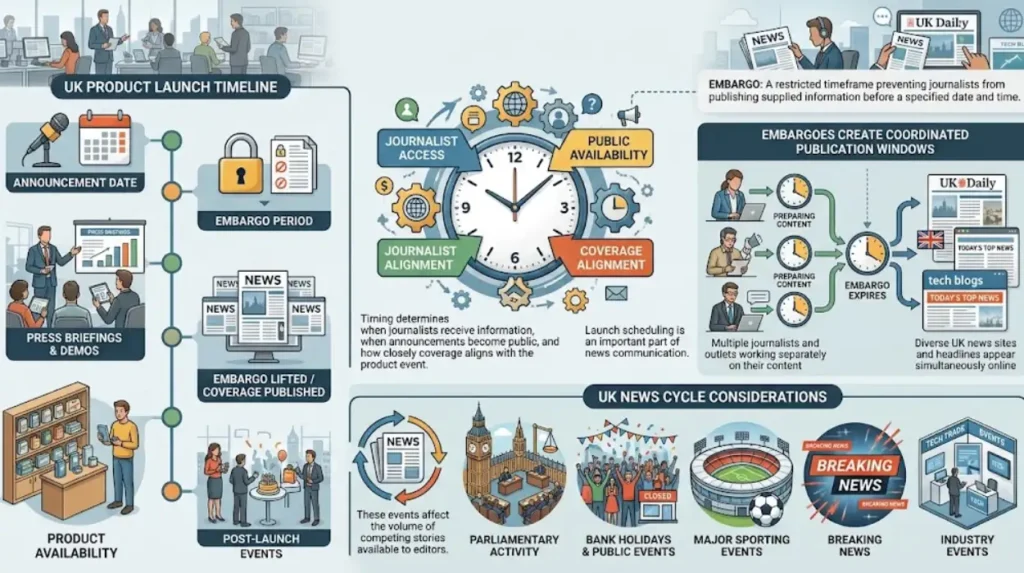
Timing determines when journalists receive launch information, when an announcement becomes publicly available, and how closely coverage aligns with the actual product event, making launch scheduling an important part of news communication.
Product launches involve multiple time-sensitive elements. These include announcement dates, publication schedules, embargoes, press briefings, demonstrations, product availability, and supporting events.
An embargo is a restriction that prevents journalists from publishing supplied information before a specified date and time.
Embargoes create coordinated publication windows. Several publications receive information in advance but publish only when the embargo expires.
For readers exploring how publication timing is coordinated across multiple outlets,
Embargo timing provides a useful next-stage explanation.
Timing also interacts with the UK news cycle. Parliamentary activity, bank holidays, major sporting events, breaking news, and industry events affect the volume of competing stories available to editors.
How does product launch coverage differ across industries?
Product launch coverage changes according to industry relevance, audience expectations, regulatory requirements, technical complexity, purchasing behaviour, and the type of evidence journalists require to report the announcement accurately.
A fintech launch requires different editorial context from a consumer electronics launch.
Fintech
Financial technology coverage often focuses on regulation, security, payments, investment, customer adoption, and financial services impact.
Healthcare
Healthcare product coverage requires precise claims, evidence, regulatory information, clinical context, and clear distinction between approved uses and broader promotional claims.
Technology
Technology coverage often examines product functionality, technical innovation, integrations, performance, cybersecurity, and competitive positioning.
Retail and consumer products
Consumer product coverage focuses on availability, pricing, features, design, target customers, and practical use.
Property and construction
Coverage often connects products with development projects, construction technology, sustainability, building performance, and industry efficiency.
The strongest editorial context depends on the relationship between the product and the publication’s established audience.
Explore More Expert Insights:
How International Events Get UK News Coverage
Why B2B Summits Need News Coverage in 2026
What can readers learn from product launch news coverage?
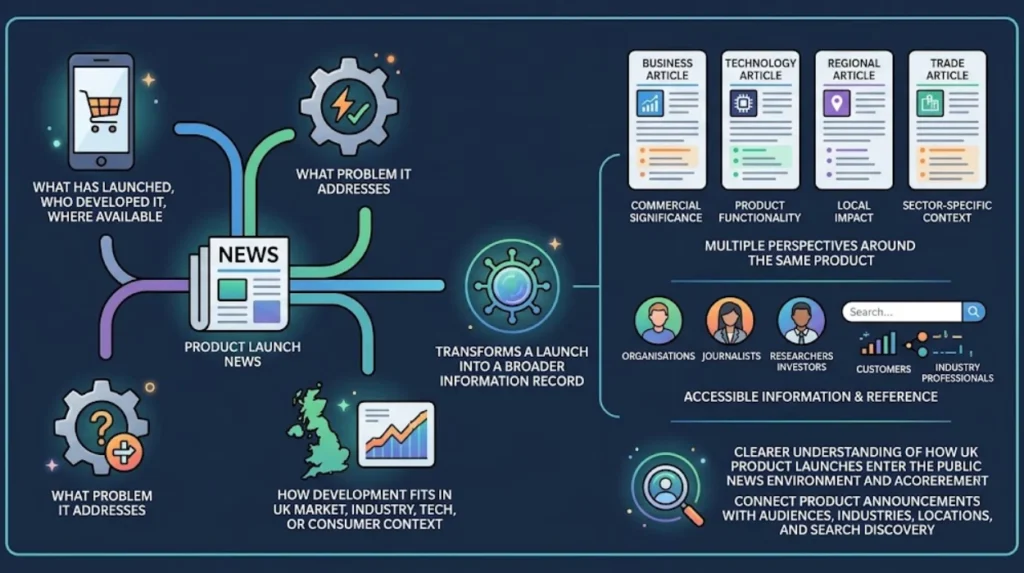
Product launch news coverage helps readers identify what has launched, who developed it, where it is available, what problem it addresses, and how the development fits within a wider UK market, industry, technology, or consumer context.
News coverage transforms a launch from a single announcement into a broader information record.
Readers can compare coverage from different publication types. A business article can explain commercial significance. A technology article can examine product functionality. A regional article can explain local impact. A trade article can provide sector-specific context.
This creates multiple perspectives around the same product.
For organisations, journalists, researchers, investors, customers, and industry professionals, these references provide accessible information about the development and its wider context.
The result is a clearer understanding of how UK product launches enter the public news environment and how editorial coverage connects product announcements with audiences, industries, locations, and search discovery.
Understanding the educational foundations of event timing and coverage provides a useful next step through: