

An embargo is an agreed instruction that prevents journalists and news sites from publishing event information before a specified date and time, creating a controlled release point across multiple publications.
In event media coverage, an embargo establishes a precise publication deadline. Event organisers, PR teams, journalists, and news publishers work from the same release time.
For example, a technology conference announces a major partnership at 10:00 BST on 15 September. Fifteen UK news sites receive the approved information before the announcement. Each publication receives the same embargo time.
The embargo does not require every publication to publish simultaneously. It establishes the earliest permitted publication time. Editorial teams retain control over whether they publish and how they frame the story.
What does an embargo control?
An embargo controls three primary elements:
- Publication date: The first permitted date for publication.
- Publication time: The exact time when coverage can go live.
- Information access: The period during which authorised journalists can review event details.
This structure separates information distribution from public publication. Journalists receive information in advance while the public receives the announcement at the agreed release point.
How does an embargo coordinate coverage across 15 news sites?
An embargo coordinates 15 news sites by giving participating publishers the same approved information, publication deadline, event details, and timing instructions before coverage becomes publicly available.
The process starts with the event announcement. The organiser prepares the press release, media assets, spokesperson information, event details, and supporting evidence.
The material then moves to participating publications. Each editorial team receives the information with a clear embargo notice.
A typical sequence looks like this:
- The event organiser finalises the announcement.
- The media distribution team prepares the release.
- Fifteen selected news sites receive the material.
- Journalists review the information before publication.
- Editors prepare headlines and article structures.
- The embargo remains active until the agreed deadline.
- Publications begin releasing coverage after the embargo expires.
- Published articles are monitored and recorded.
This process creates coordinated timing without requiring identical editorial treatment.
Why is the exact time important?
An exact publication time removes uncertainty. “Publish on 15 September” provides a date but does not establish the release moment. “Publish from 10:00 BST on 15 September” establishes a defined point.
UK event campaigns require accurate timezone management. British Summer Time applies during part of the year, while Greenwich Mean Time applies during winter. International events also require conversion between time zones.
A campaign involving UK, European, and North American publications requires one documented reference timezone. The release instructions then state the corresponding local times where necessary.
What happens before the embargo expires?
Before an embargo expires, journalists review the supplied material, verify facts, prepare editorial content, and organise publication workflows without publicly releasing the embargoed information.
The pre-publication period gives editorial teams time to examine the announcement. This is particularly relevant for conferences, corporate events, product demonstrations, awards, investment announcements, and major industry gatherings.
Journalists can check names, dates, figures, quotations, company information, and event locations. Editors can allocate publication resources and prepare headlines.
What information is prepared in advance?
A structured event media package often contains:
- Event name and date
- Venue or online event details
- Event description
- Key speakers
- Organiser information
- Announcement details
- Approved quotations
- Images and logos
- Contact information
- Relevant statistics
- Publication instructions
The information needs to remain consistent across the campaign. Factual inconsistencies create additional editorial work and increase the risk of conflicting coverage.
How do news sites handle the same embargo differently?
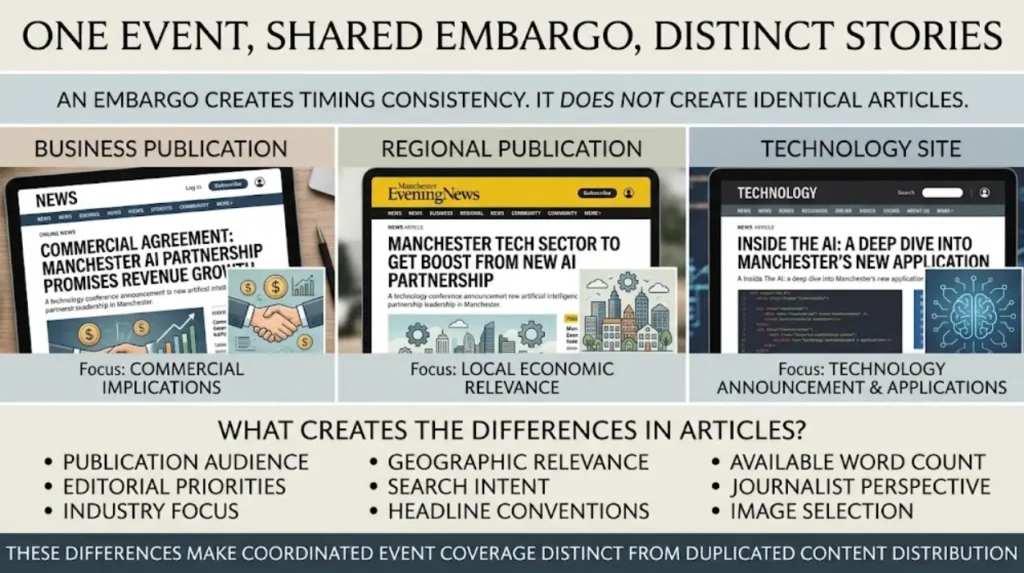
News sites follow the same embargo deadline but apply independent editorial processes, including different headlines, article lengths, angles, images, keywords, and publication formats.
An embargo creates timing consistency. It does not create identical articles.
One UK business publication can focus on commercial implications. A regional publication can focus on the event’s local economic relevance. A technology publication can focus on a technology announcement made during the event.
For example, a Manchester technology conference announces a new artificial intelligence partnership. A business publication can report the commercial agreement. A technology site can examine the AI application. A regional publication can focus on Manchester’s technology sector.
What creates differences between the 15 articles?
Editorial differences commonly result from:
- Publication audience
- Editorial priorities
- Industry focus
- Geographic relevance
- Search intent
- Headline conventions
- Available word count
- Journalist perspective
- Image selection
These differences make coordinated event coverage distinct from duplicated content distribution.
How does embargo timing affect search visibility?
Embargo timing affects search visibility by concentrating multiple legitimate publication opportunities around one announcement while allowing each news site to publish independently after the agreed release time.
Search visibility depends on several factors. Publication timing is one component.
When multiple reputable publications cover an event within a defined period, the announcement gains broader exposure. Search engines encounter several pages discussing the same event from different editorial sources.
The resulting coverage can include branded searches, event-related queries, speaker names, company names, location searches, and industry-specific terms.
For example, an Edinburgh fintech conference can generate coverage around the event name, participating companies, keynote speakers, fintech topics, and Edinburgh business activity.
Does simultaneous publication mean identical search results?
No. Search engines evaluate individual pages. Each publication has its own domain, editorial context, content structure, internal links, and audience.
The same event can therefore produce different search results across business news, technology news, regional news, and specialist trade publications.
The value comes from relevant editorial coverage rather than simple repetition.
What components need to be aligned before an embargoed event campaign?
An embargoed event campaign requires aligned release information, publication timing, media assets, contact details, editorial instructions, timezone references, and monitoring procedures before participating news sites receive the announcement.
Timing is only one part of the process. Campaign coordination also depends on information accuracy.
The core announcement needs one authoritative version. Supporting materials need consistent names, dates, figures, and quotations.
Which timing components matter most?
The essential timing components include:
- Embargo date
- Embargo time
- Timezone
- Media distribution deadline
- Journalist review period
- Expected publication window
- Monitoring start time
- Follow-up schedule
For a 10:00 BST release, the campaign documentation needs to state 10:00 BST rather than simply “10 AM UK time.”
This distinction matters when international teams participate in the campaign.
What happens when publications miss the planned timing?
A missed publication does not automatically invalidate the campaign. Editorial schedules differ between publishers.
One publication can publish at 10:02. Another can publish at 10:15. A third can publish later in the day.
The campaign therefore needs monitoring based on actual publication times rather than an assumption that all 15 articles appear at exactly the same minute.
How can event organisers measure embargoed coverage across 15 news sites?
Event organisers measure embargoed coverage by tracking publication status, publication time, article URL, publication name, headline, topic relevance, audience, and coverage outcomes across all 15 targeted news sites.
A coverage audit provides a structured record of the campaign.
The audit starts with the target publication list. Each site receives a status such as pending, published, updated, or unavailable.
What should an event coverage audit record?
A practical audit includes:
| Measurement | Purpose |
|---|---|
| Publication name | Identifies the news site |
| Article headline | Records the published story |
| Publication time | Measures embargo timing |
| Article URL | Provides the published reference |
| Coverage angle | Identifies editorial treatment |
| Event relevance | Confirms topical alignment |
| Geographic relevance | Identifies regional value |
| Search visibility signals | Tracks discoverability |
| Status | Shows campaign completion |
The audit distinguishes distribution from actual coverage. Sending information to 15 publications does not equal 15 published articles.
This distinction is essential when evaluating media performance.
When are embargoes useful for event coverage?
Embargoes are useful when an event announcement requires controlled timing, advance journalist preparation, coordinated media activity, or a defined public release moment across multiple UK news publications.
Embargoes work particularly well for events containing information that needs preparation before public disclosure.
Examples include:
- Conference speaker announcements
- Event partnerships
- Award announcements
- Corporate event launches
- Industry reports released at events
- Technology demonstrations
- Investment announcements
- Major venue announcements
- Event programme launches
How does this apply to UK events?
UK events often involve national, regional, and trade publications with different editorial schedules.
A London corporate event can target national business media and London publications. A Birmingham manufacturing conference can target regional business publications and manufacturing trade media. An Edinburgh fintech event can target Scottish business media alongside national financial publications.
The embargo establishes one controlled release point while the publication mix creates different editorial contexts.
How does embargo planning compare with immediate event coverage?
Embargo planning provides controlled pre-publication access, while immediate event coverage depends on journalists receiving information during or after the event and preparing stories within the available editorial timeframe.
Immediate coverage suits announcements that depend on live developments. Embargoed coverage suits information that requires advance preparation.
The choice depends on the announcement structure.
An event organiser announcing a keynote speaker two weeks before an event has time to distribute embargoed information. A breaking announcement made during the event follows a different media workflow.
Which model provides better control?
Embargoed distribution provides stronger control over the public release time. Immediate distribution provides faster access to information after an event development occurs.
Neither model replaces editorial independence. News sites decide whether the announcement meets their editorial standards and audience requirements.
What should organisations evaluate when planning embargoed coverage?
Organisations planning embargoed coverage need to evaluate publication relevance, timing accuracy, information quality, media preparation, geographic targeting, monitoring capability, and the difference between distribution volume and confirmed published coverage.
A 15-site campaign needs more than a publication count. The quality and relevance of those publications matter.
The publication mix needs to match the event audience. A fintech announcement requires financial and technology relevance. A construction event requires construction, property, infrastructure, or regional business relevance.
Organisations also need a documented embargo time, consistent campaign assets, and a monitoring process that records actual publication results.
For teams reviewing existing media performance, a:
Free event coverage audit provides a practical way to assess publication reach, coverage consistency, timing, and gaps before planning another campaign.
This evaluation connects event coverage strategy with measurable media outcomes rather than treating publication volume as the only performance indicator.
Explore More Expert Insights:
How International Event Coverage Reaches UK News Readers
How B2B Summit Coverage Reaches 15 News Sites in 2026
What is the main value of embargoes for multi-site event coverage?

The main value of an embargo is controlled timing. It gives journalists advance access, establishes a defined publication point, supports coordinated media planning, and enables organisations to measure coverage across multiple independent news sites.
A 15-site event campaign requires precise coordination. The embargo provides the timing framework.
The broader media strategy determines publication selection, editorial relevance, announcement quality, and monitoring. The resulting coverage remains independently produced by each publication.
For organisations comparing media approaches, understanding the difference between embargo timing, media distribution, and confirmed publication creates a clearer basis for evaluating event coverage performance.
This framework also connects naturally with:
UK product launch news coverage, where controlled announcement timing and coordinated media publication influence how audiences encounter a new development.
At the decision stage, organisations can use a free event coverage audit to examine existing coverage, identify publication gaps, and establish measurable requirements for future campaigns.



