

International events get UK news coverage when their stories contain information that is relevant to British audiences, suitable for editorial publication, and supported by clear news values. Location, public interest, timing, people, organisations, and economic relevance influence whether UK media organisations cover an event.
An international event takes place outside the United Kingdom but attracts attention from UK readers, businesses, institutions, professionals, or communities. Examples include technology conferences in Berlin, investment forums in Dubai, healthcare congresses in Singapore, and global trade exhibitions in Frankfurt.
Understanding how these events enter the UK news environment requires examining the relationship between international event organisers, news values, journalists, media outlets, press materials, and audience relevance.
Why do international events attract UK news coverage?
International events attract UK news coverage when their subject connects with British interests, industries, audiences, public policy, investment, technology, culture, or international business relationships. News relevance gives an overseas event a reason to appear in UK publications.
UK news organisations operate around defined editorial priorities. An event does not receive coverage simply because it is large or international. Editors assess whether its developments provide information that matters to their audience.
A technology conference becomes relevant when it introduces technologies used by UK companies. A financial summit becomes relevant when it affects investment, regulation, markets, or international business. A healthcare congress becomes relevant when it presents research, policy developments, or industry changes relevant to UK healthcare professionals.
What makes an international event newsworthy?
Newsworthiness describes the characteristics that make an event suitable for journalistic coverage. Common factors include:
- Timeliness: The event contains recent or upcoming developments.
- Relevance: The subject affects a defined UK audience.
- Prominence: Recognised people, organisations, or institutions participate.
- Impact: The event has measurable economic, technological, political, or social consequences.
- Novelty: The event introduces a new product, finding, agreement, or initiative.
- Geographic connection: The event has a direct relationship with the UK.
- Industry significance: The subject affects an important professional sector.
For example, an international fintech conference gains stronger UK relevance when British financial institutions, investors, regulators, or technology companies participate.
How does an international event become relevant to UK readers?
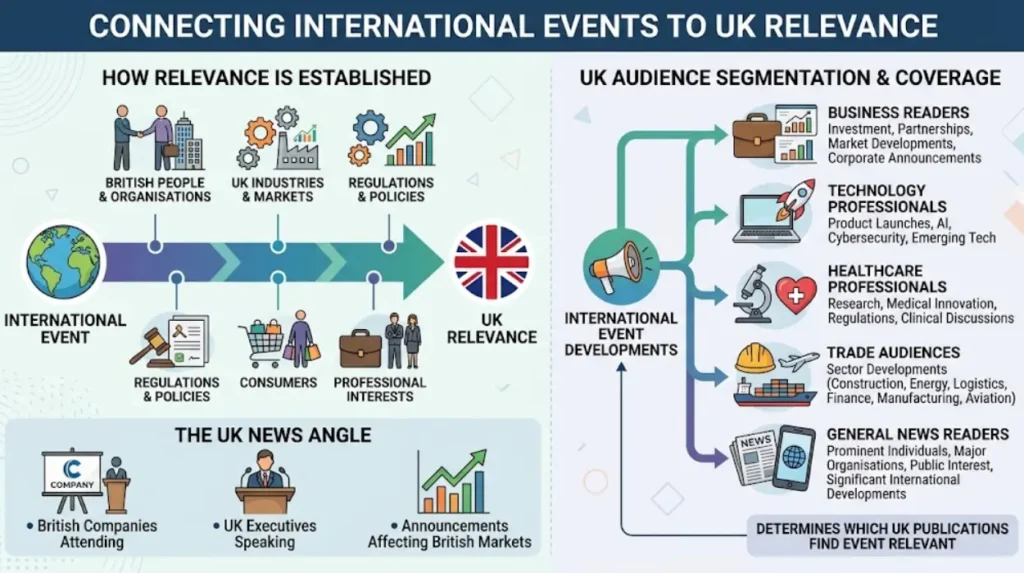
An international event becomes relevant to UK readers when its information is connected to British people, organisations, industries, markets, regulations, consumers, or professional interests. Editors use this relevance to determine whether overseas developments belong in UK-facing news coverage.
UK relevance often comes from a specific connection rather than the event’s geographic location. A conference in Paris has a stronger UK news angle when British companies attend, UK executives speak, or an announcement affects British markets.
The connection also depends on audience type. Business publications focus on commercial implications. Technology publications focus on innovation. Trade publications focus on industry developments. Regional publications focus on geographic relationships.
Which UK audiences follow international events?
Different audiences consume international event coverage for different reasons.
Business readers follow investment, partnerships, market developments, and corporate announcements.
Technology professionals follow product launches, artificial intelligence developments, cybersecurity announcements, and emerging technologies.
Healthcare professionals follow research, medical innovation, regulatory developments, and international clinical discussions.
Trade audiences follow developments affecting specific sectors, such as construction, energy, logistics, finance, manufacturing, and aviation.
General news readers follow stories involving prominent individuals, major organisations, public interest, and significant international developments.
This audience segmentation determines which UK publications find an international event relevant.
How do journalists decide whether to cover an international event?
Journalists assess international events through news value, audience relevance, factual clarity, timing, available evidence, and editorial fit. They identify the strongest news angle and determine whether the development provides sufficient information for a publishable story.
Journalists receive information through press releases, direct contacts, event announcements, interviews, official statements, photographs, research reports, and other supporting materials.
The first assessment usually concerns the central development. A clear announcement gives journalists a specific reason to investigate or report the event. A general description of an event provides less editorial information.
The quality of the information also matters. Journalists need identifiable organisations, named participants, dates, locations, figures, statements, and factual explanations.
What information helps journalists evaluate an event?
Useful event information includes:
- The event name and location.
- The confirmed event date.
- The organiser and participating organisations.
- The central announcement or development.
- Named speakers and participating experts.
- Relevant statistics and research.
- UK connections and implications.
- Official quotations.
- Supporting images or documents.
- Contact information for verification.
For example, an international energy summit becomes easier to evaluate when its announcement identifies participating energy companies, investment figures, policy discussions, and specific implications for UK energy markets.
How are international event announcements prepared for UK media?
International event announcements are prepared for UK media by identifying the strongest news angle, presenting verified facts, explaining UK relevance, and organising information into a clear editorial format that journalists can assess quickly and accurately.
A press release or media announcement normally begins with the central news development. Supporting information follows in descending order of importance.
The opening section answers the basic questions of who, what, when, where, and why. Later sections provide context, quotations, statistics, and additional event details.
UK media communication also benefits from precise terminology. Organisations need consistent names. Dates need clear formatting. Statistics need sources. Statements need attribution.
Why does the UK angle matter?
The UK angle establishes why British readers need the information.
A global investment event can highlight British investors. An international technology exhibition can identify UK companies exhibiting new products. An overseas healthcare congress can feature British researchers presenting new findings.
The connection needs to be factual. Unsupported claims about UK importance do not create genuine editorial relevance.
What role does timing play in UK coverage of international events?
Timing influences UK event coverage because journalists work around publication schedules, competing news stories, event calendars, weekends, public holidays, and the availability of confirmed information. Timely announcements give news organisations a clearer opportunity to assess developing stories.
Event communication often follows several stages. Pre-event announcements introduce speakers, programmes, partnerships, or expected developments. During-event updates report announcements, launches, awards, and major statements. Post-event coverage focuses on outcomes, agreements, statistics, and significant developments.
The strongest timing depends on the news itself.
A product announcement belongs close to its public release. An executive appointment requires coverage when the appointment becomes official. A major partnership requires publication when the agreement is confirmed.
How does event timing affect news relevance?
An announcement published weeks after a major development loses some of its immediate news value. A clear timeline helps journalists understand whether information is current.
International time zones also create practical considerations. A conference in Singapore operates several hours ahead of the UK. A major announcement released during UK overnight hours enters the UK media environment at a different point in the publication cycle.
This makes publication timing an important part of international event communications.
Which types of international events receive UK news coverage?
International events receiving UK coverage include business conferences, technology exhibitions, investment forums, healthcare congresses, trade shows, cultural events, sustainability summits, sports events, and professional gatherings with a clear connection to British audiences.
Different event categories create different news angles.
Which business events receive coverage?
International business forums generate stories about investment, partnerships, market expansion, corporate strategy, and economic developments.
Examples include investment summits in Dubai, economic forums in Switzerland, and global business conferences in Singapore.
Which technology events receive coverage?
Technology exhibitions and conferences generate stories about artificial intelligence, software, cybersecurity, telecommunications, cloud computing, robotics, and digital transformation.
Examples include technology conferences in Germany, France, Spain, and the United States.
Which professional and trade events receive coverage?
Trade events attract specialist media when they contain developments affecting a defined industry.
Examples include international construction exhibitions, global energy conferences, pharmaceutical congresses, aviation exhibitions, and manufacturing trade fairs.
How does international event coverage reach different UK publications?
International event coverage reaches UK publications through editorial relevance, targeted media communication, news distribution, journalist relationships, event participation, and timely announcements. Different publication categories select stories according to their audiences and editorial priorities.
UK media is not a single channel. It contains national newspapers, business publications, trade journals, regional publications, specialist websites, broadcasters, and digital news platforms.
A single international event therefore requires a clear understanding of publication relevance.
A financial announcement fits financial and business media. A medical research development fits healthcare publications. A technology launch fits technology media. A local UK connection fits regional publications when the geographic relationship is significant.
Readers seeking a deeper explanation of this media journey can explore:
What role do press releases play in international event coverage?
Press releases provide journalists with structured information about an international event, including the central announcement, participants, dates, location, quotations, statistics, and supporting context. They create a factual starting point for editorial assessment.
A press release is not the same as guaranteed news coverage. It is an information source that presents an event in a format suitable for media evaluation.
A strong release prioritises the news development rather than promotional descriptions. It identifies the organisations involved and provides enough factual detail for journalists to understand the story.
What makes an international event press release useful?
A useful release contains:
- A specific headline.
- A clear opening announcement.
- Verified event information.
- Relevant UK connections.
- Named people and organisations.
- Supporting statistics.
- Attributed quotations.
- Contact details.
- Relevant background information.
This structure reduces ambiguity and gives journalists the information required to assess editorial relevance.
What benefits does UK news coverage provide for international events?
UK news coverage gives international events visibility among British audiences, strengthens awareness of event developments, communicates announcements to relevant sectors, and creates accessible information about international organisations, speakers, products, research, and partnerships.
Coverage also creates a public record of significant event developments. Published articles provide readers with information about what happened, who participated, and why the development matters.
For international organisations, UK coverage can also increase awareness among British businesses, professionals, investors, researchers, and industry stakeholders.
The value depends on the relevance and quality of the coverage rather than the number of mentions alone.
Readers comparing the next stage of international media visibility can explore:
When do international events need a stronger UK news angle?
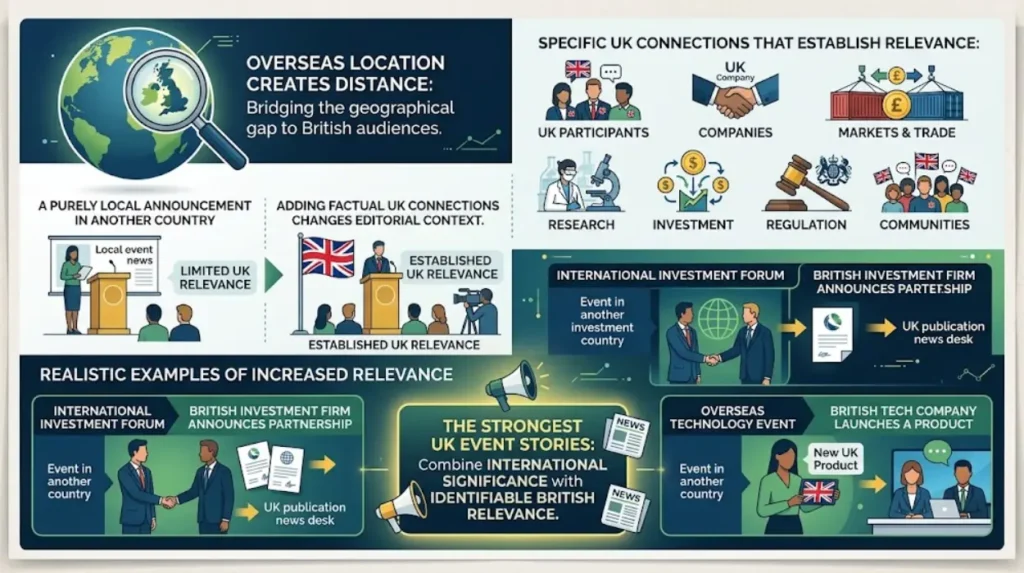
International events need a stronger UK news angle when their overseas location creates distance from British audiences. Specific connections involving UK participants, companies, markets, research, investment, regulation, or communities establish clear relevance for UK publications.
A purely local announcement in another country has limited UK relevance. Adding factual UK connections changes the editorial context.
For example, an international investment forum becomes more relevant when a British investment firm announces a partnership there. An overseas technology event gains UK relevance when a British technology company launches a product there.
The strongest UK event stories therefore combine international significance with identifiable British relevance.
What is the overall process for getting an international event into UK news?
The process starts by identifying a newsworthy event development, establishing UK relevance, preparing verified information, selecting appropriate publication categories, distributing the announcement, and providing journalists with timely facts for editorial assessment and potential coverage.
The process follows a clear sequence:
- Identify the news: Define the specific event development.
- Establish UK relevance: Connect the story to British audiences or interests.
- Collect evidence: Confirm names, dates, figures, statements, and supporting information.
- Prepare the announcement: Present the information in a clear editorial structure.
- Identify relevant media: Match the story with appropriate UK publication categories.
- Communicate the story: Provide journalists and media organisations with the information.
- Monitor coverage: Track published articles and identify the themes used by media outlets.
- Assess relevance: Examine which audiences and publication types engaged with the story.
International event coverage therefore depends on more than an event taking place overseas. It depends on news value, UK relevance, factual information, timing, editorial fit, and clear communication.
Explore More Expert Insights:
Why B2B Summits Need News Coverage in 2026
How Pharma Events Earn Compliant UK News Coverage
Understanding these elements explains how international events move from overseas venues into the UK news environment and why some developments attract British media attention while others remain limited to their original markets.



