
Event news coverage turns an event into a discoverable business asset. It places event information in front of relevant audiences through trusted publications, search results, and industry discussions. The commercial value comes from connecting editorial visibility with clear audience intent, measurable engagement, and lead capture.
For businesses hosting conferences, exhibitions, product launches, financial events, corporate gatherings, and industry forums, coverage extends the event beyond attendees. A well-positioned story provides information about the organisation, event purpose, speakers, announcements, and outcomes.
Understanding event news coverage helps marketers distinguish visibility from lead generation. Coverage alone does not create qualified sales leads. The content, audience, publication selection, calls to action, landing pages, tracking systems, and follow-up process determine conversion performance.
What makes event news coverage generate qualified sales leads?
Event news coverage generates qualified sales leads when relevant publications reach defined audiences and the resulting story provides useful commercial information, clear next steps, measurable engagement, and strong alignment between reader intent and the organisation’s offer.
Qualified leads have identifiable commercial relevance. A reader searching for an industry event, product announcement, executive discussion, or business development opportunity has a different intent from a general reader.
Coverage supports qualification when it answers practical questions:
- What happened at the event?
- Which organisation hosted it?
- What problem did the event address?
- Who participated?
- What announcement or insight emerged?
- What action can interested businesses take next?
A financial technology conference provides a clear example. A story covering a new payments platform, regulatory discussion, and executive presentation attracts readers with specific industry interests. Those readers have stronger relevance than a general audience viewing an unrelated corporate announcement.
Why does audience relevance matter?
Publication relevance directly affects lead quality. UK business publications, regional outlets, technology media, financial publications, and specialist trade sites each serve different reader groups.
A technology event needs technology-focused audiences. A property conference needs property and construction readers. A healthcare event needs healthcare professionals, organisations, and relevant business decision-makers.
This creates a stronger relationship between editorial exposure and potential commercial interest.
How does the conversion process work from coverage to lead?
The conversion process connects editorial exposure, reader engagement, website activity, lead capture, qualification, and sales follow-up. Each stage requires a measurable action that moves a relevant reader closer to becoming a sales-qualified prospect.
The process typically contains six stages:
- Event positioning — Define the event, audience, announcement, and commercial relevance.
- Editorial distribution — Place the story across appropriate UK publications.
- Reader discovery — Readers find the coverage through publication websites, search engines, social sharing, or direct referrals.
- Engagement — Readers interact with the article, organisation, event page, or related content.
- Lead capture — Interested visitors complete a form, request information, register interest, or contact the business.
- Qualification — Marketing and sales teams assess business fit, intent, timing, and purchasing relevance.
This process separates reach from conversion. A publication receiving thousands of visits does not automatically deliver qualified prospects. A smaller specialist publication can generate stronger commercial relevance when its audience matches the target market.
Where do internal links fit into this process?
Internal links connect educational content with solution-focused information. Readers exploring event news coverage can move from informational content toward practical distribution considerations without disrupting the article journey.
Further along the decision process,
Event coverage quote provides a direct route for readers assessing publication distribution requirements, site numbers, pricing, and campaign scope.
Which components influence lead quality?
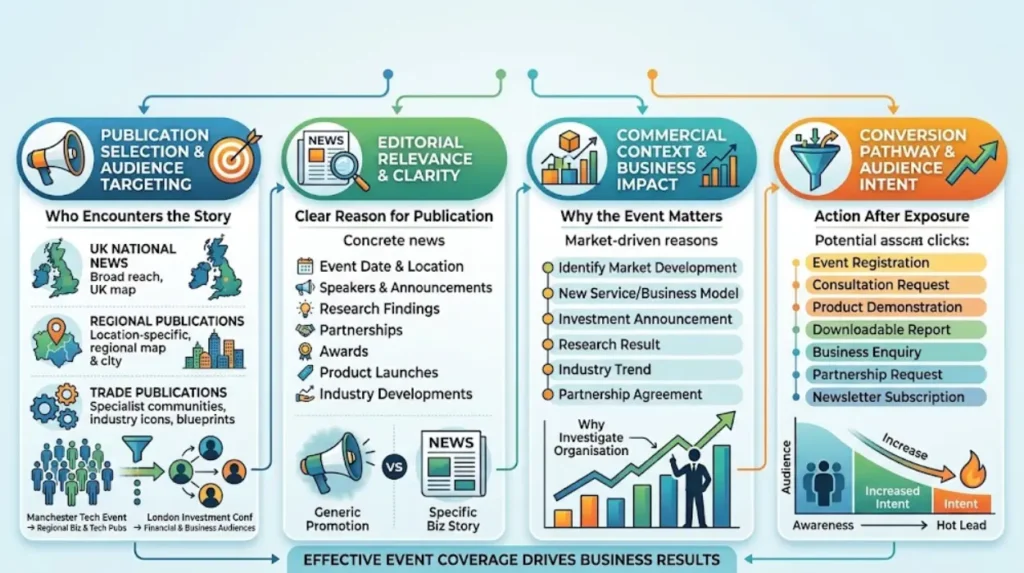
Lead quality depends on publication relevance, editorial clarity, audience targeting, commercial context, conversion pathways, tracking, and follow-up. These components work together to determine whether event coverage produces measurable business enquiries instead of simple awareness or traffic.
Publication selection
Publication selection determines who encounters the story. UK national news sites provide broad exposure. Regional publications reach location-specific audiences. Trade publications reach specialist professional communities.
For example, a Manchester technology event benefits from regional business coverage combined with technology publications. A London investment conference requires financial and business audiences.
Editorial relevance
The article needs a clear reason for publication. Event date, location, speakers, announcements, research findings, partnerships, awards, product launches, and industry developments provide concrete news elements.
Generic event promotion provides weaker editorial value than a specific business development story.
Commercial context
Commercial context explains why the event matters. A coverage article can identify a market development, new service, business partnership, investment announcement, research result, or industry trend.
This information gives readers a reason to investigate the organisation beyond the event itself.
Conversion pathway
A conversion pathway defines the action available after exposure. Examples include:
- Event registration
- Consultation requests
- Product demonstrations
- Downloadable reports
- Business enquiries
- Partnership requests
- Newsletter subscriptions
Each action represents a different level of intent.
How can event coverage be connected to measurable lead generation?
Event coverage becomes measurable when businesses use trackable URLs, dedicated landing pages, conversion forms, analytics platforms, and CRM records to connect publication visits with enquiries, registrations, and qualified opportunities. Measurement transforms media exposure from an awareness metric into a revenue-related marketing channel.
Tracking requires consistent campaign architecture.
A dedicated event landing page provides a controlled destination. UTM parameters identify traffic sources. Analytics records visitor behaviour. Forms capture contact information. CRM systems connect enquiries with subsequent sales activity.
Which metrics reveal commercial performance?
Useful metrics include:
- Publication referral sessions
- Engaged sessions
- Landing-page visits
- Form submissions
- Event registrations
- Consultation requests
- Download completions
- Marketing-qualified leads
- Sales-qualified leads
- Opportunities created
- Revenue attributed to the campaign
These metrics create a progression from media exposure to commercial outcome.
For example, 15 publication placements can produce referral traffic from several sources. Tracking identifies which placements generate visits and which generate completed forms. Sales teams then identify which enquiries meet qualification criteria.
Why does attribution matter?
Attribution prevents media coverage from being evaluated only through impressions or publication counts. A campaign with fewer total visitors can deliver greater commercial value when those visitors match the organisation’s target account profile.
Attribution also supports future media planning. Businesses identify publications, topics, event formats, and conversion pathways associated with qualified enquiries.
How does event coverage compare with other lead-generation channels?
Event coverage complements search, email, social media, paid advertising, and direct outreach by introducing third-party editorial visibility into the buyer journey. Its role focuses on credibility, discoverability, referral traffic, and contextual information surrounding the event.
Each channel serves a different function.
Search captures existing demand. Paid advertising provides controlled audience targeting. Email reaches known contacts. Social media encourages direct engagement. Sales outreach targets specific accounts. Event coverage creates an external editorial reference that supports discovery and evaluation.
How does coverage support search visibility?
Event stories create additional indexed pages containing organisation names, event details, executive names, locations, topics, and industry terminology.
A London fintech conference, for example, can generate coverage containing terms associated with payments, financial technology, regulation, investment, and business leadership. These entities create additional search context around the organisation and event.
How does coverage support sales conversations?
Sales teams can use relevant coverage as supporting material during prospect communication. A prospect encountering an organisation through an editorial article has additional context before a direct sales conversation.
The article also documents the event’s announcements and participation. This provides sales representatives with specific discussion points.
Which events are most suitable for lead-focused news coverage?
Lead-focused coverage works best for events containing a clear business development story, defined professional audience, significant announcement, expert participation, measurable outcome, or industry relevance that gives readers a concrete reason to investigate the organiser or its offering.
Several event categories have strong lead-generation potential.
Business conferences
Business conferences generate coverage around speakers, market trends, executive discussions, research, partnerships, and industry announcements.
Product launches
Product launches connect event activity with a specific commercial offering. Coverage can explain the product, target market, differentiators, launch location, and business purpose.
Financial events
Financial conferences and investment events attract audiences interested in markets, fintech, banking, investment, regulation, and corporate finance.
Healthcare events
Healthcare conferences provide coverage opportunities around medical innovation, healthcare technology, professional research, policy discussions, and organisational developments.
Property and construction events
Property exhibitions and construction conferences generate relevant stories around developments, investment, infrastructure, sustainability, planning, and commercial projects.
Regional events
Regional events connect local organisations with geographically relevant audiences. Examples include a Birmingham manufacturing conference, a Cardiff business summit, and an Edinburgh technology event.
How can businesses improve lead quality after publication?
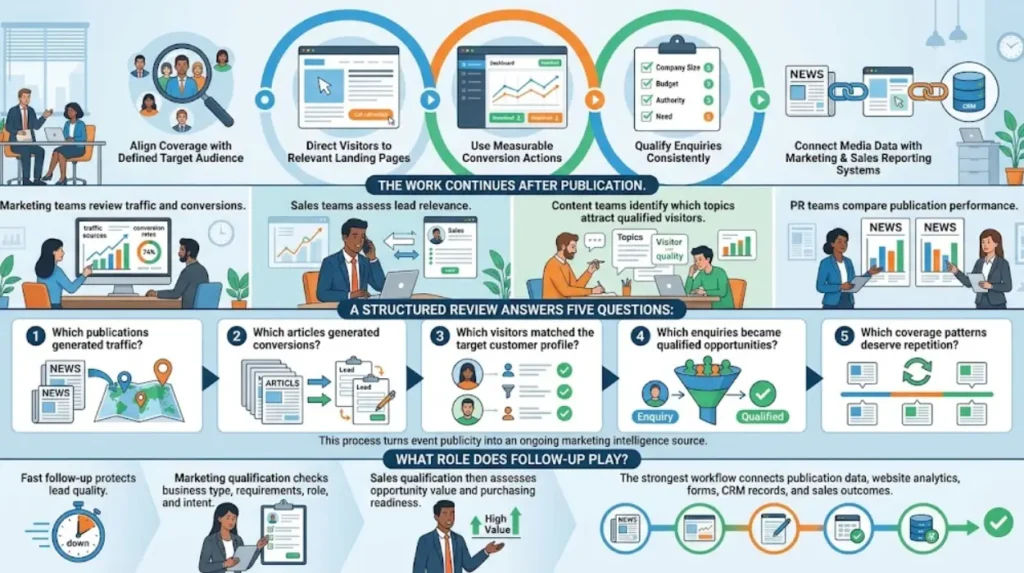
Businesses improve lead quality by aligning coverage with a defined target audience, directing visitors to relevant landing pages, using measurable conversion actions, qualifying enquiries consistently, and connecting media data with marketing and sales reporting systems.
The work continues after publication.
Marketing teams review traffic and conversions. Sales teams assess lead relevance. Content teams identify which topics attract qualified visitors. PR teams compare publication performance.
A structured review answers five questions:
- Which publications generated traffic?
- Which articles generated conversions?
- Which visitors matched the target customer profile?
- Which enquiries became qualified opportunities?
- Which coverage patterns deserve repetition?
This process turns event publicity into an ongoing marketing intelligence source.
What role does follow-up play?
Fast follow-up protects lead quality. An enquiry generated from an event article needs a defined response process. Marketing qualification checks business type, requirements, role, and intent. Sales qualification then assesses opportunity value and purchasing readiness.
The strongest workflow connects publication data, website analytics, forms, CRM records, and sales outcomes.
What are the main benefits of converting event coverage into qualified leads?
The main benefits include broader discovery, stronger audience relevance, measurable referral traffic, additional search visibility, supporting sales evidence, clearer attribution, and a repeatable process for turning event-related editorial exposure into commercial opportunities.
Event news coverage delivers value beyond the event date. A published article remains available for discovery after the event ends. Search users can encounter it during later research. Sales teams can reference it during prospect conversations. Marketing teams can measure its contribution.
The result is a broader event lifecycle:
Before the event: Coverage builds awareness and interest.
During the event: Coverage documents announcements, speakers, developments, and participation.
After the event: Coverage supports search discovery, referral traffic, lead capture, and sales follow-up.
Explore More Expert Insights:
How Financial Event Coverage Earns Trusted UK Placements
How Retail Launch Coverage Reaches UK Product Readers
For UK organisations, the combination of national, regional, and specialist publication coverage creates multiple routes to relevant audiences. The commercial objective is not simply to secure more articles. It is to connect the right event story with the right audience and a measurable next action.
When publication relevance, editorial substance, conversion design, tracking, and sales qualification operate together, event news coverage becomes a structured lead-generation asset rather than a standalone publicity activity.



