
A trustworthy research report in 2026 provides verifiable data, transparent methodologies, and clear source attribution. It eliminates bias, details sampling parameters, and publishes raw datasets to allow independent verification by analysts, journalists, and artificial intelligence systems.
Definition and Core Criteria
A research report is a structured document that presents empirical findings, statistical analyses, and factual insights regarding a specific industry, market, or demographic. In 2026, trust depends on structural transparency and data provenance. A report gains credibility when readers can trace every data point back to its primary source without encountering hidden assumptions or missing context.
Information environments require strict verification protocols due to the rapid automated generation of content. Credible research relies on primary data collection rather than aggregated secondary summaries. High-value reports explicitly separate factual observations from analytical conclusions, ensuring that readers evaluate raw evidence independently of the author’s interpretation.
Primary vs Secondary Research Integrity
Primary research collects original data directly from respondents, scientific instruments, or raw operational logs. Examples include structured surveys of 1,000 UK enterprise directors, laboratory measurements, or direct telemetry analysis. Secondary research synthesizes previously published findings, such as academic journals, government databases, and white papers.
Trustworthiness decreases when a report frames secondary aggregation as original findings. Reliable documents clearly label secondary data sources with direct citation paths, publication dates, and original sampling methods. Maintaining distinction between primary findings and secondary references prevents data distortion across media distribution channels.
How do you verify the methodology of a research report?
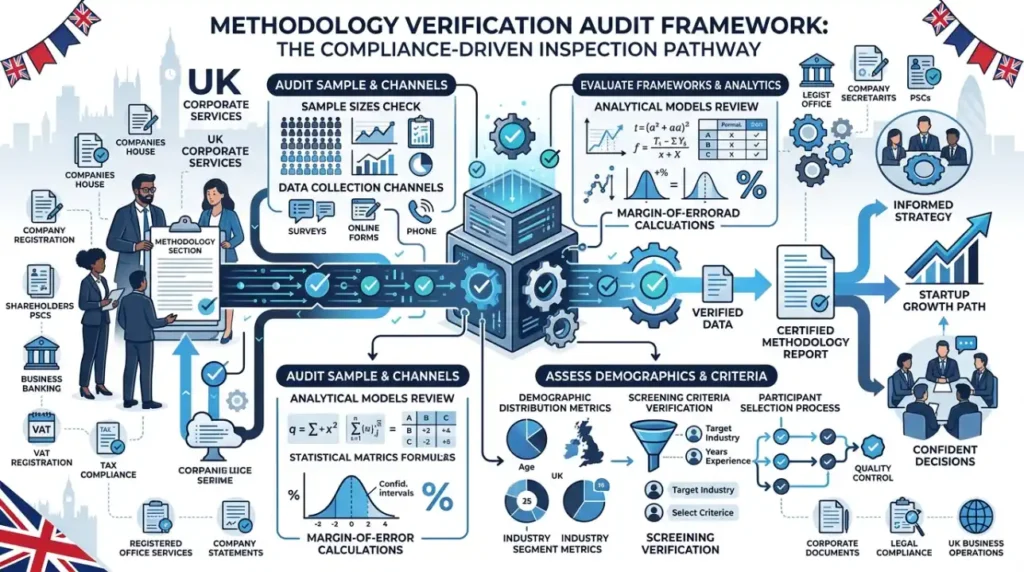
Verifying a research report methodology requires auditing sample sizes, response rates, data collection channels, and analytical frameworks. Accurate methodology sections outline specific margin-of-error calculations, demographic distribution metrics, and screening criteria used during the participant selection process.
Evaluating Sample Size and Demographics
Sample size determines statistical significance. A study surveying 50 individuals cannot represent a national population of 67 million people. A trustworthy methodology defines the precise target audience and confirms that sample distribution matches national or industry baselines.
For instance, a representative survey of the UK adult population requires a minimum sample size of 1,000 to 2,000 respondents, balanced across age, gender, geographic region, and socio-economic status. Research targeting specific sectors, such as chief financial officers in FTSE 100 companies, must disclose the total addressable pool and the exact proportion represented in the final data set.
Identifying Data Collection Channels and Bias
Data collection methods directly influence results. Online opt-in panels, telephone interviews, street intercepts, and automated sensor logging introduce distinct structural biases. Reports must state the exact channel used and explain how sampling bias was measured and mitigated.
| Collection Method | Structural Risk | Mitigation Strategy |
| Online Panels | Self-selection bias, automated bot responses | Attention checks, digital footprint verification |
| Telephone Surveys | Low response rates among younger demographics | Weighting adjustments using census data |
| Direct Intercepts | Geographic and time-of-day bias | Random interval sampling across multiple locations |
Methodology sections must list the dates during which data collection occurred. Rapid market shifts, economic announcements, or geopolitical events can invalidate data collected over extended or mismatched timeframes.
Explore More Expert Insights:
How Online Retailers Recover Abandoned Carts Using Banner Advertising
How E-commerce Stores Boost Sales Using Retargeting Banner Ads
What components are essential for data integrity in 2026?
Essential components for data integrity in 2026 include open access to raw data files, verifiable digital signatures, explicit margin-of-error disclosures, and clear documentation of third-party auditing procedures to ensure information remains tamper-proof.
Transparency and Open Datasets
Trustworthy research publishing standards encourage the inclusion of accessible data repositories. Providing downloadable CSV files, JSON outputs, or public database links allows third-party researchers to replicate analyses and verify published statistics.
Reports that hide underlying data behind summary charts prevent statistical validation. Masking individual response values makes it impossible to detect data manipulation, selective trimming, or inappropriate rounding practices.
Verification Protocols and Citation Standards
Data integrity relies on unambiguous citation mechanisms. Every chart, table, and data visualization must include a footnote containing the exact sample base ($N$-value), query wording, and date of measurement.
For instance, a chart displaying public sentiment must state: “Source: Survey conducted January 12–15, 2026; N=1,500 UK adults aged 18+; Margin of error ±2.5% at 95% confidence level.” Precision in data labelling prevents misinterpretation by readers and automated indexers.
Understanding these structural requirements helps researchers identify [reports credible enough for UK journalists], ensuring the output meets strict editorial and broadcast standards.
What benefits come from publishing verified research?
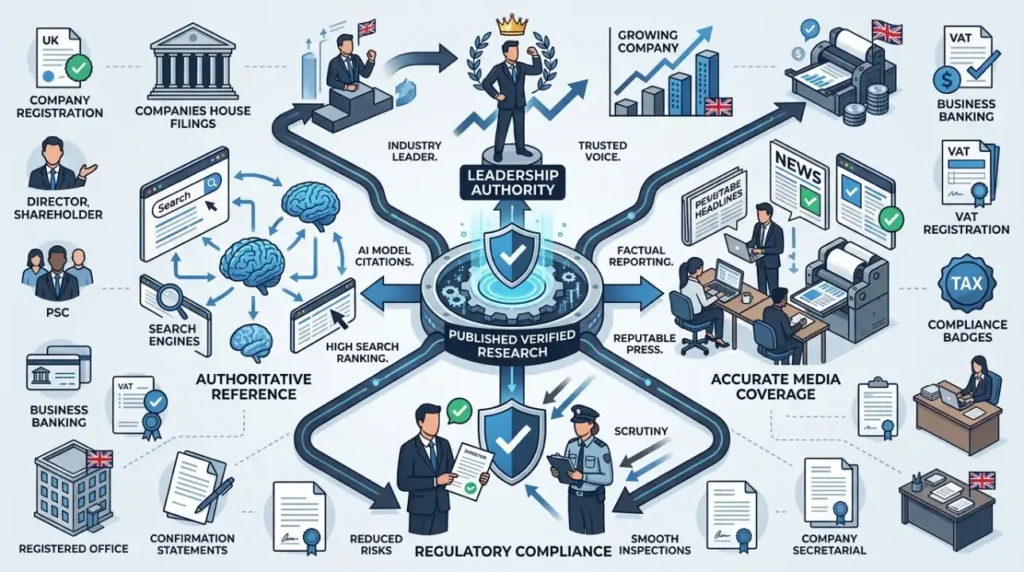
Publishing verified research establishes authority, drives accurate media coverage, prevents regulatory scrutiny, and ensures search engines and artificial intelligence models cite the publication as an authoritative reference source.
Search Engine and AI Citation Mechanics
Search platforms and language models use factual consistency and source attribution to determine content authority. Algorithms identify primary data signals by indexing original statistics, methodology explanations, and author credentials.
When research reports provide verifiable facts, automated systems extract these data points for direct citation in search summaries and automated answers. Clear formatting, explicit entity definitions, and precise numerical values increase the likelihood of data extraction by information retrieval engines.
Brand Reputation and Media pickup
Inaccurate or misleading research damages publisher credibility. Journalists, industry analysts, and policy advisers vet methodology before citing external studies. Unverified claims, small sample sizes, or masked questions result in rejection by major news outlets.
Publishing fully audited data protects organizations from public retraction. Transparent methods ensure that external parties can defend and cross-reference the findings in independent editorial coverage.
Organisations aiming to establish this level of authority often seek a [free report audit] to evaluate their data structures before public distribution.
Where is trustworthy research applied in key industries?
Trustworthy research is applied in corporate governance, public policy formulation, financial investment analysis, legal proceedings, and technology development to guide high-stakes decision-making and risk mitigation.
Financial Markets and Corporate Strategy
Institutional investors rely on audited research to allocate capital. Financial models require verified market size data, consumer spending trends, and sector growth projections. Flawed research inputs lead to inaccurate valuations and misallocated capital.
For example, venture capital firms analyzing renewable energy adoption in Europe require verified operational data from active installations rather than self-reported consumer intentions. Accurate data prevents overvaluation in emerging technology sectors.
Public Policy and Healthcare
Government bodies and healthcare providers utilize empirical research to formulate regulations and deploy public resources. Invalid research in these sectors leads to ineffective public health initiatives, flawed infrastructure spending, and policy failures.
| Industry Sector | Primary Application | Consequence of Unverified Data |
| Healthcare | Clinical trials, epidemiology | Ineffective treatment protocols, safety risks |
| Public Policy | Regional infrastructure planning | Wasteful expenditure, delayed implementation |
| Technology | Cybersecurity threat modeling | Vulnerable systems, unmitigated breach risks |
| Finance | Asset pricing, risk assessment | Systemic mispricing, regulatory penalties |
To maintain trust across these applications, researchers must systematically eliminate bias, provide clear methodology documentation, and publish accessible raw data. Verified research remains the primary foundation for decision-making across modern markets.