
A product outage affects more than system availability. It changes customer perception, media attention, investor confidence, and employee morale. The duration of the outage, the quality of communication, and the speed of recovery shape long-term brand reputation. Understanding these factors helps technology startups prepare for incidents before they occur.
What is a product outage, and why does it affect brand reputation?
A product outage is a period when users lose access to a digital product or its core functions. The outage immediately influences trust because customers expect reliable service, transparent communication, and timely updates throughout every stage of the disruption and recovery process.
A product outage is an interruption that prevents users from accessing a software application, website, platform, or online service. The interruption lasts from a few minutes to several hours or even days.
Brand reputation is the collective perception that customers, investors, employees, partners, regulators, and journalists hold about an organisation. It develops over time through consistent experiences.
When an outage occurs, users experience inconvenience or business disruption. Their experience often becomes public through social media posts, online reviews, community forums, and news coverage.
How does trust change during an outage?
Trust depends on reliability and transparency. A startup that delivers continuous service builds credibility. An unexpected outage interrupts that expectation.
For example, a payment application that becomes unavailable during business hours interrupts financial transactions. A project management platform that fails during a product launch delays team collaboration. These experiences directly influence customer confidence.
Why does reputation respond faster than technical recovery?
Technical teams restore systems. Public perception responds to communication.
If customers receive accurate updates every 30 to 60 minutes, uncertainty decreases. If updates stop, speculation increases regardless of technical progress.
Which stakeholders are affected during a product outage?
A product outage influences multiple stakeholder groups simultaneously. Customers experience service disruption, employees manage increased workloads, investors evaluate operational resilience, journalists monitor public reactions, and business partners assess reliability before maintaining long-term commercial relationships together.
Every stakeholder measures the incident differently.
Customers
Customers focus on usability.
Examples include:
- Online retailers unable to process orders
- Marketing agencies unable to access campaign dashboards
- Developers unable to deploy applications
Customers evaluate:
- Service availability
- Communication frequency
- Resolution time
- Future reliability
Investors
Investors assess operational maturity.
They review incident handling, leadership communication, customer retention, and financial impact.
Repeated outages often increase concern about operational risk.
Employees
Employees become brand representatives during an outage.
Support teams answer customer questions.
Engineers investigate technical causes.
Marketing and communications teams publish updates.
Leadership coordinates decisions across departments.
Media
Technology journalists often report major outages when they affect a large number of users or critical infrastructure.
News coverage commonly includes:
- Timeline of events
- Customer reactions
- Official statements
- Recovery status
- Business impact
How does a product outage influence customer trust?
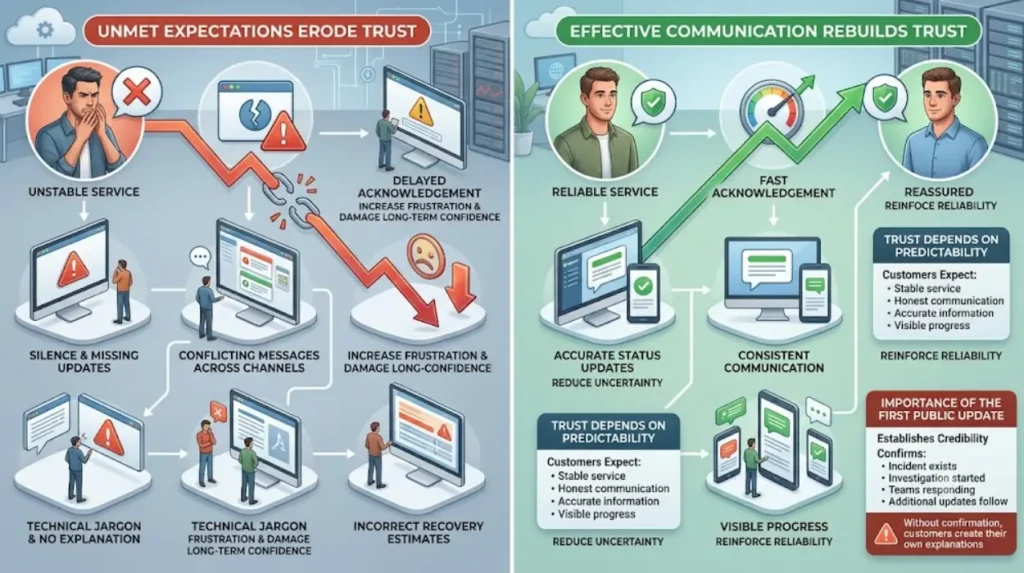
Customer trust declines when expectations for reliability remain unmet. Fast acknowledgement, accurate updates, and consistent communication reduce uncertainty, while silence, conflicting information, and repeated service interruptions increase frustration and damage long-term confidence in the product experience significantly.
Trust depends on predictability.
Customers expect:
- Stable service
- Honest communication
- Accurate information
- Visible progress
Why is the first public update important?
The first update establishes credibility.
It confirms:
- An incident exists.
- Investigation has started.
- Teams are responding.
- Additional updates will follow.
Without confirmation, customers create their own explanations.
What increases customer frustration?
Several communication failures increase dissatisfaction.
Examples include:
- Delayed acknowledgement
- Missing status updates
- Technical language without explanation
- Different messages across communication channels
- Incorrect recovery estimates
These factors extend reputational damage beyond the technical incident.
What factors determine the size of reputational damage?
Reputational impact depends on outage duration, customer visibility, communication quality, service importance, previous reliability, and recovery performance. These measurable factors influence how audiences remember the incident long after systems return to normal operation successfully together.
Not every outage produces the same outcome.
Outage duration
A 15-minute interruption affects users differently from an eight-hour outage.
Longer outages increase:
- Customer complaints
- Media attention
- Social media discussion
- Support requests
Service importance
Essential services receive greater scrutiny.
Examples include:
- Payment platforms
- Healthcare software
- Cloud infrastructure
- Cybersecurity monitoring
- Business communication tools
Previous reliability
A startup with a strong operational history often retains more customer confidence after a single incident.
Repeated outages establish a pattern that reduces trust.
Communication quality
Consistent updates improve confidence even before technical recovery finishes.
Clear communication demonstrates operational control.
How does social media influence brand reputation during an outage?
Social media distributes customer experiences immediately across large audiences. Positive communication limits misinformation, while unanswered complaints, screenshots, and speculation expand public visibility and shape broader perceptions of organisational reliability during technical incidents rapidly online.
Customers often report problems before official confirmation.
Platforms display:
- Error screenshots
- Downtime reports
- Customer complaints
- Questions about recovery
- Comparisons with competitors
Why does misinformation spread?
Information gaps encourage speculation.
Users attempt to explain:
- Technical failures
- Security incidents
- Data breaches
- Internal problems
Official updates reduce uncertainty by replacing rumours with verified facts.
Why is consistency important?
Different messages create confusion.
Support teams, executives, developers, and communication teams require identical factual information throughout the incident.
What role does transparency play during recovery?
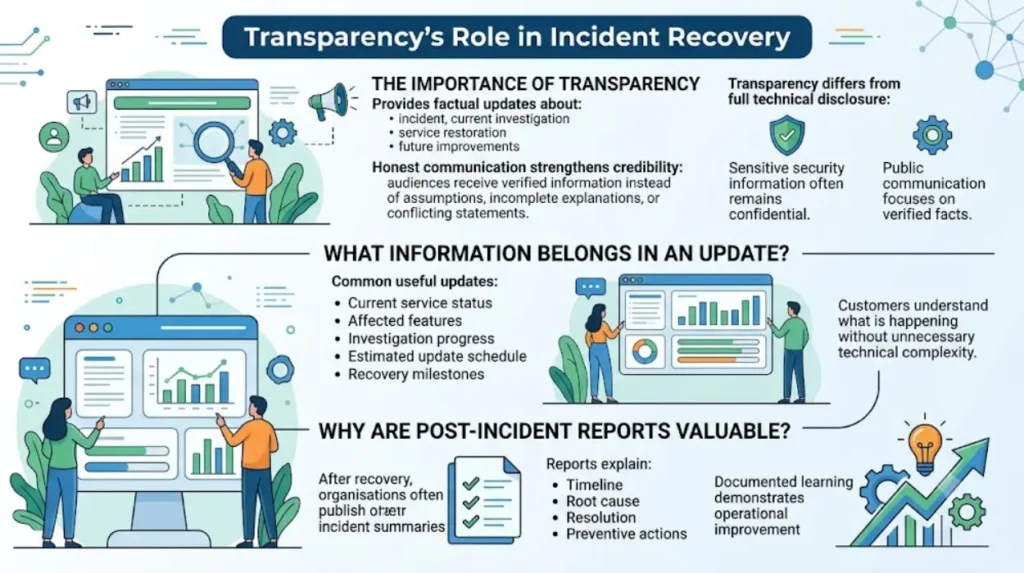
Transparency provides factual updates about the incident, current investigation, service restoration, and future improvements. Honest communication strengthens credibility because audiences receive verified information instead of assumptions, incomplete explanations, or conflicting public statements during recovery efforts consistently.
Transparency differs from full technical disclosure.
Sensitive security information often remains confidential.
Public communication focuses on verified facts.
What information belongs in an update?
Useful updates commonly include:
- Current service status
- Affected features
- Investigation progress
- Estimated update schedule
- Recovery milestones
Customers understand what is happening without unnecessary technical complexity.
Why are post-incident reports valuable?
After recovery, organisations often publish incident summaries.
These reports explain:
- Timeline
- Root cause
- Resolution
- Preventive actions
Documented learning demonstrates operational improvement.
Explore More Expert Insights:
How Tech Journalists Filter Through Hundreds of Pitch Press Releases Daily
Why Organic SEO and Media PR Are the Ultimate Growth Loop for B2B SaaS
Readers interested in structured incident communication can explore:
Crisis Communication Frameworks for SaaS.
How can startups prepare before an outage occurs?
Preparation reduces confusion during future incidents. Defined responsibilities, documented communication procedures, monitoring systems, and regular response exercises enable faster coordination, clearer messaging, and more organised recovery when unexpected service interruptions occur across production environments together.
Preparation begins before technical problems appear.
Create an incident response process
An incident response process defines:
- Technical ownership
- Executive responsibilities
- Customer communication
- Internal reporting
- Approval workflows
Clear responsibilities reduce delays.
Maintain communication templates
Prepared templates improve response speed.
Templates exist for:
- Initial acknowledgement
- Progress updates
- Recovery confirmation
- Incident summary
Templates improve consistency across communication channels.
Train response teams
Practice exercises improve coordination.
Examples include:
- Service interruption simulations
- Database failures
- Infrastructure outages
- Authentication failures
Training identifies operational weaknesses before real incidents occur.
What lessons do successful recoveries demonstrate?
Successful recoveries demonstrate preparation, accountability, consistent updates, technical expertise, and measurable operational improvements. These actions rebuild confidence because stakeholders observe responsible management rather than uncertainty, delayed communication, or repeated operational failures after service restoration completes.
Recovery extends beyond restoring servers.
Long-term reputation depends on organisational behaviour.
Common characteristics of effective recoveries
Successful incident management often includes:
- Immediate acknowledgement
- Regular public updates
- Accurate technical information
- Fast customer support
- Published incident reviews
- Infrastructure improvements
These actions demonstrate operational maturity.
Continuous improvement
Each outage generates operational data.
Teams analyse:
- Detection speed
- Response time
- Resolution time
- Communication effectiveness
- Customer feedback
These measurements improve future resilience.
Readers interested in secure communication practices during high-risk incidents can explore:
Secure and Compliant PR Distribution Solutions.
A product outage affects technology, customer experience, and organisational reputation at the same time. Brand reputation changes according to communication quality, operational preparedness, service reliability, and recovery performance. Customers, investors, employees, media organisations, and business partners all evaluate the incident through different perspectives.
Startups that prepare incident response procedures, communicate consistently, publish verified updates, and analyse every outage strengthen operational resilience over time. A technical failure becomes a reputational event when communication fails. Clear processes, transparent reporting, and continuous improvement reduce long-term reputational impact while reinforcing confidence in the organisation’s ability to manage future incidents.