
Business-to-business (B2B) software companies compete for attention in search engines, industry publications, and professional communities. Organic search engine optimisation (SEO) increases long-term visibility through search rankings. Media public relations (PR) increases visibility through editorial coverage, news mentions, and trusted publications.
When both disciplines operate together, they reinforce each other. Media coverage creates authority signals, brand searches, and high-quality references. Organic SEO captures that interest through informative content and optimized landing pages. This continuous interaction forms a sustainable growth loop that expands visibility, authority, and qualified traffic.
What is the growth loop between organic SEO and media PR?
Organic SEO attracts visitors through unpaid search results, while media PR generates awareness through editorial coverage. Together they increase brand visibility, strengthen authority, improve search demand, expand content reach, and create continuous opportunities for qualified traffic acquisition across multiple digital channels over extended periods.
Organic SEO is the process of improving website visibility in unpaid search engine results. It includes technical optimisation, keyword targeting, content development, internal linking, and user experience improvements.
Media PR is the structured process of distributing newsworthy information to journalists, trade publications, business magazines, and online media outlets. Successful coverage exposes a company to new audiences.
The growth loop begins when media coverage introduces a business to new readers. Some readers search for the company, product category, or related educational topics. Well-optimised content answers these searches, attracting additional visitors through organic search.
Search engines also evaluate authority signals across the web. Editorial mentions, citations, and references contribute to a stronger online presence. As authority grows, informative content earns greater visibility for relevant search terms.
The process repeats with every new announcement, report, product update, or research publication.
How does the loop continue?
Each successful campaign contributes new signals, including:
- Increased branded searches
- Editorial citations
- Industry references
- New backlinks from relevant publications
- Additional indexed content
- Higher user engagement
Each signal supports future organic visibility.
Why does media coverage influence organic search performance?
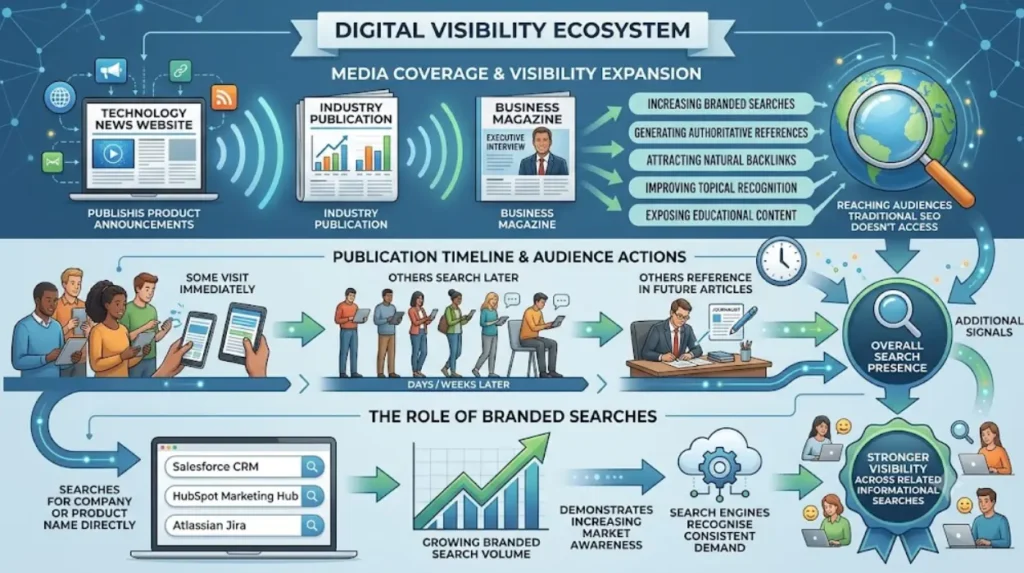
Media coverage expands digital visibility by increasing branded searches, generating authoritative references, attracting natural backlinks, improving topical recognition, and exposing educational content to larger professional audiences that continue discovering information through search engines after publication ends permanently.
Media coverage reaches audiences that traditional search optimisation does not immediately access.
For example:
- A technology news website publishes a product announcement.
- An industry publication covers original research.
- A business magazine interviews company executives.
Each publication introduces the topic to thousands of readers.
Some readers immediately visit the website.
Others search days or weeks later.
Others reference the information in future articles.
These activities generate additional signals that strengthen overall search presence.
What role do branded searches play?
Branded search occurs when users search for a company or product name directly.
Examples include:
- Salesforce CRM
- HubSpot Marketing Hub
- Atlassian Jira
Growing branded search volume demonstrates increasing market awareness. Search engines recognise consistent user demand, supporting stronger visibility across related informational searches.
How does organic SEO extend the value of media PR?
Organic SEO transforms temporary media attention into long-term search visibility by publishing educational resources, optimising topic clusters, improving page relevance, and capturing ongoing search demand after news coverage finishes generating immediate referral traffic from publishers.
News coverage naturally loses visibility over time.
Search traffic continues for months or years when educational resources remain relevant.
For example:
A cybersecurity company publishes original ransomware research.
Industry publications report the findings.
The company also publishes supporting educational content covering:
- ransomware prevention
- threat intelligence
- endpoint security
- incident response
Those pages continue attracting search traffic long after the initial media attention declines.
Educational content extends the lifespan of media exposure.
Why does evergreen content matter?
Evergreen content remains useful throughout the year.
Examples include:
- implementation guides
- technical documentation
- compliance explanations
- software comparison articles
- glossary pages
Unlike breaking news, evergreen content supports consistent organic traffic over long periods.
What content supports both SEO and media PR?
Research-driven, educational, and data-backed content supports journalists and search engines simultaneously. Original information increases publication opportunities, while structured educational resources answer recurring search queries that generate sustainable organic visibility throughout multiple business cycles consistently.
Some content formats perform well across both disciplines.
Original research
Industry surveys provide exclusive statistics.
Example:
A survey of 1,200 IT managers analysing cloud migration priorities.
Journalists cite original statistics.
Search engines index detailed reports.
Industry reports
Annual market reports generate recurring interest.
Examples include:
- SaaS adoption reports
- cybersecurity trends
- developer productivity benchmarks
Case studies
Case studies document measurable outcomes.
Examples:
- reduced deployment time by 38%
- increased workflow automation by 52%
- lowered operational costs by 24%
Case studies support educational search intent while providing evidence for journalists.
Educational resources
These include:
- implementation guides
- compliance checklists
- technical explainers
- API documentation
- onboarding tutorials
Each resource answers specific search questions.
How do backlinks strengthen the SEO and PR relationship?
Editorial backlinks connect trusted publications with authoritative website content. Relevant backlinks improve content discovery, strengthen topic authority, increase referral traffic, and support stronger organic rankings through recognised relationships between trusted digital sources across related industries online.
A backlink is a hyperlink from one website to another.
Editorial backlinks differ from paid or artificial links because journalists include them naturally within published articles.
Examples include links from:
- technology publications
- software review websites
- developer communities
- business news organisations
- industry associations
Search engines evaluate backlink quality, relevance, and authority.
Editorial links frequently originate from established publications with strong trust signals.
These links strengthen overall website authority.
Why does relevance matter?
Industry relevance carries significant value.
Examples include:
- cybersecurity publications linking to cybersecurity research
- finance publications referencing fintech studies
- developer websites citing API documentation
Relevant references strengthen topical relationships.
How does topical authority support long-term growth?
Topical authority develops when a website consistently publishes comprehensive information covering one subject area. Search engines recognise expertise through interconnected content, complete topic coverage, editorial references, and user engagement across multiple related search queries over time.
Topical authority grows through consistent publication.
Instead of publishing isolated articles, successful websites develop complete knowledge libraries.
A B2B SaaS company focusing on customer relationship management covers topics including:
- CRM implementation
- sales automation
- lead scoring
- customer retention
- pipeline reporting
- workflow integration
Internal links connect these related resources.
This structure helps search engines understand subject expertise.
It also improves navigation for users.
Readers interested in:
Post-Launch Momentum to understand how ongoing content supports long-tail search traffic after announcements.
Which metrics measure the SEO and media PR growth loop?
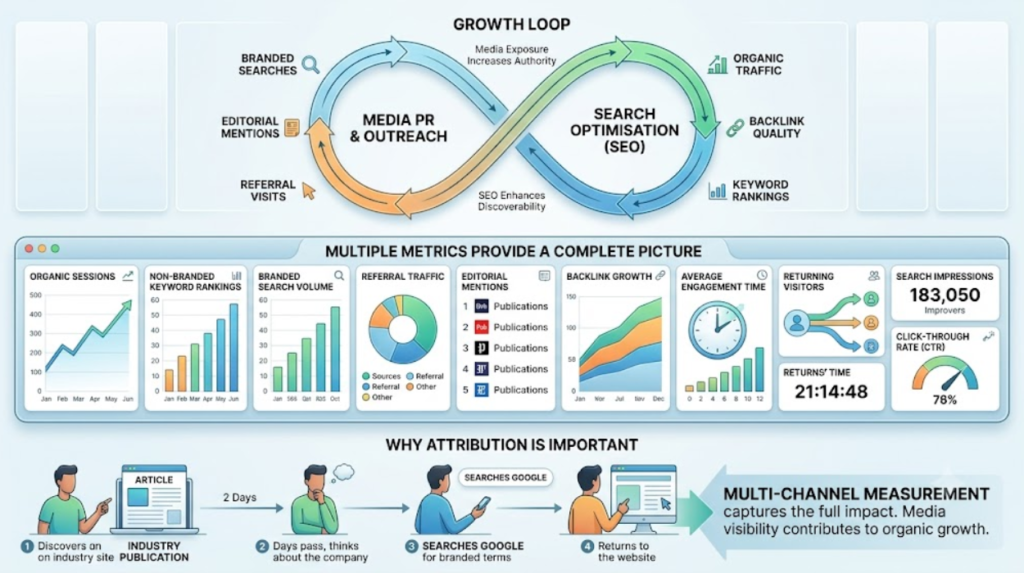
Organic traffic, branded searches, referral visits, editorial mentions, backlink quality, keyword rankings, indexed pages, and engagement metrics demonstrate how media exposure and search optimisation reinforce one another through measurable improvements across multiple acquisition channels consistently over time.
Measuring multiple metrics provides a complete picture.
Important indicators include:
- Organic sessions
- Non-branded keyword rankings
- Branded search volume
- Referral traffic
- Editorial mentions
- Backlink growth
- Average engagement time
- Returning visitors
- Search impressions
- Click-through rate
These metrics reveal how media visibility contributes to organic growth.
Why is attribution important?
Different channels influence each other.
A visitor first discovers an article in an industry publication.
Several days later, the same visitor searches Google before returning.
Without multi-channel measurement, the contribution of media exposure remains incomplete.
Which B2B SaaS industries benefit most from combining SEO and media PR?
Industries with complex buying decisions benefit from combining educational search content and trusted editorial coverage. Professional audiences research extensively before purchasing software, making search visibility and credible media references valuable throughout extended evaluation processes together.
Several sectors depend heavily on information quality.
Examples include:
- cybersecurity software
- financial technology
- healthcare software
- cloud infrastructure
- developer platforms
- enterprise resource planning
- customer relationship management
- data analytics
Professional buyers compare vendors through detailed research before making purchasing decisions.
Educational content supports discovery.
Editorial coverage strengthens credibility.
Together they create stronger visibility across the research journey.
Readers comparing:
Press Release Distribution Networks for decision-focused information about distribution options for developer product launches.
How can B2B SaaS companies build a sustainable SEO and media PR strategy?
A sustainable strategy combines consistent content publishing, newsworthy announcements, original research, technical optimisation, editorial outreach, internal linking, and ongoing performance measurement to increase visibility through complementary search and media channels over extended periods successfully.
The process follows a structured sequence.
Publish educational content consistently
Develop content around customer questions.
Cover complete subject areas instead of isolated keywords.
Produce original data
Research creates exclusive information.
Journalists reference original statistics more frequently than repeated information.
Maintain technical SEO
Important technical elements include:
- fast page loading
- structured headings
- internal linking
- crawlable architecture
- mobile optimisation
Technical quality improves search accessibility.
Create newsworthy announcements
Examples include:
- product launches
- annual reports
- market research
- strategic partnerships
- feature releases
- security updates
These announcements generate editorial opportunities.
Explore More Expert Insights:
How Software Companies Build Trust and Credibility in Highly Competitive Niches
The Role of PR in Accelerating Growth and Valuation After a Seed Round
Track search growth, media mentions, backlinks, referral traffic, and branded search trends together instead of evaluating each channel separately.
Organic SEO and media PR support different stages of digital visibility, yet they perform most effectively when combined. Media coverage introduces businesses to new audiences through trusted publications. Organic SEO captures continued demand through educational content, technical optimisation, and comprehensive topic coverage.
The interaction creates a continuous growth loop. Editorial mentions increase awareness, branded searches, and authoritative references. Search-optimised content converts that attention into sustained organic visibility. Original research, evergreen resources, relevant backlinks, and topical authority reinforce the cycle over time.
For B2B SaaS organisations operating in competitive markets, integrating organic SEO and media PR creates a structured framework for expanding discoverability, strengthening authority, and maintaining long-term search performance without relying on a single acquisition channel.