
Software-as-a-Service (SaaS) companies operate in environments where outages, security incidents, data processing issues, and service disruptions attract immediate public attention. Customers expect transparent communication within minutes rather than hours. A structured crisis communication framework enables organisations to respond consistently, protect stakeholder confidence, and reduce misinformation.
An official statement serves as the organisation’s verified source of information during a crisis. It explains what happened, identifies the affected services, outlines immediate actions, and establishes expectations for future updates. A predefined framework reduces delays and ensures every communication aligns with operational facts and legal requirements.
What is a crisis communication framework for SaaS companies?
A crisis communication framework for SaaS companies is a documented process that defines responsibilities, approval workflows, messaging standards, communication channels, and update schedules. It enables organisations to publish accurate official statements quickly while maintaining consistency, regulatory compliance, and stakeholder confidence throughout an incident.
A crisis communication framework is a structured operating model used during unexpected events that affect customers, partners, employees, or regulators.
Unlike an incident response plan, which focuses on technical recovery, a crisis communication framework focuses on information management. Its objective is delivering verified updates to every stakeholder without creating confusion.
For SaaS businesses, common communication-triggering events include:
- Platform outages
- Security incidents
- API failures
- Data processing delays
- Authentication failures
- Payment service interruptions
Each scenario requires predefined messaging, approval paths, and publishing procedures.
Why communication speed matters
Customers immediately search for answers when services stop working.
A delayed response increases uncertainty. Users often rely on social media speculation when official information is unavailable.
Publishing an initial verified statement within the first 30 minutes establishes a trusted source for future updates.
Why do SaaS companies need a structured communication process during incidents?
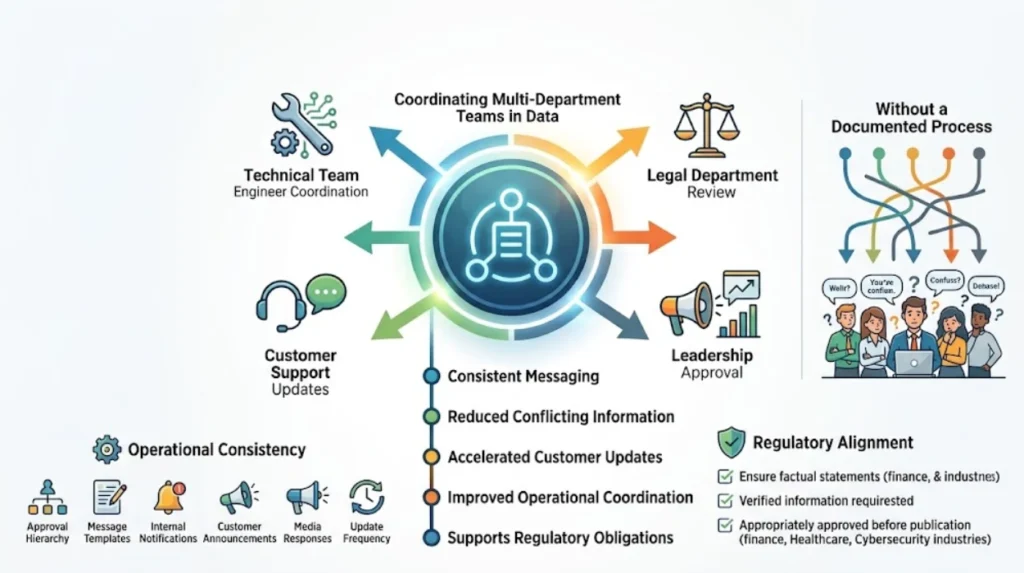
Structured communication processes enable SaaS companies to coordinate technical teams, legal departments, customer support, and leadership. Consistent messaging reduces conflicting information, accelerates customer updates, improves operational coordination, and supports regulatory obligations during high-pressure situations involving service disruptions or cybersecurity events.
Multiple departments contribute information during a major incident.
Engineering teams investigate root causes.
Security teams validate technical findings.
Customer success teams respond to user enquiries.
Legal teams review regulatory obligations.
Executive leadership approves external messaging.
Without a documented process, different teams distribute conflicting information.
Operational consistency
A communication framework standardises:
- Approval hierarchy
- Message templates
- Internal notifications
- Customer announcements
- Media responses
- Update frequency
This consistency improves decision-making throughout the incident.
Regulatory alignment
Many SaaS organisations operate within regulated industries including finance, healthcare, and cybersecurity.
Documented communication processes support compliance requirements by ensuring statements remain factual, verified, and appropriately approved before publication.
What are the essential components of an official SaaS crisis statement?
An effective SaaS crisis statement contains confirmed facts, affected services, customer impact, response actions, investigation status, expected update timing, and official contact information. Every statement prioritises verified information instead of assumptions, speculation, or incomplete technical conclusions.
An official statement provides clear information without overwhelming readers with technical details.
Every sentence answers a practical customer question.
Incident summary
The opening paragraph explains:
- What happened
- When it started
- Which systems are affected
Example:
“A service disruption affecting customer logins began at 09:18 BST. Engineering teams identified the issue and restoration activities are in progress.”
Customer impact
State exactly who is affected.
Examples include:
- Dashboard access unavailable
- API requests delayed
- File uploads temporarily suspended
- Payment processing interrupted
Avoid vague descriptions.
Current response
Explain ongoing actions.
Examples include:
- Infrastructure restoration
- Security investigation
- Database recovery
- Traffic rerouting
Customers expect visibility into active response efforts.
Next communication schedule
Provide a precise update commitment.
Example:
“The next official update will be published at 11:00 BST.”
Regular updates reduce repeated support enquiries.
How can SaaS organisations formulate an official statement quickly?
Fast statement creation depends on predefined templates, verified approval workflows, prepared spokespersons, and real-time operational information. Organisations using standardised communication assets publish official updates significantly faster than teams writing every statement from the beginning during active incidents.
Preparation begins before any crisis occurs.
Templates eliminate unnecessary drafting time.
Communication teams simply replace predefined placeholders with verified information.
Use approved communication templates
Templates normally include:
- Incident title
- Time detected
- Services affected
- Customer impact
- Investigation status
- Current actions
- Next update time
Only verified information enters the template.
Create an approval matrix
Every organisation needs defined approval authority.
A common workflow includes:
- Incident Commander verifies facts.
- Engineering Lead confirms technical accuracy.
- Legal reviews regulatory implications.
- Communications Lead finalises wording.
- Executive approves publication.
Defined responsibilities eliminate approval delays.
Prepare spokesperson guidance
Official spokespersons require consistent messaging across interviews, customer briefings, webinars, and media enquiries.
Prepared guidance reduces contradictory statements.
Which communication channels work best during a SaaS crisis?
Effective crisis communication combines multiple official channels including status pages, email, customer dashboards, social platforms, help centres, and media statements. Every channel distributes identical verified information while directing audiences toward one authoritative source for ongoing updates.
Customers receive information through different platforms.
Using multiple channels improves communication reach.
Status pages
Status pages become the primary incident information source.
Each update includes:
- Incident timeline
- Service availability
- Restoration progress
- Historical updates
Email notifications
Email informs registered customers directly.
Priority notifications work well for:
- Enterprise customers
- Account administrators
- Procurement contacts
- Technical administrators
Customer dashboard alerts
In-product notifications reach active users immediately.
Dashboard banners reduce unnecessary support tickets.
Social platforms
Social platforms distribute concise updates while directing users toward the official status page.
They complement—not replace—official incident communications.
How do communication teams balance transparency with legal and security requirements?
Communication teams publish confirmed operational facts without exposing confidential investigations, customer data, or security-sensitive information. Legal review verifies regulatory obligations while preserving transparency through factual, regularly updated statements supported by confirmed evidence.
Transparency means sharing verified information.
Transparency does not include publishing confidential forensic evidence.
Security investigations require controlled disclosure.
Share confirmed facts only
Examples include:
- Incident start time
- Systems affected
- Restoration progress
- Customer guidance
Avoid publishing:
- Internal vulnerabilities
- Security architecture
- Unverified root causes
- Individual employee actions
Coordinate with legal teams
Legal review confirms:
- Regulatory wording
- Customer notification obligations
- Disclosure timing
- Industry-specific compliance requirements
Structured review prevents inaccurate public statements.
How can organisations improve communication after a crisis ends?
Post-incident communication evaluates response timelines, stakeholder feedback, statement effectiveness, approval speed, and customer satisfaction. Lessons learned strengthen future crisis communication frameworks and improve organisational readiness for subsequent operational incidents.
Every incident creates measurable communication data.
Reviewing that data improves future performance.
Measure communication performance
Useful performance indicators include:
- Time to first statement
- Time between updates
- Customer support volume
- Status page traffic
- Email open rates
- Customer satisfaction scores
These metrics identify operational improvements.
Conduct communication reviews
Review meetings involve:
- Communications
- Engineering
- Security
- Customer Support
- Legal
- Executive leadership
Each team documents successful processes and improvement opportunities.
Update communication documentation
Templates, approval workflows, escalation procedures, and contact lists require revision after every major incident.
Updated documentation strengthens organisational readiness.
Readers comparing communication planning with broader incident response strategies can explore:
Tech Startup’s Brand Reputation for additional planning considerations.
Organisations evaluating secure distribution options for official incident announcements can reference:
Secure and Compliant PR Distribution Solutions when assessing communication delivery approaches.
What are the benefits of adopting a documented SaaS crisis communication framework?
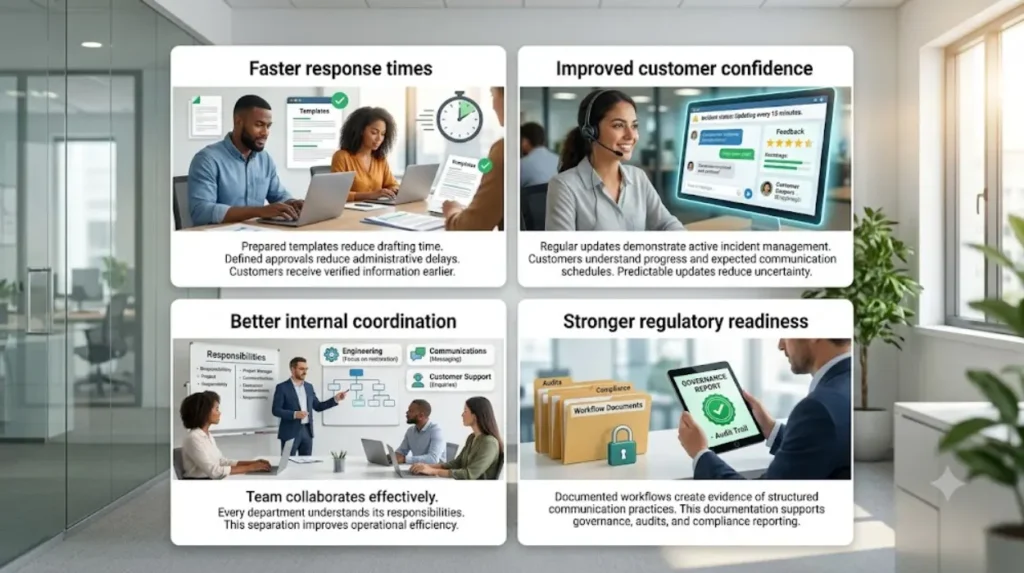
Documented crisis communication frameworks improve response speed, message consistency, customer confidence, regulatory readiness, cross-functional coordination, and operational efficiency. Standardised communication processes reduce avoidable delays while ensuring stakeholders receive reliable information throughout every stage of an incident.
Communication frameworks produce measurable operational benefits beyond crisis response.
Faster response times
Prepared templates reduce drafting time.
Defined approvals reduce administrative delays.
Customers receive verified information earlier.
Improved customer confidence
Regular updates demonstrate active incident management.
Customers understand current progress and expected communication schedules.
Predictable updates reduce uncertainty.
Better internal coordination
Every department understands its responsibilities.
Engineering focuses on restoration.
Communications manage messaging.
Customer support addresses enquiries using approved information.
This separation improves operational efficiency.
Stronger regulatory readiness
Documented workflows create evidence of structured communication practices.
This documentation supports governance, audits, and compliance reporting across regulated industries.
Explore More Expert Insights:
Crafting a Press Release for Major Software Updates: What Reporters Actually Care About
Maximizing Post-Launch Momentum: Turning Press Release Syndication into Long-Tail Search Traffic
Crisis communication is an operational capability rather than a reactive activity. SaaS companies that document communication frameworks before incidents occur respond faster, maintain message consistency, and improve stakeholder confidence.
An effective framework defines responsibilities, approval workflows, communication channels, update schedules, and statement templates before an incident begins. During a service disruption, these documented processes enable teams to publish verified information quickly while supporting technical recovery and regulatory obligations.
As SaaS platforms continue supporting critical business operations across sectors such as financial technology, healthcare technology, and cybersecurity, structured crisis communication remains an essential component of operational resilience. Organisations with prepared communication frameworks issue accurate official statements faster, coordinate teams more effectively, and deliver consistent information throughout every phase of an incident.