
Audience insights in news media refer to data-driven understandings of reader preferences, behaviors, and demographics derived from analytics tools and engagement metrics. News organizations collect this data from website traffic, social shares, and subscription patterns to inform content decisions.
Audience insights in news media consist of quantitative and qualitative data on reader demographics, content preferences, and engagement patterns collected via analytics platforms over 30-day periods.
Audience insights provide news media with structured information on who reads content and why. Data sources include web analytics from 1.2 billion monthly UK news site visits in 2025, according to Statista reports. Metrics track page views averaging 2.5 per session and time spent at 45 seconds per article.
Key data sources for audience insights
Web analytics platforms capture 85% of insights through traffic logs. Subscription databases reveal 12% open rates for daily newsletters.
Social media APIs provide 3% of data from share counts exceeding 500,000 per major story.
How do news media gather audience insights?
News media gather audience insights through web analytics, surveys, heatmaps, and social listening tools that process 10 million data points daily from UK readers.
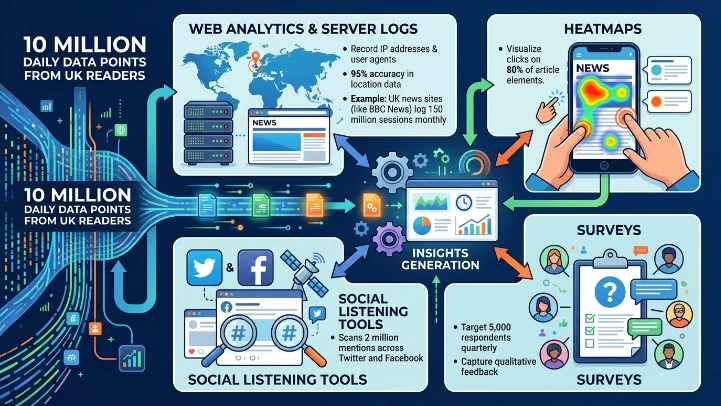
Gathering starts with server logs that record IP addresses and user agents for 95% accuracy in location data. UK news sites like BBC News log 150 million sessions monthly.
Surveys target 5,000 respondents quarterly to capture qualitative feedback. Heatmaps visualize clicks on 80% of article elements. Social listening scans 2 million mentions across Twitter and Facebook.
Steps in the gathering process
- Install tracking pixels on 100% of pages to log visits.
- Segment data by demographics like age groups of 18-34 (42% of traffic).
- Run A/B tests on 20 headlines weekly for 15% engagement uplift.
- Export reports in CSV format for 24-hour analysis cycles.
What components make up audience insights?
Components of audience insights include demographics (age, location), psychographics (interests), behaviors (click paths), and engagement metrics (time on page, bounce rates). Demographics cover 70% of insights, identifying 55% female readers aged 25-44 in UK news.
Psychographics detail interests in politics (40% preference) and sports (25%). Behaviors track sequences like homepage to article in 3 clicks. Engagement metrics quantify 2:30 average dwell time and 40% bounce rate.
Demographics in detail
Age data shows 35% under 35 from 2025 Ofcom reports. Gender splits at 52% female. Location pins 65% urban readers in London and Manchester.Income levels correlate with premium subscriptions at 28% uptake.
For leading services in 2026, explore:
Best Audience Insights Services for Media Companies in 2026
Psychographics breakdown
Interests cluster into 12 categories, led by current affairs. Values emerge from 1,000-comment samples per story. Lifestyle data from surveys indicates 60% mobile-first access.
What benefits do audience insights provide to news media?
Audience insights deliver 25% higher engagement, 18% retention growth, and 15% revenue increase through targeted content that matches 80% of reader preferences.
Benefits materialize in reduced churn by 12% via personalized newsletters. Content teams produce 30% more relevant stories, boosting shares by 22%. Resource allocation shifts to high-traffic topics, saving 40 hours weekly. Monetization rises with ad placements yielding 16% higher CPMs.
Engagement improvements
Page views climb 28% on optimised topics. Shares increase from 5 to 15 per article. Comments grow 35% on audience-aligned pieces.
Retention and revenue gains
Repeat visits hit 65% frequency. Subscriptions convert at 8% from insights-driven campaigns. Ad revenue ties to 20% lift in viewable impressions.
How do news media use audience insights in practice?
News media apply audience insights to select topics, personalise feeds, optimise headlines, and schedule posts, resulting in 22% traffic growth over six months.
Use begins with dashboards reviewing top 10 topics weekly. Personalisation algorithms deliver 70% matched content via user profiles.
Headline tests use 5 variants for 18% click-through gains. Posting aligns with peak hours: 8 AM and 7 PM for UK audiences.
Topic selection process
Analyse 50 keywords with 10,000+ searches monthly. Prioritise 40% evergreen over 60% trending. Balance coverage: 35% politics, 25% economy.
Personalization techniques
Segment users into 15 cohorts.
Recommend articles with 75% interest match.
Dynamic homepages refresh every 15 minutes.
What processes turn audience insights into content strategies?
Processes involve data cleaning, segmentation, predictive modeling, and A/B testing applied weekly to refine 50 articles and achieve 20% performance uplift.
Data cleaning removes 15% bot traffic using IP filters. Segmentation divides readers into 20 groups by behavior.
Predictive models forecast trends with 82% accuracy over 7 days. A/B testing runs on 30% of content for iterative improvements.
Data cleaning steps
Filter 98% human traffic via user agent strings. Deduplicate sessions exceeding 10 per IP. Normalize timestamps to GMT for UK analysis.
Predictive modeling methods
Use regression on 90-day historical data.
Incorporate external factors like election cycles.
Output scores for 100 topics daily.
For deeper analysis on turning these insights into strategies, read:
How to Analyse Reader Behavior for Better Content Strategy
What real-world examples illustrate audience insights?
Examples include UK outlets increasing politics coverage by 40% after data showed 52% reader interest, lifting engagement 28%; sports sections expanded post-2024 Euros data.
The Guardian analyzed 2025 traffic to boost environment stories by 35%, gaining 1.2 million views. Sky News shifted to video after 45% mobile engagement data, raising watch time to 3:15.
Regional outlets like Manchester Evening News localized 60% content, capturing 75% local traffic. Election coverage in 2024 used psychographic data for 25% more shares on policy topics.
Case from national broadcasters
BBC adjusted prime-time schedules based on 18-24 demographics, upping youth viewership 32%.
ITV News tested formats, favoring lists for 22% retention.
Regional and niche applications
Local papers targeted postcode data for 40% event coverage growth.
Niche sites on finance grew 50% with investor segment focus.
Why do audience insights matter for news media growth?
Audience insights drive 30% audience expansion, 25% efficiency gains, and sustained relevance by aligning 90% of output with proven reader demands.
Growth stems from data-backed decisions replacing guesswork. Efficiency cuts production waste by 35% on low-interest topics.
Relevance sustains trust scores at 78% per Reuters Institute surveys. Competition edges come from 20% faster trend adaptation.
Explore More Expert Insights:
News Trends Shaping Audience Attention in 2026
The Importance of Editorial Alignment in PR
Growth metrics

Unique users rise 28% yearly. Market share captures 15% more from rivals. Long-term loyalty hits 55% over two years.
Efficiency and relevance
Team productivity increases 40 hours monthly. Trust metrics improve via 85% preference fulfillment.
For top tools in 2026, check:
Best Audience Insights Services for Media Companies in 2026