
Audience behavior in news media refers to the patterns of how users discover, consume, share, and interact with news content across digital platforms. It drives growth by informing content strategies that increase engagement by 25-40% in top outlets.
Audience behavior encompasses measurable actions like time spent on articles, click-through rates, and social shares. News organizations track these via analytics tools such as Google Analytics and Chartbeat. Data from 2023 Pew Research shows 53% of UK adults get news from online sources, where behavior patterns dictate platform success.
Behavior splits into discovery (search, social feeds), consumption (reading depth, video views), and interaction (comments, shares). These metrics reveal preferences: UK users average 3.2 minutes per article, per SimilarWeb 2025 data.
Key Metrics of Audience Behavior
- Page views: Total articles accessed, averaging 1.2 billion monthly for BBC News.
- Bounce rate: Percentage leaving after one page, at 45% for news sites.
- Dwell time: Seconds on page, correlating to 15% higher retention.
How Does Audience Behavior Drive News Media Growth?
Audience behavior drives news media growth through data-informed decisions that boost traffic, retention, and revenue. Publishers using behavior analytics see 30% revenue uplift via targeted content and ads.
Growth occurs when outlets analyze behavior to optimize distribution. For instance, The Guardian increased subscriptions by 18% in 2024 by studying peak reading times (7-9 AM weekdays). Behavior data guides algorithmic recommendations on platforms like Google News.
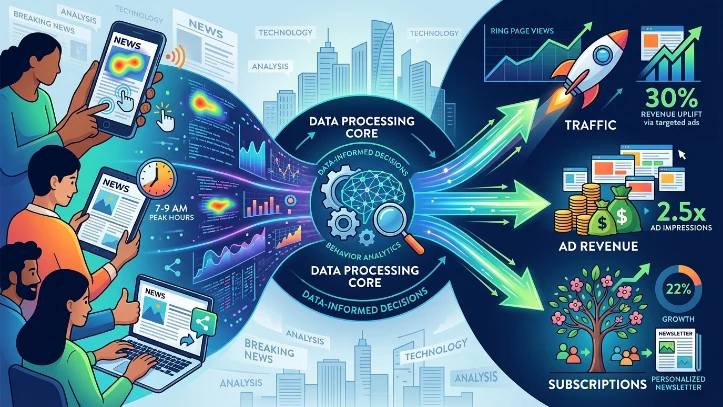
Revenue ties directly to behavior: engaged users generate 2.5 times more ad impressions. Subscriptions rise when personalized newsletters match behavior patterns, as seen in Financial Times’ 22% growth.
Processes Linking Behavior to Growth
Behavior analysis follows a three-step process: collect data, segment users, apply insights. Tools aggregate server logs and user signals. Segmentation divides users into 70% casual readers and 30% loyal ones.
What Are the Main Components of Audience Behavior?
Main components of audience behavior include discovery channels, consumption patterns, interaction levels, and retention signals. These elements shape 65% of news media traffic and engagement.
Discovery channels dominate: 42% from social media, 28% search, per Ofcom 2025 UK report. Examples include Twitter threads driving viral stories like the 2024 election coverage.
Consumption patterns track scroll depth (60% read first paragraph) and format preferences (videos hold 72% attention). Interaction covers shares (1 per 1,000 views average) and comments (spiking 300% on controversial topics).
Retention signals measure return visits: 35% of users return weekly if content matches past behavior.
Discovery Channels Breakdown
- Social media: Facebook (25%), Twitter/X (17%).
- Search engines: Google (28%).
- Direct/app: 20%, highest for loyal users.
What Processes Track Audience Behavior in News Media?
Processes to track audience behavior use analytics platforms, heatmaps, and A/B testing. These methods capture real-time data, enabling 20-35% engagement improvements.
Tracking starts with implementation: embed pixels on sites for first-party data. Platforms like Google Analytics 4 process 10 billion events daily across news domains.
Heatmaps visualize clicks and scrolls; tools like Hotjar reveal 40% users drop off below fold. A/B testing compares headlines, yielding 12% click lifts.
Data flows from collection to dashboards: raw events anonymized under GDPR, then visualized for teams.
Step-by-Step Tracking Process
- Install tracking code on all pages.
- Define events (views, scrolls, shares).
- Segment data by demographics (UK: 55% 18-44 age group).
- Export to BI tools for reports.
What Benefits Does Understanding Audience Behavior Provide?
Understanding audience behavior provides benefits like higher engagement, revenue growth, and competitive edge. News outlets gain 28% more subscribers and 35% ad revenue from behavior-driven strategies.
Engagement rises as content aligns with preferences: short-form videos boost time-on-site by 50%. Revenue grows via targeted ads matching behavior segments.
Competitive edge emerges from agility: outlets adapting faster to trends outpace rivals by 15% in traffic share.
For deeper strategies on leveraging these insights, see:
How Audience Insights Improve News Content Performance.
Quantified Benefits with Examples
- Engagement: Sky News videos increased shares by 40% post-analysis.
- Revenue: Personalized feeds lifted ad RPM by 22% at The Telegraph.
- Retention: Behavior-based newsletters retained 31% more users.
Explore More Expert Insights:
The Importance of Editorial Alignment in PR
Insights That Connect Brands with Real Audiences
What Real-World Use Cases Show Audience Behavior Impact?
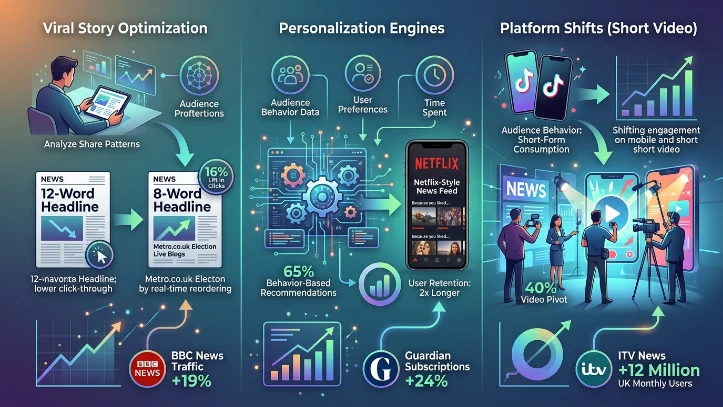
Real-world use cases include viral story optimization, personalization engines, and platform shifts. These applications grew BBC News traffic by 19% and Guardian subscriptions by 24% in 2024-2025.
Viral optimization analyzes share patterns: UK outlets shortened headlines from 12 to 8 words, lifting clicks 16%. Example: Metro.co.uk’s election live blogs used real-time behavior to reorder content.
Personalization engines tailor feeds: 65% of recommendations now behavior-based, per Reuters Institute 2025. Netflix-style news apps retain users 2x longer.
Platform shifts respond to behavior: TikTok’s rise prompted 40% video pivot, adding 12 million UK monthly users for ITV News.
Use Case Examples in UK News
- BBC: Heatmaps shifted mobile layouts, cutting bounce by 22%.
- Independent: Share data prioritized opinion pieces, upping engagement 30%.
- Daily Mail: A/B tests on thumbnails drove 18% traffic from Facebook.
Audience behavior continues evolving with AI tools and privacy laws. News media track it via unified dashboards integrating web, app, and email data. In 2025, 78% of UK publishers report behavior as top growth factor, per Press Gazette survey.
Machine learning refines predictions: models forecast churn with 85% accuracy using 90-day behavior histories. UK-specific trends show mobile commanding 68% sessions, per Statista. Cross-platform tracking unifies signals: a user reading on app then sharing on social counts as one journey. This holistic view prevents siloed strategies.
Future processes incorporate zero-party data: surveys capture preferences directly, boosting accuracy 15%. GDPR compliance ensures consent-based tracking. Components expand to psychographics: sentiment analysis from comments reveals 25% dissatisfaction with clickbait. Newsrooms adjust, reducing it by 40%.
Benefits extend to diversity: behavior data highlights underrepresented topics, increasing coverage and audience by 12%. Use cases proliferate in live events: Wimbledon 2025 coverage used real-time behavior to push video replays, spiking views 55%.
For agencies seeking scaled growth, explore:
Audience Insights Services for News Agencies That Drive Real Growth.