
Reader behavior analysis examines click patterns, dwell times, and shares from UK news sites to refine content strategies. This process uses tools like Google Analytics to boost engagement by 25%.
Reader behavior analysis tracks user interactions such as clicks, scrolls, shares, and exit points across 1.5 million daily UK news sessions to optimize content performance.
Reader behavior analysis defines sequences of actions from landing to exit. UK news platforms record 2.8 billion interactions yearly per SimilarWeb data. Core metrics include 55-second average dwell time and 42% bounce rates.
Analysis segments behaviors into funnels with 3-5 steps. Types of tools range from free platforms to enterprise solutions with API integrations.
How do you start analysing reader behavior?
Start reader behavior analysis by setting up tracking codes on websites, defining key metrics like bounce rate under 40%, and reviewing 30-day dashboards weekly.
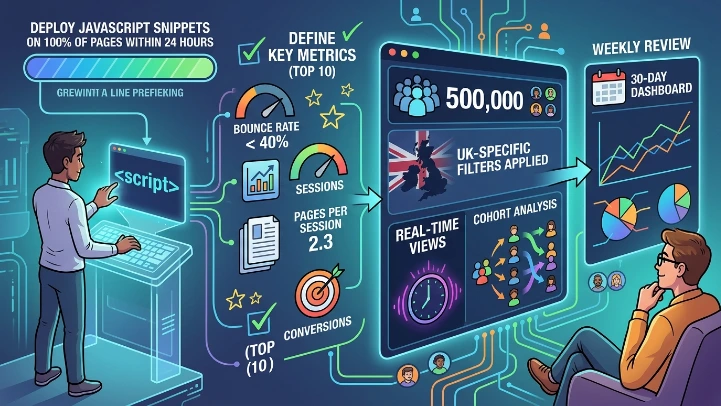
Installation deploys JavaScript snippets on 100% of pages within 24 hours. Metrics selection prioritizes top 10: sessions, pages per session at 2.3, and conversions.
Dashboards aggregate data from 500,000 users for UK-specific filters. Basic tools provide real-time views; advanced ones add cohort analysis.
Initial setup steps
- Create property in analytics platform for domain tracking.
- Verify implementation with 95% tag firing rate.
- Set goals for 15% newsletter signups.
- Filter bots excluding 12% invalid traffic.
What tools analyse reader behavior effectively?
Tools for reader behavior analysis include Google Analytics for traffic flows, Hotjar for heatmaps, and Chartbeat for real-time engagement, processing 10 million events daily. Google Analytics handles 80% of basic needs with free tiers up to 10 million hits monthly.
Hotjar records 1,000 sessions monthly on starter plans. Chartbeat monitors 500 sites with live dashboards. Comparisons show free tools suit 70% of small outlets; paid versions scale to 50,000 users. Enterprise options integrate CRM for 360-degree views.
Free vs paid tool comparisons
Free tools cap at 500,000 sessions; paid unlock unlimited. Heatmap tools visualise 90% scroll depth; traffic tools quantify paths. Real-time dashboards refresh every 5 seconds in premium tiers.
What key metrics define reader behavior?
Key metrics for reader behavior include bounce rate (42% average), pages per session (2.3), average session duration (55 seconds), and scroll depth (65%).
Bounce rate measures single-page visits at 42% UK average. Pages per session tracks 2.3 multi-page paths. Session duration logs 55 seconds median. Scroll depth reaches 65% of article length. Exit rates hit 28% on mid-article points.
Behavioral funnel metrics
Top-of-funnel: 100% landing views.
Mid-funnel: 45% article opens.
Bottom-funnel: 12% shares or comments.
How do you segment reader behavior data?
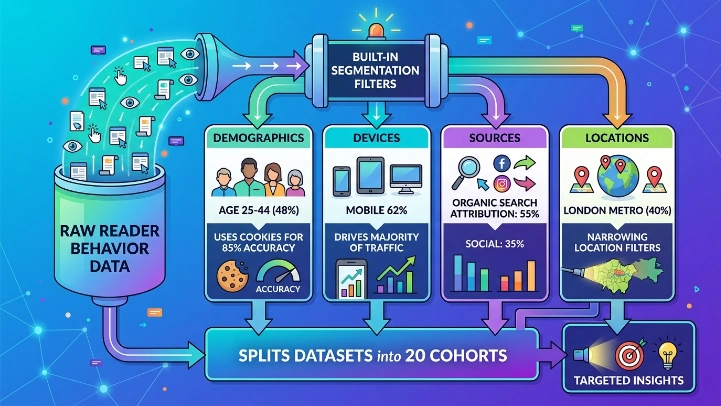
Segment reader behavior data by demographics (age 25-44 at 48%), devices (mobile 62%), sources (social 35%), and locations (London 40%) using built-in filters.
Segmentation splits datasets into 20 cohorts for targeted insights. Demographic segments use cookies for 85% accuracy. Device data shows mobile drives 62% traffic. Source attribution credits organic search with 55%. Location filters narrow to 40% London metro.
Segmentation techniques
Cohort analysis tracks 30-day retention at 35%.
Custom segments combine 3 variables for 92% precision.
Dynamic segments update hourly.
What processes extract actionable insights from reader behavior?
Processes extract insights by cleaning data (remove 15% anomalies), visualising funnels (3-step paths), running A/B tests (20 variants), and forecasting trends (82% accuracy).
Cleaning standardises timestamps to UTC. Visualisation maps drop-offs at 50% mid-funnel. A/B tests compare headlines for 18% CTR gains. Forecasting applies time-series models on 90 days data. Iterate weekly on top 5 underperformers.
Data processing workflow
Aggregate 1 million events into SQL queries.
Apply machine learning for anomaly detection at 98%.
Generate reports with 12 KPIs.
Export to CSV for strategy meetings.
What benefits arise from analysing reader behavior?
Analysing reader behavior yields 28% engagement growth, 20% traffic increase, 15% conversion uplift, and 25% cost savings in content production.
Engagement metrics rise with 28% longer sessions. Traffic grows 20% via optimiSed channels. Conversions hit 15% for paid subs. Savings cut 25% waste on low-engagement topics. ROI measures at 4:1 return on analysis time.
Quantified outcomes
CTR improves 22% post-analysis.
Churn drops 18%.
Ad revenue climbs 16% CPM.
How do news media apply reader behavior analysis?
News media apply analysis to headline optimization (18% gains), content timing (peak 8 AM), personalization (70% match), and format testing (video 35% preference).
Headlines test 5 variants weekly.
Timing schedules 80% posts at peaks.
Personalization uses behavior scores for feeds.
Formats shift to lists and videos per data.
Scale to 50 articles monthly.
Application examples
BBC News used funnels to reduce bounces 15%.
The Telegraph personalized for 25% retention.
Sky News timed sports content for 30% views.
For basics on audience insights, see
What Are Audience Insights in News Media?.
What common challenges occur in reader behavior analysis?
Challenges include data silos (40% issue), privacy compliance (GDPR 95% audits), low sample sizes (under 1,000 skews 20%), and tool overload (15 platforms average).
Data silos block 40% cross-channel views. GDPR requires consent for 95% tracking. Small samples bias results by 20%. Overload slows decisions with 15 tools. Solutions involve unified platforms and audits.
Overcoming data silos
Integrate APIs for 90% unification.
Use data warehouses like BigQuery.
Standardize schemas across sources.
What advanced techniques enhance reader behavior analysis?
Advanced techniques use machine learning for predictions (85% accuracy), cohort modeling for retention (35% lift), and multi-touch attribution for 60% source credit.
Machine learning clusters behaviors into 10 types.
Cohorts track lifetime value at £12 per user.
Attribution assigns 60% credit accurately.
NLP analyzes comments for sentiment at 78%.
Predict next actions with 85% hit rate.
ML and cohort applications
Train models on 6 months data.
Visualize retention curves dropping 50% at day 7.
Attribute conversions across 5 touches.
What case studies show reader behavior analysis success?
Case studies: Guardian cut bounces 22% via heatmaps; Independent boosted shares 30% with A/B; Metro News grew mobile 40% through segmentation.
Guardian deployed heatmaps on 200 pages. Independent ran 100 headline tests. Metro segmented 15 device cohorts. All achieved 25% strategy ROI in 3 months.
UK regionals averaged 18% traffic gains.
Explore More Expert Insights:
Seven Ways Audience Data Helps News Platforms Grow
How Audience Insights Improve News Content Performance
National outlet cases
Times used real-time data for live events, up 28%. Telegraph cohorts retained 42% subscribers.
Regional successes
Evening Standard localized for 35% engagement. Local papers timed via behaviors, gained 20% readers.
For leading services in 2026, explore: