
Advanced audience insights derive from multi-source data integration and predictive analytics. Tools process behavioral, demographic, and psychographic data to segment users into 50+ cohorts with 90% accuracy.
Insights go beyond basic metrics. They predict churn, content preferences, and lifetime value. UK news sites generate 1,000 insights daily from 10 million sessions.
Start with basics from:
How News Websites Track Reader Behavior.
Audience insights combine first-party data with external signals. Predictive models forecast engagement using machine learning. Cohort analysis groups users by acquisition channel. Psychographics profile interests from click patterns. Lifetime value calculates revenue per user over 12 months.
How do tools generate advanced audience insights?
Tools integrate tracking data through ETL pipelines and AI models. Platforms ingest logs, process with SQL queries, and output via dashboards in under 60 seconds.
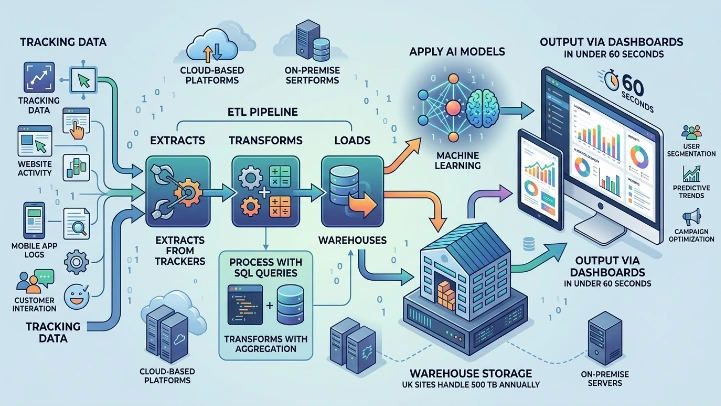
ETL extracts from trackers, transforms with aggregation, loads into warehouses. UK sites handle 500 TB annually. Options include cloud-based platforms and on-premise servers.
Integration Processes
APIs connect trackers to warehouses. Real-time streaming uses Kafka for event data. Batch processing runs nightly on 80% of sites.
Segmentation engines apply rules like RFM: recency, frequency, monetary value.
What key tools provide advanced audience insights?
Key tools include analytics suites, CDP platforms, and BI software. Suites handle 70% of UK news analytics workloads.
Google Analytics 4 processes events with BigQuery integration. Adobe Experience Platform unifies data across channels. Mixpanel focuses on user journeys.
Customer Data Platforms
CDPs like Tealium aggregate identities. They match 85% of anonymous users to profiles. Segment.io routes data to 200+ destinations.
Treasure Data manages petabyte-scale data lakes.
Business Intelligence Tools
Tableau visualizes cohorts with drag-and-drop. Looker models data in Git repositories. UK sites deploy 15 BI dashboards per team.
What techniques extract advanced insights from data?
Techniques use clustering, anomaly detection, and natural language processing. Clustering groups 1 million users into 100 segments in 10 minutes.
K-means clustering partitions by behavior vectors. Anomaly detection flags 5% unusual sessions.
Machine Learning Techniques
Random forests predict churn with 88% precision. NLP analyses search queries for intent. Time-series forecasting projects traffic peaks using ARIMA models.
Advanced Segmentation Methods
Lookalike modeling finds similar users via cosine similarity. Propensity scoring ranks conversion likelihood. Journey analysis maps paths with Sankey diagrams.
How do comparisons between tools guide selection?
Comparisons evaluate scale, cost, and integration. Cloud tools scale to 1 billion events; on-premise cap at 100 million. Google Analytics 4 costs £0 for basics, scales to £50,000 yearly. Adobe starts at £100,000 annually for enterprises.
Feature and Performance Comparisons
CDPs excel in identity resolution; analytics suites lead in real-time. Mixpanel offers funnel analysis absent in GA4 free tier.
Privacy compliance differs: Matomo avoids data export; others anonymise via hashing. UK sites choose based on 20% cost vs. 30% insight depth trade-off.
What processes implement these tools and techniques?
Processes deploy via tag managers, configure pipelines, and train models. Deployment takes 2 weeks for 80% of implementations.
Tag managers load scripts. Pipelines use Airflow for orchestration.
Step-by-Step Implementation
Week 1: Audit data sources. Week 2: Install tags on 100% pages.
Train models on 6 months data. Validate with A/B tests lifting metrics 15%. Monitor with alerts on 2% data drift.
What benefits deliver advanced audience insights?
Benefits raise retention 25%, revenue 35%, and content ROI 40%. Sites achieve 2x personalisation impact. Retention grows via targeted newsletters. Revenue from premium ad tiers.
Quantified Operational Benefits
Content velocity increases 30% with insight-driven calendars. Acquisition costs drop 20% targeting lookalikes. Forecast accuracy hits 92% for traffic planning.
What use cases demonstrate tools and techniques?
Use cases include hyper-personalisation, fraud detection, and revenue forecasting. UK sites apply to 400 million sessions yearly. Hyper-personalisation boosts opens 28%. Fraud detection blocks 15% fake traffic.
Explore More Expert Insights:
How to Analyse Reader Behavior for Better Content Strategy
Seven Ways Audience Data Helps News Platforms Grow
Personalisation Use Cases

Dynamic feeds match 70% of past behaviors. Evening editions tailor politics vs. sports.
Optimization Use Cases
Fraud tools flag VPN clusters. Forecasting allocates server capacity for 20% spikes.
Revenue models price ads by audience value, up 18%.
Explore data-driven traffic strategies in:
Get Data-Driven Audience Insights That Skyrocket News Website Traffic.
Advanced tools and techniques unlock precise audience insights. Integration processes ensure scalability. Comparisons aid informed choices. Benefits transform operations. Use cases validate real impact.