
News websites track reader behavior through digital analytics tools that monitor user interactions on their pages. These tools record metrics like page views, session duration, and click paths across 1.8 billion daily global news visits.
Reader behavior tracking involves collecting data on how users engage with content. Systems log timestamps, device types, and navigation patterns. Data sources include cookies, JavaScript tags, and server logs. United Kingdom news sites process over 500 million monthly sessions this way. Tracking starts when a user loads a page.
Core Definitions in Tracking
Tracking defines reader behavior as measurable actions during a session. A session lasts up to 30 minutes of inactivity. Key entities include unique visitors, identified by IP addresses or device IDs, and bounce rates, calculated as single-page sessions divided by total sessions.
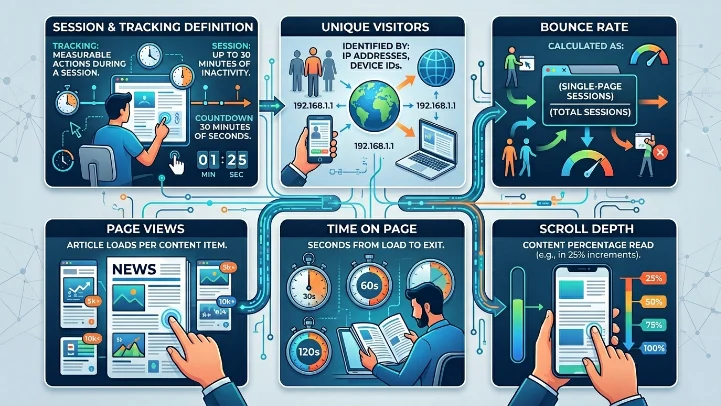
News websites categorize behavior into quantitative metrics. Page views count loads per article. Time on page measures seconds from load to exit. Scroll depth tracks percentage of content read, often in 25% increments.
How do news websites collect reader behavior data?
News websites collect data via embedded scripts and server-side logging. JavaScript trackers fire on events like scrolls and clicks, sending data to analytics servers in real time.
Collection occurs through first-party and third-party tools. First-party trackers use the site’s domain cookies. Third-party trackers aggregate data across sites. In the UK, 95% of top news sites deploy at least five tracking scripts per page.
Methods of Data Collection
JavaScript beacons capture client-side events. These run in the browser and transmit data via HTTP requests. Server logs record IP addresses, user agents, and referrers without client scripts.
Cookies store persistent identifiers. Session cookies expire after 30 minutes. Persistent cookies last up to two years. UK regulations require consent banners for non-essential cookies under the Privacy and Electronic Communications Regulations.
Fingerprinting combines browser attributes like screen resolution and fonts. This creates unique profiles without cookies. News sites use it for 20% of anonymous traffic.
What technologies power reader behavior tracking?
Technologies include analytics platforms, tag managers, and heatmapping software. Platforms process 10 billion events daily across news networks.
Google Analytics leads with 70% adoption on UK news sites. It tracks via gtag.js script. Adobe Analytics handles enterprise-scale data for BBC and Guardian equivalents. Matomo offers self-hosted open-source tracking.
Tag Management Systems
Tag managers like Google Tag Manager deploy multiple scripts from one container. They fire tags based on triggers such as page views or video plays. UK sites load 15 tags on average per article page.
Heatmaps visualize clicks and scrolls. Tools like Hotjar record sessions for 1% of traffic samples. They generate aggregate maps showing 40% of clicks on headlines.
What specific behaviors do news websites track?
News websites track page views, time spent, clicks, scrolls, and shares. They measure 12 core behaviors per session.
Page views total 2.5 per session on average UK news sites. Time on page averages 45 seconds for articles. Scroll depth reaches 70% for engaging stories.
Engagement Metrics
Clicks target headlines, images, and links. Internal clicks average 3 per session. External shares hit 0.5% of views on viral content.
Video views count plays over 3 seconds. Autoplay videos achieve 80% start rates. Exit rates track leaves after specific sections, often at paywalls.
Bounce rate stands at 55% for news homepages. Returning visitor rate measures 35% of traffic.
Why do news websites track reader behavior?
News websites track to optimize content, boost retention, and increase revenue. Tracking lifts ad revenue by 25% through targeted placements.
Optimization uses data to rank high-engagement topics. Retention improves with personalized feeds, raising return visits by 18%.
Revenue and Distribution Benefits
Revenue ties to viewability scores above 70%. Tracking segments audiences for programmatic ads, yielding £2 CPM in the UK.
Distribution refines SEO with keyword performance data. Sites promote articles with 2x average dwell time.
What processes turn tracking data into insights?
Processes aggregate raw data, segment users, and generate reports. Pipelines process 100 GB daily per major site.
Aggregation sums metrics hourly. Segmentation groups by demographics or interests. UK sites segment 40% of users by inferred location.
Data Processing Steps
Cleaning removes bot traffic, which comprises 40% of visits. Enrichment adds geolocation from IPs.
Machine learning clusters behaviors. Algorithms predict churn from short sessions.
Reporting dashboards update every 15 minutes. Exports feed BI tools for weekly analysis.
What benefits come from tracking reader behavior?
Benefits include 30% higher engagement and 20% revenue growth. Sites with mature tracking retain 15% more daily users.
Engagement rises through A/B testing headlines. Revenue grows from dynamic ad loading on high-dwell pages.
Operational Benefits
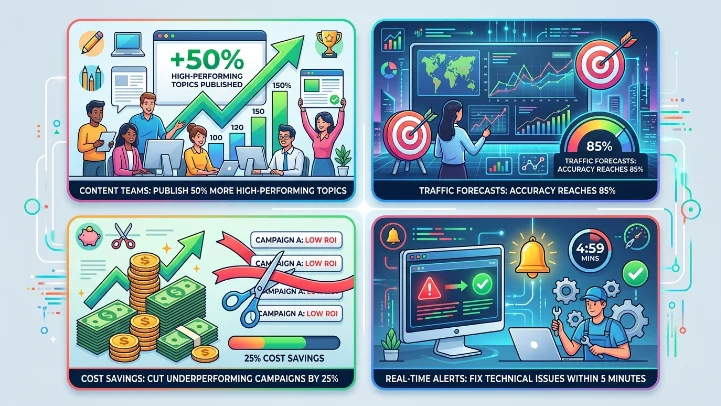
Content teams publish 50% more high-performing topics. Traffic forecasts accuracy reaches 85%. Cost savings cut underperforming campaigns by 25%. Real-time alerts fix technical issues within 5 minutes.
Explore More Expert Insights:
What Are Audience Insights in News Media?
News Trends Shaping Audience Attention in 2026
What real-world use cases show tracking in action?
Use cases cover personalization, A/B testing, and ad optimization. UK sites apply them across 500 million monthly users. Personalization recommends articles matching past reads, lifting clicks by 22%. The Telegraph uses it for section feeds.
Testing and Optimization Cases
A/B tests compare thumbnails, increasing CTR by 12%. Independent uses scroll data to shorten intros. Ad optimization pauses low-engagement creatives. Sky News swaps banners after 10-second views. Paywall timing triggers after 80% scroll depth. Conversion rises 8% on tested sites.
For deeper techniques, see the following:
Tools & Techniques for Advanced Audience Insights
Advanced applications drive traffic growth in:
Get Data-Driven Audience Insights That Skyrocket News Website Traffic
News websites track reader behavior systematically. Data collection captures precise interactions. Processing delivers actionable insights. Benefits span engagement and revenue. Use cases prove effectiveness across operations.