
Audience data is the recorded information about readers, viewers, and subscribers. It includes page views, scroll depth, session duration, referral source, device type, location, and subscription behavior. News platforms use it to understand what audiences read, when they read, and how they return.
Audience data is the foundation of modern news publishing. It turns traffic into measurable behavior. It shows which stories attract first-time readers, which topics keep loyal readers active, and which formats support subscription growth.
For news platforms in the United Kingdom, audience data also reveals regional reading patterns, weekday traffic shifts, and device preferences across mobile, desktop, and app channels. A national outlet, for example, can compare engagement on politics coverage in London with sports coverage in Manchester and local news interest in Birmingham.
This data comes from analytics tools, paywall systems, email platforms, app dashboards, and CRM records. Each source adds a different layer of reader behavior.
What counts as audience data?
Audience data includes:
- Traffic volume, such as unique visitors and page views.
- Engagement metrics, such as average time on page and scroll depth.
- Acquisition data, such as search, social, direct, newsletter, and referral traffic.
- Subscription data, such as sign-ups, trials, churn, and renewal rates.
- Device and technical data, such as mobile operating system, browser, and app usage.
- Geographic data, such as country, city, and region.
Which editorial signals matter most?
The most useful editorial signals include:
- Click-through rate from homepage, newsletters, and search.
- Average engaged time, not only raw page views.
- Scroll depth on long-form articles.
- Return visits to the same topic.
- Shares and saves on social and app channels.
These signals reveal whether a story creates short attention or sustained interest.
What strategic choices come from the data?
Audience data informs:
- Topic prioritisation.
- Format selection.
- Publishing schedules.
- Newsletter planning.
- Homepage curation.
- Evergreen content updates.
These choices increase consistency across editorial, audience, and commercial teams.
How does audience data improve audience acquisition?
Audience data improves acquisition by showing where new readers come from and which channels bring the highest-quality traffic. It helps news platforms focus on search, social, newsletters, referrals, and direct visits that convert into repeat users.
Acquisition data explains which channels generate sustainable growth. Search traffic often brings high intent on specific topics. Social traffic often brings spikes on breaking stories. Newsletter traffic often produces stronger repeat visits. Direct traffic often reflects brand loyalty.
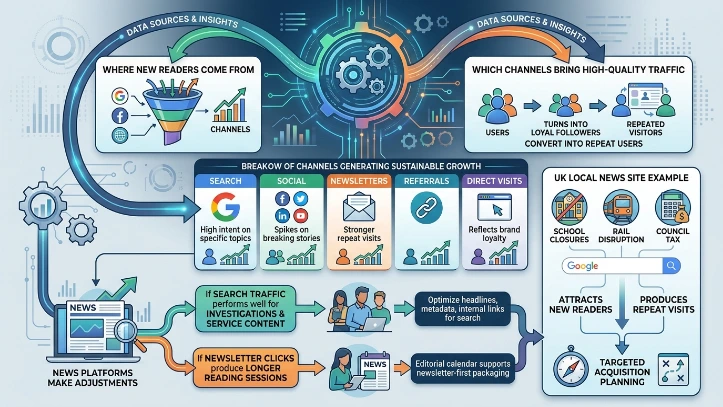
News platforms use this information to adjust distribution. If search traffic performs well for investigations and service content, the platform can optimise headlines, metadata, and internal links for search. If newsletter clicks produce longer reading sessions, the editorial calendar can support more newsletter-first packaging.
A UK example: a local news site tracks traffic from Google search on school closures, rail disruption, and council tax. It learns that these topics attract new readers and produce repeat visits during seasonal peaks. That insight supports more targeted acquisition planning.
Which acquisition sources matter most?
Common acquisition sources include:
- Organic search.
- Social media.
- Email newsletters.
- Direct traffic.
- Referral links from partners.
- App notifications.
Each source has a different value profile. Audience data shows that value clearly.
How does audience data help retention and loyalty?
Audience data helps retention by identifying the habits of returning readers. It shows which topics, formats, and channels bring people back, so platforms can strengthen loyalty through repeated relevance and better timing.
Retention is central to news growth. A platform grows faster when readers return without constant paid acquisition. Audience data shows which readers become habitual visitors and which content sequences increase repeat sessions.
Teams track returning user frequency, newsletter reopens, subscription login behavior, and topic recurrence. They also measure whether a reader returns after one article, three articles, or a full session. These patterns show loyalty strength.
A strong retention pattern often appears in recurring categories. Examples include politics during election cycles, football coverage during match weeks, and consumer advice during inflation periods. UK readers also show strong repeat behavior around weather disruptions, transport updates, and major national events.
What retention signals matter?
Important retention signals include:
- Returning visitor rate.
- Weekly active users.
- Newsletter repeat click patterns.
- App open frequency.
- Subscription renewal behavior.
- Topic-based repeat sessions.
These signals help news teams reduce churn and increase repeat engagement.
How does audience data influence subscriptions and revenue?
Audience data influences subscriptions and revenue by showing which readers have the highest conversion intent and which content drives paywall value. It helps platforms price attention, protect premium journalism, and improve revenue from ads and subscriptions.
Commercial teams use audience data to identify monetizable behavior. Readers who consume several articles on the same topic often show stronger conversion intent. Readers who return through newsletters or direct visits often indicate higher loyalty. Readers who access premium investigations, exclusive analysis, or local service updates often support paid conversion.
Audience data also improves advertising strategy. Platforms use audience segments to package inventory by topic, location, and device. A finance audience, a sports audience, and a parenting audience all carry different commercial value.
A news platform in the United Kingdom can use this data to define subscription triggers. For example, repeated reading of political analysis, market coverage, or investigative reporting often signals readiness for a trial or paid access model. Audience data helps the platform place the paywall where value is highest.
Which revenue decisions depend on audience data?
Audience data supports:
- Paywall meter design.
- Subscription offer timing.
- Renewal messaging.
- Ad targeting.
- Premium content selection.
- Bundle planning across web, app, and email.
These decisions connect reader behavior with revenue outcomes.
How do news platforms segment audiences with data?
News platforms segment audiences by grouping readers with similar behavior, interests, geography, or device patterns. Segmentation makes content, distribution, and monetisation more precise because each audience group receives the right story at the right time.
Segmentation is one of the most practical uses of audience data. It separates broad traffic into clear reader groups. Each group behaves differently. A commuter audience reads early in the morning. A sports audience peaks in the evening. A policy audience reads longer and returns more often.
Segments can be built from simple rules. A platform can group users by frequent topic visits, email engagement, app usage, or region. It can also compare new visitors with loyal readers or casual browsers with subscribers.
Learn about:
Hire Audience Insights Experts to Scale Your News Platform Faster.
For example, a national UK publisher can segment readers into:
- London political readers.
- Football readers in the North West.
- Business readers who return via newsletters.
- Local news readers on mobile devices.
These groups help teams build more relevant experiences.
What are the main segmentation types?
The main types are:
- Demographic segmentation, such as age or household profile where collected.
- Geographic segmentation, such as city, region, or country.
- Behavioral segmentation, such as visit frequency and topic interest.
- Channel segmentation, such as search, email, app, or direct.
Each type improves the precision of editorial and commercial decisions.
Explore More Expert Insights:
How Audience Insights Improve News Content Performance
How Engagement Metrics Improve Media Placement
How does audience data create a growth loop?
Audience data creates a growth loop by linking audience behavior, content performance, distribution, and revenue into one system. Better data leads to better content choices, which produce stronger engagement, which creates more data for further improvement.
This is the core growth mechanism for news platforms. Data does not replace editorial judgment. It improves it through feedback. The newsroom publishes content, the audience reacts, the platform measures that reaction, and the next round of decisions becomes more accurate.
A typical growth loop works in this order:
- A story is published.
- Audience data records traffic and engagement.
- The team identifies the strongest-performing topics and formats.
- Editors refine the next stories, headlines, and timing.
- Distribution teams push the best content through the best channels.
- Commercial teams use the same signals to support subscriptions and ad revenue.
That loop strengthens both editorial quality and business performance.
Why does this matter for UK news platforms?
UK news platforms face high competition, fragmented attention, and fast-changing topical demand. Audience data gives them a way to compete with precision. It highlights local relevance, national interest, and recurring audience needs across the United Kingdom.
Platforms that use audience data well build clearer editorial priorities, cleaner audience segments, and stronger monetisation pathways. That combination supports sustainable growth without guesswork.
If you want to go deeper into the methods behind this, see:
News Trends Shaping Audience Attention in 2026
for a related explanation of audience insight use in news growth.