
Property development projects depend on milestones. Each milestone creates a fresh opportunity for media coverage, stakeholder engagement, and public awareness. A press release gains stronger relevance when its publication aligns with significant planning events such as zoning approvals, construction phases, infrastructure completion, and public openings. Strategic timing improves message relevance and increases the likelihood of media interest.
Why does timing matter when announcing property development milestones?
Synchronising a press release with confirmed planning and development milestones improves news relevance, strengthens stakeholder confidence, increases journalist interest, supports search visibility, and creates consistent communication throughout the property development lifecycle without relying on repeated promotional announcements alone.
Timing is the deliberate selection of a publication date that matches a verified business event. In property development, this event often relates to planning, construction, investment, or occupancy.
Journalists prioritise news with immediate public value. A planning approval announced three months after approval loses relevance. Likewise, announcing a completed construction phase before completion creates credibility risks.
Every milestone provides a clear reason for communication.
Examples include:
- Local authority zoning approval
- Planning permission confirmation
- Groundbreaking ceremony
- Completion of Phase One
- Infrastructure installation
- Commercial tenant signing
- Residential launch
- Public opening
Each milestone supports a different audience.
Investors focus on project progress.
Local communities focus on planning impacts.
Commercial buyers focus on availability.
Media outlets focus on newsworthiness.
A structured communication calendar connects every milestone with a suitable announcement.
What are the key zoning and development milestones worth announcing?
Property developments contain multiple verified milestones suitable for media communication. Planning approvals, zoning changes, construction phases, occupancy milestones, infrastructure delivery, executive appointments, and community initiatives each provide distinct opportunities for accurate and timely press releases across different stakeholder groups.
Not every construction update deserves media attention.
Announcements require measurable progress.
Zoning approval
Zoning approval confirms permitted land use.
Examples include:
- Residential expansion
- Mixed-use development
- Commercial redevelopment
These approvals often attract regional business publications and local government reporting.
Planning permission
Planning permission confirms approval for a specific development proposal.
The announcement normally includes:
- Project scale
- Number of residential units
- Commercial floor space
- Environmental commitments
- Expected construction timetable
Construction phase completion
Large developments often progress through multiple stages.
Examples include:
- Site preparation complete
- Foundations complete
- Structural framework complete
- Roofing complete
- Internal fit-out complete
Each completed stage demonstrates measurable progress.
Infrastructure completion
Infrastructure milestones include:
- Road construction
- Utility connections
- Public transport links
- Drainage systems
- Public green spaces
Infrastructure updates often interest local communities and regional media.
Public opening
Completed developments generate strong media interest.
Examples include:
- Retail centre opening
- Residential handover
- Business park launch
- Community facility opening
Each announcement represents a completed outcome rather than future intention.
How do you build a press release schedule around development phases?
An effective announcement schedule aligns every verified project milestone with clear communication objectives, defined audiences, supporting evidence, internal approvals, media distribution planning, and publication dates that match the project’s operational timetable rather than arbitrary marketing calendars.
Press release planning begins before construction starts.
Communication becomes part of project management.
Create a milestone calendar
List every major project milestone.
Include:
- Approval date
- Expected completion
- Responsible department
- Supporting documents
- Photography schedule
- Media deadline
The calendar provides visibility across the project lifecycle.
Match each milestone with its audience
Different milestones attract different readers.
Examples include:
| Milestone | Primary Audience |
|---|---|
| Zoning approval | Local media |
| Planning permission | Industry publications |
| Construction milestone | Investors |
| Retail tenant announcement | Commercial property media |
| Residential launch | Homebuyers |
| Public opening | Regional press |
Audience selection improves distribution accuracy.
Prepare content early
Draft press releases before milestone completion.
Update only the confirmed information after verification.
This process reduces publication delays.
Coordinate internal approvals
Legal teams confirm compliance.
Planning teams verify facts.
Project managers confirm dates.
Executive spokespeople approve quotations.
Early coordination reduces bottlenecks.
How does synchronising announcements improve media relevance?
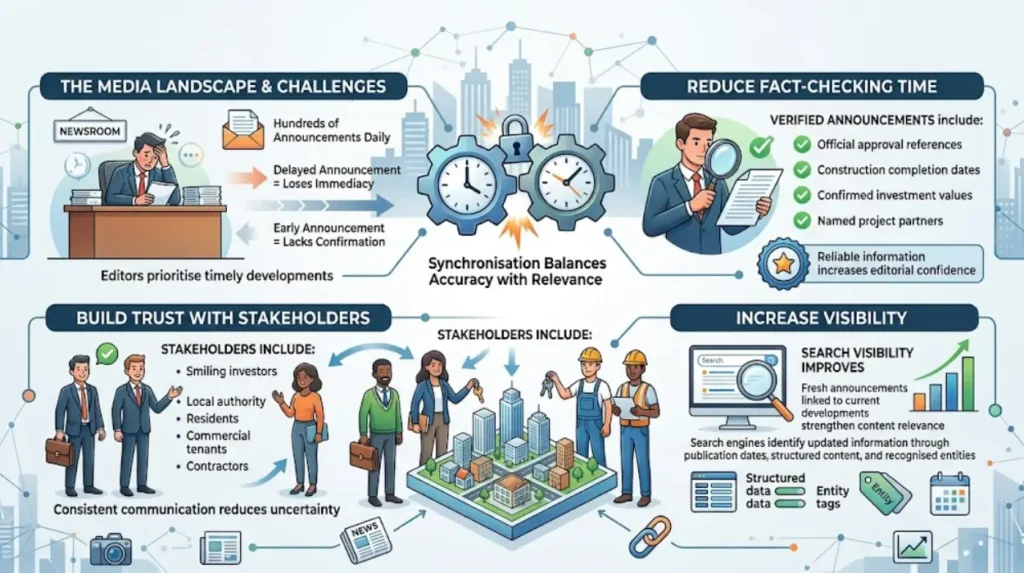
Media organisations prioritise announcements connected to current events, verified progress, and measurable public interest. Synchronised publication improves editorial relevance, supports factual reporting, increases publication opportunities, and strengthens the overall credibility of property development communications across multiple channels.
Newsrooms receive hundreds of announcements every day.
Editors prioritise timely developments.
A delayed announcement loses immediacy.
An early announcement lacks confirmation.
Synchronisation balances accuracy with relevance.
Journalists value confirmed information
Confirmed milestones reduce fact-checking time.
Verified announcements include:
- Official approval references
- Construction completion dates
- Confirmed investment values
- Named project partners
Reliable information increases editorial confidence.
Stakeholders receive consistent updates
Stakeholders include:
- Investors
- Local authorities
- Residents
- Commercial tenants
- Contractors
Consistent communication reduces uncertainty.
Search visibility improves
Fresh announcements linked to current developments strengthen content relevance.
Search engines identify updated information through publication dates, structured content, and recognised entities.
For broader planning strategies, see:
What information belongs in a milestone-based property press release?
Every milestone announcement requires verified project facts, measurable progress, stakeholder quotations, location details, development statistics, timelines, planning references where appropriate, and supporting context that explains the significance of the completed milestone without unnecessary promotional language.
A factual structure improves clarity.
Every announcement answers essential questions.
Project identification
Include:
- Development name
- Project location
- Developer name
- Development type
Readers immediately understand the project.
Milestone description
State exactly what has occurred.
Examples include:
- Planning permission granted
- Phase One completed
- Infrastructure operational
- Public opening confirmed
Avoid future promises.
Supporting statistics
Quantifiable information strengthens credibility.
Examples include:
- 420 residential units
- 35,000 square metres
- £85 million investment
- 24-month construction programme
Specific figures improve reporting accuracy.
Verified quotations
Executive quotations explain significance.
Project manager quotations explain progress.
Planning authority quotations explain approvals when publicly available.
Supporting assets
Useful supporting materials include:
- Site photography
- Project renderings
- Maps
- Construction images
- Executive headshots
Visual assets assist media coverage.
How do different development phases require different communication approaches?
Each development phase addresses distinct stakeholder priorities. Planning announcements emphasise regulatory progress, construction updates demonstrate delivery, commercial milestones highlight market activity, and completed developments focus on operational outcomes and community impact through accurate factual communication.
Communication evolves with the project.
Early announcements explain approval.
Later announcements demonstrate delivery.
Pre-construction
Focus areas include:
- Planning approval
- Environmental assessments
- Community consultation
- Investment confirmation
Construction
Focus areas include:
- Progress updates
- Safety achievements
- Infrastructure completion
- Sustainability initiatives
Commercial activation
Focus areas include:
- Anchor tenant agreements
- Office occupancy
- Retail leasing
- Business investment
Completion
Focus areas include:
- Occupancy
- Public opening
- Community facilities
- Economic contribution
Each phase serves different information needs.
What common timing mistakes reduce press release effectiveness?
Delayed publication, announcing unverified milestones, inconsistent project updates, missing supporting evidence, overlapping announcements, and poor coordination between project teams reduce announcement relevance, confuse stakeholders, and weaken long-term media relationships throughout the development lifecycle.
Several common mistakes reduce media value.
The first mistake is announcing before confirmation.
Planning applications differ from planning approvals.
Construction commencement differs from construction completion.
The second mistake is combining unrelated announcements.
Examples include announcing executive appointments alongside planning approvals.
Separate announcements create clearer narratives.
The third mistake is inconsistent timing.
Publishing five announcements within one week followed by six months of silence creates communication gaps.
The fourth mistake is missing documentation.
Editors expect supporting evidence.
This includes planning references, verified statistics, and approved photography.
The fifth mistake is ignoring local relevance.
Regional developments deserve regional communication alongside national industry coverage.
Explore More Expert Insights:
How to Build a Comprehensive Digital Press Kit That Captures the Attention of Property Journalists
Step-by-Step Blueprint: Turning Proprietary Real Estate Market Reports into Major Media Assets
How can organisations create a long-term announcement strategy?
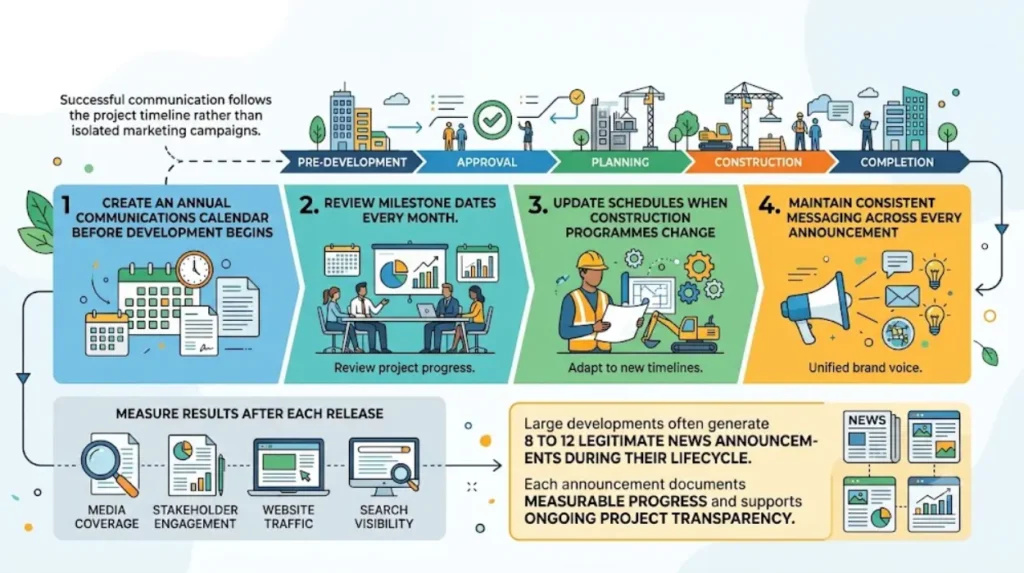
Long-term announcement planning connects every project milestone with defined communication objectives, publication schedules, stakeholder priorities, and appropriate distribution methods to maintain continuous visibility throughout the complete property development process from approval to completion.
Successful communication follows the project timeline rather than isolated marketing campaigns.
Create an annual communications calendar before development begins.
Review milestone dates every month.
Update schedules when construction programmes change.
Maintain consistent messaging across every announcement.
Measure results using media coverage, stakeholder engagement, website traffic, and search visibility after each release.
Large developments often generate between eight and twelve legitimate news announcements during their lifecycle. Each announcement documents measurable progress and supports ongoing project transparency.
As organisations evaluate publication timing alongside media distribution options,
Property wire provides the next stage of decision-making for selecting suitable distribution channels.
Strategic timing transforms individual press releases into a structured communication programme. Every announcement reflects a verified milestone, delivers relevant information to defined audiences, and supports consistent visibility throughout the development lifecycle. Organisations that align announcements with zoning approvals, construction phases, infrastructure completion, and public openings produce communications that remain accurate, timely, and valuable for journalists, investors, communities, and commercial stakeholders.