
Institutional funding plays a central role in the growth of real estate startups across the United Kingdom. Pension funds, insurance companies, investment trusts, private equity firms, and property investment funds allocate capital based on structured due diligence. Financial performance remains important, but investors also evaluate market credibility, leadership visibility, governance, and public reputation. A strategic media presence strengthens these areas by establishing a consistent and verifiable public record.
Why does a strategic media presence matter for institutional funding?
A strategic media presence provides verified public information that strengthens investor confidence. Institutional investors review leadership credibility, project visibility, market positioning, governance standards, and external recognition before allocating capital. Consistent media coverage creates documented evidence supporting due diligence and reducing perceived investment uncertainty during funding assessments.
Institutional funding refers to investment provided by professional organisations managing large pools of capital. Examples include pension funds, property investment funds, sovereign wealth funds, and private equity firms.
Strategic media presence refers to planned communication across recognised news publications, industry journals, regional media, and professional platforms. It differs from occasional publicity because it follows defined business milestones.
Institutional investors collect information from multiple independent sources. These include:
- Company announcements
- National business publications
- Property trade journals
- Local planning news
- Executive interviews
- Industry conference coverage
Each source contributes to a broader assessment of organisational credibility.
What do institutional investors verify?
Professional investors examine several measurable factors before investing.
These include:
- Leadership experience
- Development pipeline
- Financial transparency
- Regulatory compliance
- Planning progress
- Market reputation
- Public communication consistency
A documented media record supports verification across these categories.
Why do many new real estate startups receive limited investor attention?
Many real estate startups remain invisible because they publish little verified information. Investors struggle to confirm project progress, leadership capability, planning activity, and commercial achievements when independent media coverage, public reporting, and structured announcements remain limited throughout the business lifecycle and growth.
New businesses often rely exclusively on investor presentations. These documents represent internal communication rather than independent verification.
Institutional investors compare information across external sources before making investment decisions.
Without sufficient public information, businesses become harder to evaluate.
Why does limited visibility create investment barriers?
Real estate developments involve significant capital commitments.
Examples include:
- Residential developments
- Build-to-rent schemes
- Mixed-use regeneration projects
- Logistics parks
- Student accommodation developments
Large investments require extensive due diligence.
Limited visibility increases verification costs for investors because analysts spend additional time confirming company claims.
What information do institutional investors expect to find?

Institutional investors expect structured public evidence covering leadership, planning approvals, partnerships, financial milestones, sustainability initiatives, governance, and project delivery. Independent reporting across recognised publications strengthens transparency and supports detailed commercial due diligence before investment decisions are made successfully.
Investors rarely rely on a single announcement.
They review multiple categories of information.
Leadership credibility
Executive biographies demonstrate industry experience.
Relevant information includes:
- Previous developments
- Professional qualifications
- Board appointments
- Industry recognition
Project milestones
Project milestones create measurable evidence of business progress.
Examples include:
- Land acquisitions
- Planning submissions
- Planning approvals
- Construction commencements
- Development completions
Commercial partnerships
Strategic partnerships demonstrate operational capability.
Examples include:
- Contractors
- Architects
- Engineering consultancies
- Housing associations
- Local authorities
Governance
Governance refers to the systems used to direct and manage a business.
Institutional investors examine governance because it affects operational stability and regulatory compliance.
How does media coverage improve credibility?
Independent media coverage strengthens credibility because recognised publications verify newsworthiness before publication. Consistent reporting establishes an accessible public record that investors reference during commercial due diligence, reducing uncertainty and improving confidence in organisational transparency and operational progress over time.
Credibility develops through repeated verification.
Each published announcement contributes additional evidence.
Examples include:
- Planning permission secured
- Sustainability certifications achieved
- Senior executive appointments
- Joint venture announcements
- Project financing milestones
Together these reports establish a documented corporate history.
Why is independent reporting valuable?
Independent publications operate outside the company.
Their editorial review adds external validation.
Investors value independently published information because it supplements company-produced documents.
What role does leadership visibility play in funding decisions?
Leadership visibility demonstrates executive expertise, accountability, and industry engagement. Institutional investors assess public interviews, conference participation, published commentary, and executive announcements to understand strategic direction, governance quality, and organisational stability before approving substantial property investments across competitive markets.
Leadership represents organisational capability.
Visible executives communicate business strategy more effectively.
Examples include:
- Speaking at property conferences
- Participating in planning discussions
- Publishing industry commentary
- Announcing development milestones
These activities create an accessible record of executive engagement.
Why do investors evaluate executive communication?
Institutional investors invest in management teams as well as projects.
Experienced leadership improves investor confidence because operational decisions directly influence project performance.
How does consistent communication support investor confidence?
Consistent communication creates reliable business records across multiple development stages. Institutional investors compare announcements over time to confirm operational progress, financial discipline, planning achievements, and strategic consistency before committing significant long-term capital into property developments and regeneration projects.
Property development follows predictable phases.
Typical stages include:
- Land acquisition
- Planning application
- Planning approval
- Construction commencement
- Phase completion
- Occupancy
- Asset management
Each milestone provides relevant information for investors.
Publishing updates throughout these stages creates a chronological record of business progress.
Readers interested in planning announcement schedules can explore:
Why does public transparency reduce investment risk?
Public transparency improves investment assessment by providing accessible evidence of company activity. Institutional investors compare disclosed milestones, governance updates, planning developments, and commercial partnerships against financial information to evaluate operational consistency and identify potential investment risks objectively before funding commitments.
Transparency refers to making important business information publicly available.
Transparent organisations disclose significant developments regularly.
Examples include:
- Annual reports
- Planning updates
- Sustainability reports
- Executive appointments
- Project announcements
Accessible information simplifies investor verification.
How does transparency influence due diligence?
Due diligence involves reviewing commercial, legal, operational, and financial information before investing.
Publicly available information accelerates verification by providing documented evidence.
Which common communication mistakes weaken investor confidence?
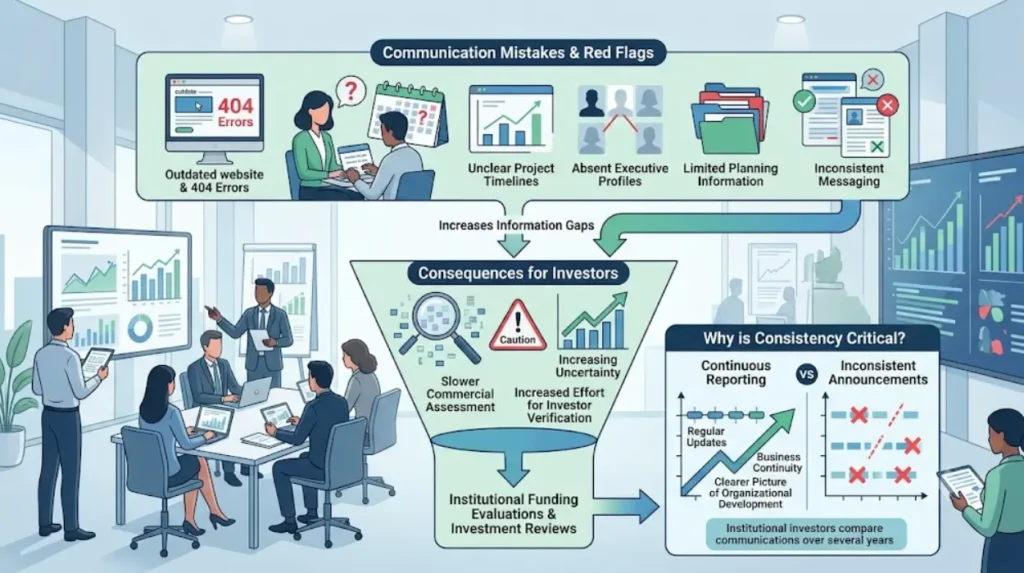
Several communication mistakes reduce organisational credibility. Irregular announcements, inconsistent messaging, incomplete project updates, absent executive profiles, and limited public documentation restrict investor understanding, making commercial assessment slower and increasing uncertainty throughout institutional funding evaluations and investment reviews significantly.
Several recurring issues appear among early-stage property businesses.
Examples include:
- Infrequent public updates
- Outdated websites
- Missing executive information
- Unclear project timelines
- Limited planning information
- Inconsistent messaging across channels
Each issue creates information gaps.
Information gaps increase the effort required for investor verification.
Why do inconsistent announcements create problems?
Institutional investors compare communications over several years.
Incomplete records interrupt business continuity.
Continuous reporting provides a clearer picture of organisational development.
Explore More Expert Insights:
The Direct Impact of Media Authority on Building Local Community Trust for Controversial Projects
How High-Authority Business Backlinks Resurrect Online Visibility for Struggling Construction Brands
How does strategic communication support long-term business growth?
Strategic communication documents measurable organisational progress over time. Consistent reporting across planning, construction, sustainability, governance, partnerships, and financial milestones builds an accessible corporate history that supports future funding rounds, stakeholder engagement, and commercial expansion through transparent public information.
Media presence extends beyond fundraising.
Documented communication also supports relationships with:
- Local authorities
- Planning stakeholders
- Commercial partners
- Professional advisers
- Industry analysts
Consistent public information benefits multiple stakeholder groups simultaneously.
As businesses expand, documented communication creates historical evidence supporting future investment discussions.
Readers seeking guidance on evaluating distribution channels for executive announcements can explore:
Institutional funding depends on comprehensive due diligence supported by reliable public information. Real estate startups that lack a strategic media presence often present limited evidence of leadership capability, governance, operational progress, and commercial achievements. Investors require independently verifiable information alongside financial documentation to assess investment opportunities accurately.
A structured media presence strengthens transparency by documenting planning milestones, executive leadership, partnerships, sustainability initiatives, and project delivery over time. Consistent public communication creates an accessible corporate record that supports investor verification, improves organisational credibility, and facilitates more efficient funding assessments throughout the growth of a real estate business.