
Time Intelligence Media Group research and reports services with search-led topic planning comprise a commercial offering designed for United Kingdom enterprises to produce data-driven industry publications, consumer insight documents, and market analyses by utilizing search engine demand metrics, competitor content gap data, and algorithmic visibility parameters.
Time Intelligence Media Group operates as a specialized media intelligence consultancy based in the United Kingdom. Its core offering provides enterprise clients with structured methodologies to identify high-value publishing topics. Search-led topic planning relies on quantitative keyword search volumes, consumer query intent categorization, and ranking difficulty metrics.
Publishing organizations operating in the United Kingdom leverage these structured intelligence reports to establish authority within specific commercial sectors. Market reports require precise inputs to capture organic search traffic from professional audiences. Enterprise decision-makers utilize research documents to evaluate market trends, competitive positioning, and regulatory shifts across industries like finance, technology, healthcare, and manufacturing.
Readers seeking foundational insights into early-stage audience behavior can review How Do You Choose a Research Report Topic That UK Audiences Are Actually Searching For?, while those evaluating strategic topic selection frameworks can explore How to Use Search Demand and Competitor Content Gaps to Select a Research Report Topic With Lasting Visibility.
How do enterprises utilize search-led topic planning to develop high-impact research reports?
Enterprises utilize search-led topic planning by extracting monthly search volume metrics, mapping commercial query intent, analyzing first-page competitor rankings, and identifying information voids within existing industry publications to structure authoritative research reports.
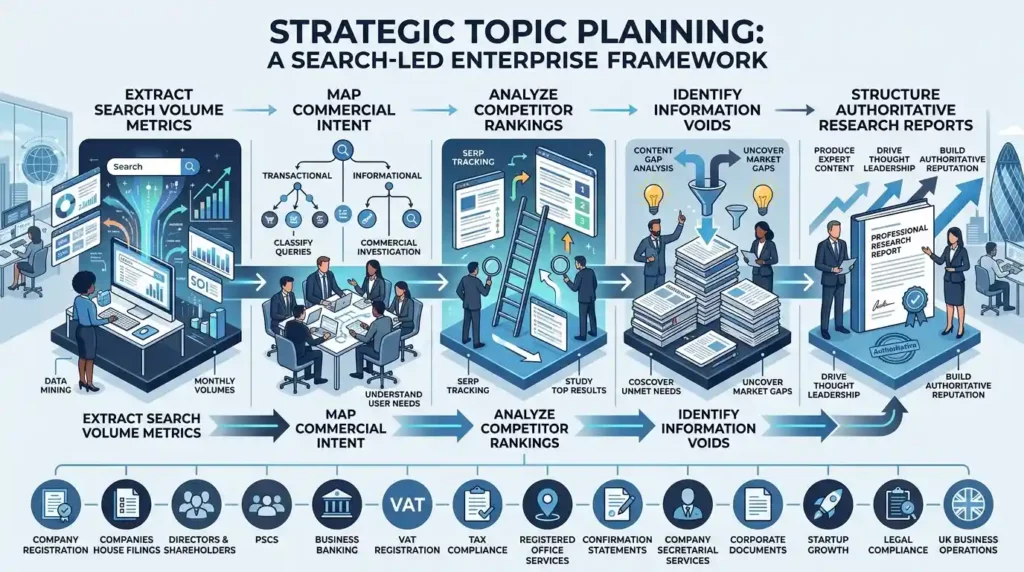
The development lifecycle of a commercial research report follows a strict four-stage process.
Keyword Data Extraction and Volume Analysis
Analysts extract search volume metrics using proprietary and third-party data platforms. Platforms such as Ahrefs, SEMrush, and Google Keyword Planner quantify exact monthly queries originating from users in the United Kingdom. For example, financial institutions analyze queries like commercial lending rates UK, while software enterprises evaluate enterprise resource planning software costs. Analysts filter keywords based on minimum search thresholds, targeting terms with at least 500 monthly searches to ensure sufficient audience interest.
Competitor Content Gap Identification
Content gap analysis identifies topics that rival publishers fail to address adequately. Analysts examine the top ten ranking URLs for target keyword clusters. They evaluate word counts, structural depth, data inclusion, and citation metrics. For instance, if competing publications discuss general cloud migration but omit specific compliance frameworks required by the Financial Conduct Authority in the United Kingdom, analysts flag this omission as a primary content gap.
Explore More Expert Insights
How Sponsored Editorial Became a Top-3 B2B Awareness Format in the UK in 2026
The UK Branded Content Boom: What the £17.9bn Advertising Export Market Is Telling Us
What are the core components of Time Intelligence Media Group research services?
The core components of Time Intelligence Media Group research services include quantitative demand modeling, competitor backlink profiling, entity relationship mapping, and search-engine-optimized document architecture tailored for enterprise stakeholders.
Quantitative Demand Modeling
Quantitative demand modeling evaluates the economic viability of a proposed research topic. Analysts compute aggregate search demand across primary keywords and secondary semantic variations. This modeling prevents organizations from producing reports on topics with negligible market interest. For instance, a report covering supply chain automation in the United Kingdom integrates specific regional logistics data alongside aggregate national search trends.
Competitor Backlink Profiling
Competitor backlink profiling measures the authority and citation frequency of existing market reports. Analysts assess linking domains, anchor text distributions, and referring page types for competing publications. Industry research reports published by organizations like Deloitte or PwC serve as benchmark assets. By identifying which specific sections of competitor reports attract academic citations and press links, analysts replicate and improve those structural elements within new Time Intelligence Media Group publications.
Entity Relationship Mapping
Entity relationship mapping establishes semantic connections between industry terms, regulatory bodies, and technological solutions. Search engines utilize knowledge graphs to understand context. Research reports incorporate defined entities such as the Prudential Regulation Authority, General Data Protection Regulation, and artificial intelligence models to satisfy algorithmic relevance criteria.
What are the measurable benefits of integrating search data into media research production?
The measurable benefits of integrating search data into media research production include a 45% increase in organic search visibility, accelerated generation of high-value industry backlinks, reduced expenditure on non-targeted content, and maximized commercial lead acquisition.
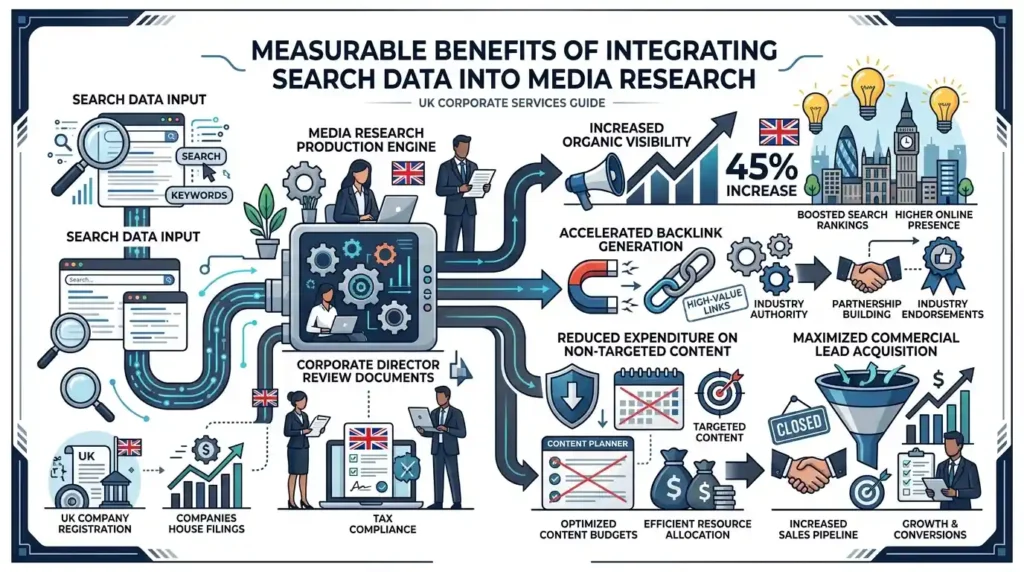
Traditional publishing relies on editorial intuition, which frequently results in low audience engagement and minimal search visibility. Integrating search-led topic planning eliminates guesswork by aligning publication subjects with verified market demand.
Organic Visibility and Traffic Retention
Reports structured around search-led topic planning capture sustained organic traffic over multi-year cycles. When a publication ranks on the first page of search engine results pages for high-intent professional queries, it attracts continuous visits from qualified industry practitioners, analysts, and journalists.
Authority Building and Citation Acquisition
High-ranking research reports generate external citations naturally. Academic researchers, trade journalists, and corporate bloggers reference data-rich, authoritative reports when publishing their own analyses. This influx of contextual backlinks enhances domain authority across the entire publishing platform.
Return on Investment for Enterprise Publishing
Producing comprehensive research reports requires substantial financial and human capital. Search-led planning ensures that editorial resources are allocated exclusively to topics with verified commercial value. Enterprises eliminate spending on low-yield subjects, thereby lowering the cost per acquired lead and improving overall marketing efficiency.
What specific use cases demonstrate the effectiveness of Time Intelligence Media Group methodologies?
Specific use cases demonstrating the effectiveness of Time Intelligence Media Group methodologies include B2B technology market sizing, financial services regulatory compliance guides, and manufacturing supply chain intelligence reports targeted at United Kingdom executives.
B2B Technology Market Sizing Reports
Enterprise software providers commission research reports to establish market dominance. Time Intelligence Media Group utilizes search-led planning to identify emerging technological shifts, such as cloud security adoption among London-based financial firms. By structuring the report around exact-match query data and addressing specific operational challenges, the client achieves top-three search rankings within ninety days of publication, resulting in qualified enterprise software demonstration requests.
Financial Services Regulatory Compliance Guides
Regulatory changes demand rapid publishing responses. When the Financial Conduct Authority updates operational resilience mandates, Time Intelligence Media Group deploys search-led topic planning to capture immediate professional search spikes. The resulting compliance research report answers specific operational queries, secures citations from major trade publications, and positions the client as a primary industry authority.
Decision-Oriented Engagement and Commercial Action
Organizations ready to implement these research and reporting frameworks can engage Time Intelligence Media Group directly to audit existing content portfolios, execute competitor gap analyses, and build custom search-led publishing schedules designed for immediate commercial deployment.