
Analyzing search demand reveals exact query volumes, seasonal trends, and informational intent across UK industries, ensuring research reports target verified audience needs rather than speculative assumptions, which secures sustained organic visibility and high-value search engine rankings over time.
Search demand analysis functions as the empirical foundation of modern content strategy. By measuring monthly search volumes via tools such as Ahrefs, Semrush, and Google Keyword Planner, analysts identify exact terms used by UK professionals. For instance, an environmental analytics firm tracks terms like UK carbon reporting standards to quantify exact user interest.
Targeting verified query volumes prevents organizations from producing redundant publications. Instead of guessing topics, editorial teams measure baseline interest across specific sectors. This process prioritizes subjects with proven query histories, establishing reliable organic traffic pathways.
The Mechanics of Monthly Search Volume Metrics
Monthly search volume metrics quantify the exact number of times specific queries enter search engines within a designated geographic region. For the UK market, filtering tool outputs to United Kingdom data isolates domestic search behaviors from global noise. For example, financial institutions analyze queries like SME lending analytics UK to measure exact regional demand.
Precise volume thresholds establish viability parameters for upcoming research reports. High-volume queries indicate broad market curiosity, whereas low-volume, high-intent queries signal specialized B2B interest. Evaluating historical search trajectories uncovers whether interest peaks seasonally or maintains steady year-round engagement.
Differentiating Informational and Commercial Intent in Queries
Informational intent queries dictate the structural requirements of effective research report topics. Users searching for how to conduct supply chain audits seek educational frameworks and methodological guides rather than direct product pitches.
Aligning report content with explicit search intent reduces bounce rates and improves engagement signals. Search engines reward content that directly resolves the user query. Consequently, identifying informational query patterns ensures the final publication matches what target audiences expect to find.
What is a competitor content gap and how do you locate them in your industry?
A competitor content gap represents specific industry topics, questions, and keywords that rival publications fail to address adequately, allowing new research reports to capture unserved search traffic and establish authoritative market positioning.
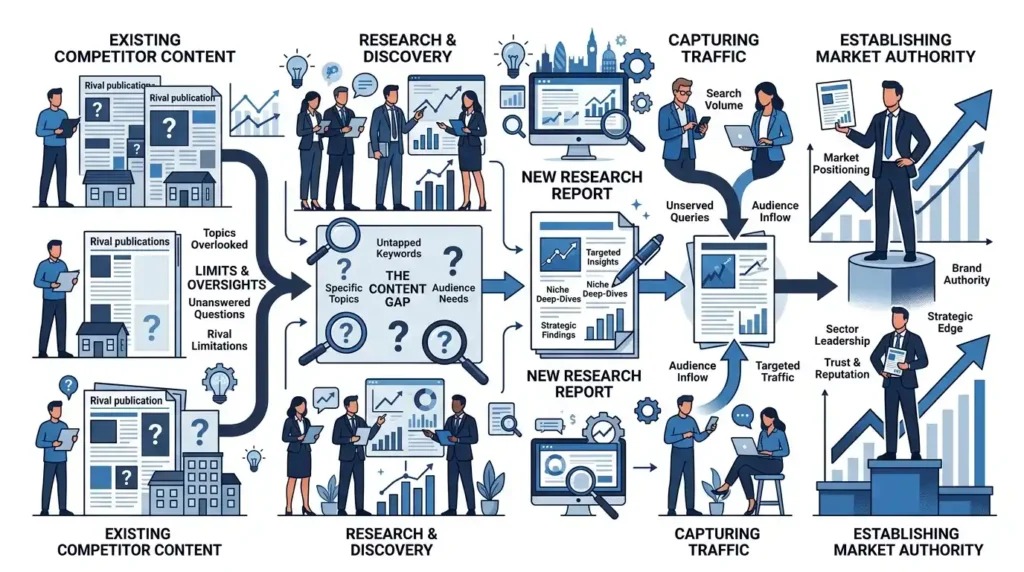
Competitor content gap analysis involves systematically auditing existing market literature to uncover unaddressed subtopics. For example, a fintech research team audits competitor white papers on open banking protocols to identify missing regulatory compliance breakdowns.
Locating these gaps requires side-by-side domain comparisons using SEO crawler tools. By inputting competing publishing sites into content gap matrices, analysts isolate keywords where rivals rank outside the top ten positions. These specific vulnerabilities highlight prime opportunities for targeted content creation.
Executing Systematic Competitor Content Audits
Systematic competitor content audits extract URLs from top-performing industry publishers and evaluate their index coverage. Analysts compile comprehensive inventories of published white papers, industry surveys, and annual reports. For example, a healthcare market researcher reviews publications from NHS analytics providers and private health consultancies.
Comparing these inventories against comprehensive keyword target lists reveals missing subject matter. If five major competitors publish on general digital transformation but omit legacy system migration costs in healthcare, a distinct content gap emerges for the next research report.
Leveraging Content Gap Matrices for Strategic Advantage
Content gap matrices organize comparative keyword data into actionable editorial pipelines. These matrices score keywords based on keyword difficulty, search volume, and competitor positioning. For instance, a software consultancy uses a matrix to identify low-competition, high-volume terms related to enterprise cybersecurity frameworks.
Utilizing these matrices prevents resource allocation on oversaturated topics. Publishing research that fills verified market voids attracts immediate inbound links from industry commentators. This strategic differentiation accelerates domain authority growth across competitive search landscapes.
Explore More Expert Insights:
Headlines for Sponsored Articles: 9 Formulas That Drive UK News Reader Clicks
Sponsored Content Calendar Planning: A 12-Month UK Framework for B2B Brands
How do you combine search volume data with content gaps to select a single report topic?
Combining search volume data with content gaps involves cross-referencing high-volume keyword opportunities against unserved competitor themes, producing a prioritized scoring matrix that selects research topics with maximum traffic potential and minimal existing competition.
Merging quantitative search data with qualitative gap analysis removes subjectivity from editorial planning. A market research director evaluates a list of 50 potential subjects by cross-tabulating monthly search volumes with competitor ranking deficits. For instance, topics displaying monthly queries exceeding 1000 combined with zero direct competitor coverage receive the highest priority scores.
This dual-methodology approach ensures that selected topics possess both proven audience demand and realistic ranking viability. Organizations avoid investing resources into high-volume terms dominated by entrenched authorities by focusing strictly on identified gaps within those high-demand sectors.
Constructing a Prioritized Topic Scoring Framework
A prioritized scoring framework assigns numerical values to core metrics including search volume, commercial relevance, and competitor deficit. For example, an energy sector publisher scores renewable energy grid integration by rating search volume on a scale of 1 to 10 and competitor weakness on a scale of 1 to 10.
Calculating composite scores establishes an objective hierarchy of report topics. Topics accumulating the highest aggregate scores move directly into the production pipeline. This structured evaluation eliminates internal bias and aligns publishing schedules with measurable market opportunities.
Validating Topic Viability Through Search-Led Topic Planning
Search-led topic planning validates long-term viability before primary research or data collection begins. Analysts examine SERP feature volatility, featured snippet opportunities, and related questions boxes for the target phrase. For example, analyzing search results for UK manufacturing productivity metrics reveals whether users prefer data tables, PDF downloads, or extensive analytical articles.
Validating these structural preferences informs the final output format of the research report. Ensuring the format matches user expectations improves dwell time and signal clarity for search engine crawlers. Readers interested in the educational stage of healthcare awareness campaigns can explore How Do You Choose a Research Report Topic That UK Audiences Are Actually Searching For to understand broader structural alignment principles.
What are the core components of a research report optimized for search engines and AI citation?
An optimized research report requires clear entity definitions, structured H2 and H3 hierarchies, explicit data tables, and comprehensive executive summaries designed to satisfy both human reading patterns and automated AI retrieval models.
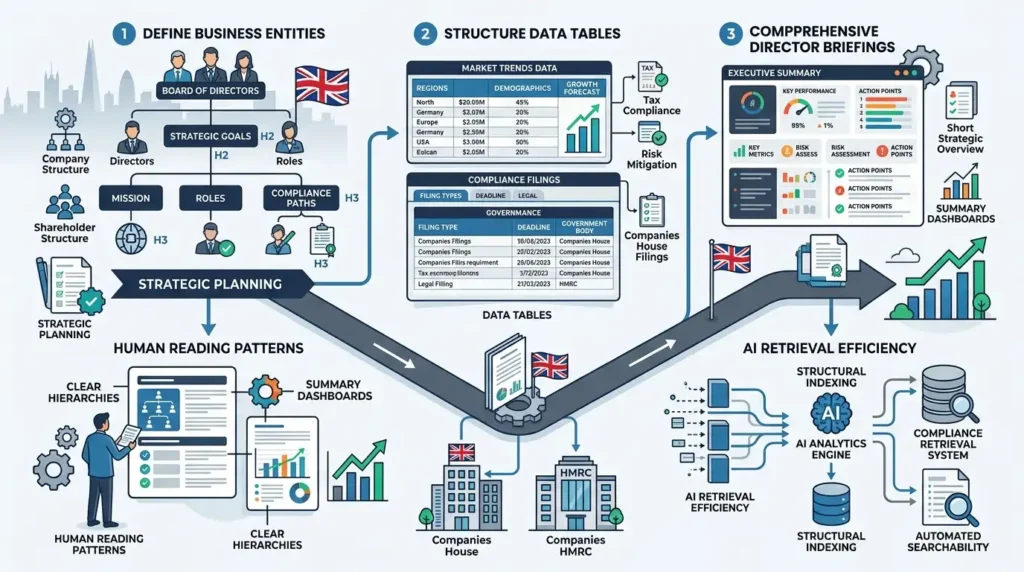
Search engines and AI citation models rely on structured semantic clarity to index and reference research data accurately. A well-optimized report on logistics automation trends utilizes strict semantic markup, explicit statistical callouts, and cleanly formatted data lists.
Structuring text with descriptive headings prevents ambiguity during natural language processing parsing. AI models extract definitive statements when core entities and their relationships are defined explicitly within the first sentences of each section.
Structuring Information for AI Retrieval and Natural Language Processing
AI retrieval models prioritize concise, declarative sentences that state facts without rhetorical flourish. For example, writing Automated guided vehicles reduce warehouse picking errors by 14 percent provides a citable data point for generative search systems.
Avoiding convoluted syntax and hedging language ensures that machine learning scrapers extract accurate information. Structuring key findings into bulleted lists further enhances machine readability, increasing the probability of direct inclusion in generative engine response summaries.
Integrating Semantic Entities and Contextual Vocabulary
Semantic entities include specific industry terms, regulatory bodies, geographic regions, and proprietary methodologies. An energy report incorporates entities like Ofgem, National Grid, and smart meter deployment rates to establish contextual depth.
Embedding these entities naturally across the document signals topical authority to search engine crawlers. This comprehensive vocabulary coverage helps the publication rank for a wider array of long-tail semantic variations related to the primary keyword.
How do you transition search-led research readers toward solution awareness without hard selling?
Transitioning search-led research readers toward solution awareness involves embedding contextual references to professional methodologies and comprehensive analytical frameworks within informational content, gently guiding readers to recognize their need for specialized industry expertise.
As readers consume informational research reports, their understanding of complex industry challenges naturally deepens. A reader exploring enterprise cloud migration strategies moves from basic problem identification toward evaluating implementation methodologies.
Soft solution awareness introduces specialized service models without employing aggressive promotional language. For example, referencing structured diagnostic frameworks or enterprise advisory methodologies illustrates how organizations resolve complex data challenges effectively. Readers evaluating implementation partners can review Time Intelligence Media Group Research and Reports Services With Search-Led Topic Planning for detailed decision-making frameworks.
Designing Informational Content for Progressive Reader Education
Progressive reader education structures content to mirror the evolving cognitive states of target audiences. Initial sections address foundational definitions, while subsequent sections explore operational complexities. For instance, a report on supply chain resilience begins with baseline vulnerability metrics before detailing advanced risk mitigation architectures.
This progressive depth builds trust between the publishing organization and the professional reader. By providing exhaustive, objective insights upfront, the publication establishes credible authority within the specific market sector.
Introducing Solution Types Softly Within Educational Frameworks
Softly introducing solution types involves explaining categories of intervention rather than promoting specific brand offerings. When detailing challenges in financial regulatory compliance, the text outlines the structural benefits of automated auditing software and dedicated advisory partnerships as standard industry solutions.
This educational approach respects the informational intent of the user while illuminating potential pathways for advanced problem resolution. Consequently, readers naturally develop an awareness of professional support options as they conclude their research journey.