
PR distribution is the process of delivering press releases and media content to news outlets, journalists, journalists’ databases, and online channels across the United Kingdom. It includes written releases, multimedia assets, contact lists, and tracking metrics.
PR distribution refers to the set of activities that take a written announcement or media asset and place it where news editors, reporters, and the public can access it. Core elements include press release drafting, creation of images or video, selection of distribution channels, and sending content via email or platform feeds. Distribution paths in the UK involve national newspapers, regional titles, trade publications, industry-specific websites, broadcast media contacts, and social syndication.
Distribution targets vary by sector; for example, healthcare releases target clinical journals and health trade media, while tech product launches target national tech outlets and specialist blogs. Distribution also includes follow-up outreach such as personalised pitches to journalists and supplying additional resources on request.
How do UK PR distribution costs break down?
Costs for PR distribution in the UK include content creation fees, list access or placement fees, multimedia production, geographic targeting charges, and analytics or reporting costs. Each component has a measurable price range.
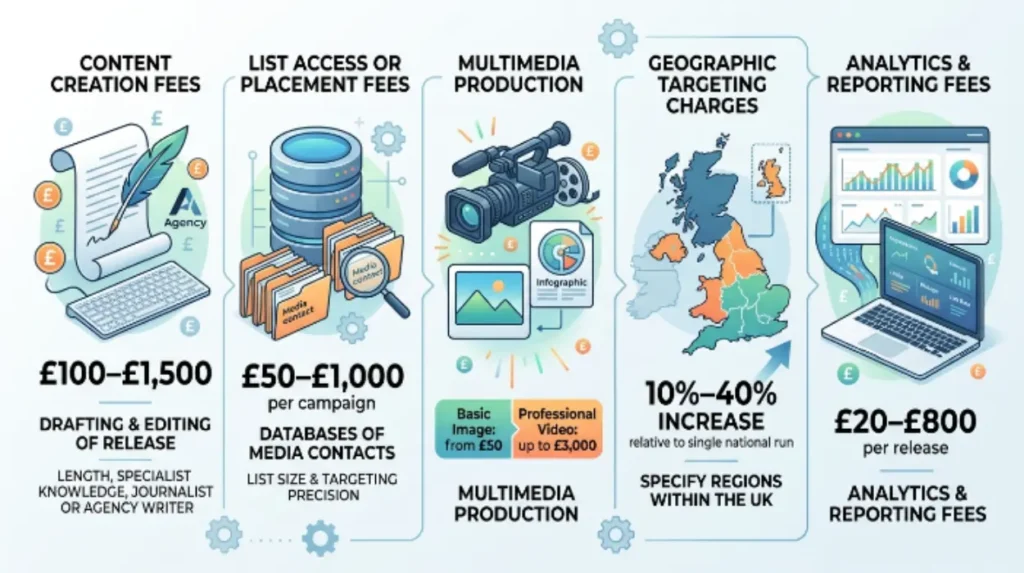
Content creation fees pay for drafting and editing of the release, and typically range from £100 to £1,500 depending on length, specialist knowledge required, and whether a journalist or agency writes the copy. List access or placement fees cover the databases of media contacts and can add £50 to £1,000 per campaign based on list size and targeting precision. Multimedia production costs for images, video, or infographics range from £50 for basic images to £3,000 for professional video. Geographic targeting charges apply when distributions specify regions within the UK; targeting England, Scotland, Wales, or Northern Ireland often increases cost by 10%–40% relative to a single national run. Analytics and reporting fees supply metrics such as impressions, clicks, pickups, and link data; these services cost between £20 and £800 per release.
What distribution methods exist and how do they affect price?
Distribution methods include email pitches, press release wire services, curated journalist databases, social syndication, and paid placement on news sites; each method has distinct pricing and reach. Choice of method changes both cost and outcome measures.
Email pitching involves personalised outreach to selected journalists and costs primarily in staff time or freelance fees; hourly rates range from £25 to £150. Wire services supply automated feeds to hundreds of outlets; single-release fees typically range from £50 for basic national text-only runs to £800 for text-plus-multimedia with regional targeting. Curated journalist databases sell access by subscription or per-send; subscriptions start at about £300 per month and per-send charges vary. Social syndication uses social networks to amplify a release; organic posts cost staff time, while paid social promotion carries ad spend from £50 upward. Paid placement on news sites or sponsored content spaces involves negotiated fees; placements on major national websites start around £500 and can exceed £10,000 for high-visibility positions.
Which metrics determine the value of a PR distribution buy?
Value is measured by reach, media pickups, unique impressions, referral traffic, backlinks, and journalist engagement; these metrics map directly to the budget allocation. Clear numerical targets align spending with outcomes.
Reach quantifies the size of audience exposure and is often reported as potential impressions based on outlet circulation and site traffic. Media pickups count how many independent outlets republished or referenced the release. Unique impressions measure distinct viewers and are available via analytics tools. Referral traffic shows clicks driven to the organisation’s website from published items; tracking requires UTM parameters or referral tags. Backlinks measure inbound links from published stories and contribute to search visibility; the number and domain authority determine SEO value. Journalist engagement tracks replies, interview requests, or feature interest and reflects media relations quality. Each metric requires a specific tracking setup; for example, measuring referral traffic and backlinks needs web analytics and link monitoring services that typically cost £10–£200 per month when outsourced.
What budget levels correspond to common outcomes for UK campaigns?
Small campaigns under £500 deliver targeted local coverage and limited online syndication; mid-range campaigns £500–£3,000 deliver regional to national reach with multimedia; large campaigns over £3,000 aim for national pickups, broadcast interest, and extensive analytics. Budget bands map to predictable deliverables.
A sub-£500 budget covers a short text release distributed via a basic wire or a handful of email pitches. Expected outcome is local or niche-site pickup, a few hundred to a few thousand potential impressions, and minimal multimedia. A £500–£3,000 budget adds multimedia assets, broader regional targeting, and access to curated lists; outcomes commonly include regional press coverage, several online republications, and measurable referral traffic in the low thousands. Budgets above £3,000 enable professional multimedia production, national wire distribution with targeted sector lists, and sustained follow-up outreach; outcomes aim for national news placements, broadcast mentions, improved backlink profiles, and detailed reporting that supports decision-making.
What non-monetary costs affect PR distribution success?
Non-monetary costs include time for journalist outreach, time to prepare follow-up materials, internal review cycles, and reputational risk management; each factor affects delivery speed and pickup rates. These operational elements change effective cost and campaign timing.
Time invested in personalised outreach improves pickup rates but increases labour hours. Preparing follow-up assets such as spokesperson statements, data sheets, or interview availability shortens journalist response times and increases coverage quality. Internal review processes, including legal clearance and compliance checks, can delay distribution by days or weeks; delays often reduce timeliness and media interest. Reputational risk management involves verifying facts and securing permissions, which adds review cycles but prevents corrections or retractions that damage long-term media relationships. These factors affect campaign outcomes as strongly as monetary spend.
Which components should you include when planning a PR distribution budget?
A comprehensive budget includes writing and editing, multimedia production, list or wire fees, journalist outreach time, targeting charges, and analytics/reporting costs. Each component needs a quantified allocation.
Allocate funds to writing and editing based on content complexity. Set aside production budget for images or video if the story benefits from visuals. Reserve placement fees for wires or database access to reach desired outlets. Budget staff or freelancer hours for personalised outreach and follow-up. Add targeting premiums for regional or sector-specific lists. Include analytics and monitoring costs to measure impressions, pickups, referral traffic, and backlinks. For example, a mid-range distribution plan could allocate 20% to content creation, 30% to placement and list fees, 25% to multimedia, and 25% to outreach and analytics.
Explore More Expert Insights:
Do Images and Video Actually Increase Press Release Pickup in the UK?
What Time of Day Gets UK Press Releases the Most Coverage
What are typical use cases for different budget sizes in the UK?
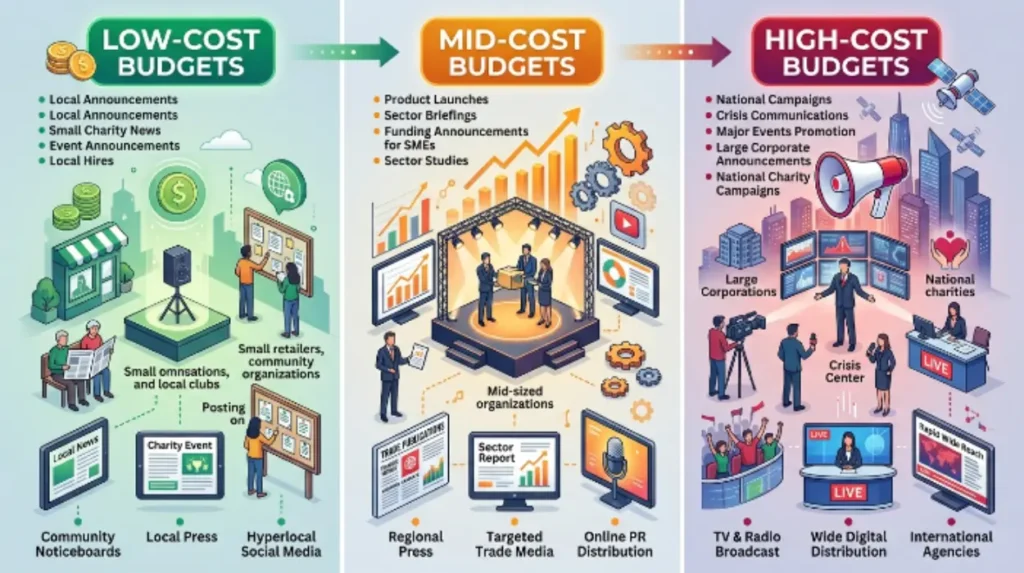
Low-cost budgets suit local announcements or small charity news; mid-cost budgets suit product launches and sector briefings; high-cost budgets suit national campaigns, crisis communications, and major events. Use cases determine the mix of channels and assets.
Local clubs, community organisations, and small retailers commonly use low-cost distributions for event announcements or local hires. Mid-cost budgets support new product launches, funding announcements for SMEs, and sector studies for mid-sized organisations, with regional press and targeted trade media as primary outputs. High-cost budgets support large corporate announcements, national charity campaigns, crisis response requiring rapid wide reach, or major event promotion where broadcast and national media attention matters.
How do timing and targeting choices change cost and effectiveness?
Timing and precise targeting increase effectiveness but raise costs; planned campaigns with defined audiences lower wasted spend compared to broad, last-minute distributions. Early planning reduces premiums and improves media uptake.
Scheduling releases to match editorial calendars increases pickup probability. Targeting specific trade outlets yields higher relevance scores and lower wasted reach than a broad national run. Last-minute distributions incur higher labour costs for quick personalisation and may require expedited placement fees. Planning at least two weeks ahead allows for personalised outreach, multimedia creation, and review cycles, lowering average cost per pickup.
For evaluations of specific provider models and technical differences, see:
Time Intelligence Media Group vs Traditional UK Newswires: What’s Different
This article defined PR distribution in the UK, detailed cost components and distribution methods, listed outcome metrics, described budget bands and typical use cases, and explained how non-monetary factors and timing affect results.
For deeper comparisons between owned newsroom approaches and paid distribution strategies, see:
Owned Newsroom vs Paid Distribution: What Works Better for UK Brands