
UK journalists read and pick up press releases most between 09:00 and 11:00 local time on weekdays. Morning news desks run editorial meetings then, assign stories, and schedule coverage; midday follow-ups occur between 13:00 and 15:00 for breaking updates and reaction pieces.
Journalists’ routines drive when editors and reporters actively scan incoming press releases. National and regional newsrooms hold editorial meetings between 09:00 and 10:30 where assignment decisions occur. Reporters check inboxes immediately before and after these meetings. A clear morning appearance in an inbox increases chance of selection. Midday attention rises again after 13:00 when reporters update live streams, file midday pieces, and seek comment on earlier items. Late afternoons between 16:00 and 18:00 see lower pickup for new feature-style releases and higher pickup for urgent breaking stories.
What newsroom processes determine press release pickup times?

Editorial meetings, news cycles, and production deadlines determine pickup times. Meeting schedules at 09:00–10:30 set priorities, midday production slots at 13:00–15:00 handle updates, and print deadlines around 16:00–18:00 shape late-afternoon coverage decisions.
Editorial workflows set which items receive coverage. News editors curate headlines during morning meetings and assign reporters to follow-ups. Online desks publish continuously but prioritize items aligned to morning editorial decisions. Broadcast newsrooms integrate releases into scheduled bulletins—early morning shows at 06:00–09:00 use overnight and very early releases; breakfast shows use material prepared the previous evening or early morning. Print newspapers require finalized copy before print deadlines, so releases timed before midday have higher chance for inclusion in next-day print. Specialist trade desks follow sector-specific meeting times, for example financial desks align with market opens at 08:00 and 09:00.
Which hours produce the highest national press coverage rates?
The highest national press coverage rates occur from 09:00 to 11:00 on weekdays, and from 13:00 to 14:00 for follow-ups. Weekend pickup is concentrated between 08:00 and 10:00 for Saturday and Sunday morning papers.
National outlets operate larger editorial teams and structured schedules. The morning window yields the most national coverage because it coincides with agenda-setting meetings and business news alignment with market openings. The early afternoon window captures reaction, quotes, and supplementary reporting. Weekend newspapers run longer lead times; their editorial selection often finalizes by mid-morning on Saturdays and Sundays, so early delivery is essential. Coverage rates drop significantly after 18:00 for national print planning, though online-only publishers may still publish late-breaking items.
How do specific UK media types affect optimal send times?
Different media types require different send times: broadcast needs early morning or late-night feeds; national print needs morning delivery; online newsrooms accept continuous updates but prefer morning story packages; trade and regional desks follow sector and regional meeting schedules.
Broadcast newsrooms work to fixed bulletin times and rely on wire copy and direct calls; they need concise releases ahead of bulletins. National print requires releases that fit morning editorial selection and copy deadlines; aim for before 09:00. Online outlets publish continuously but prefer complete, well-sourced releases in the morning for higher visibility. Regional newsrooms react to local events and often operate with smaller teams that scan inboxes during local editorial meetings, typically 09:00–10:00. Specialist trade media align releases with market and industry events, for example healthcare publications coordinate with press briefings or conference schedules.
How do embargoes and timing strategies influence coverage?
Embargoes concentrate journalist attention at a set release time. Morning embargoes at 09:00 yield synchronized coverage during editorial meetings. Evening embargoes for next-day print align with overnight reporting and morning briefings.
An embargo fixes a publication moment for multiple outlets, increasing simultaneous coverage when managed precisely. A clear embargo time of 09:00 leads journalists to prepare copy ahead and publish or broadcast at embargo lift. Poorly communicated embargo terms cause mistrust and reduce pickup. For next-day print, providing embargoed materials in the evening allows journalists to prepare fuller features for morning editing. Embargoes require accurate distribution and clear embargo labels to prevent mis-timed publication and to maintain relationships with newsrooms.
What factors reduce pickup rates at certain times?
Low pickup occurs outside key editorial windows, during holidays, and at major competing events. Late-night and very early morning releases receive low attention, and overloaded news days reduce visibility for routine releases.
Journalists ignore releases sent outside typical work hours unless the content is breaking news or highly relevant. Major national events or crises overshadow routine communications and push them down editorial priority. Holiday periods compress staffing; fewer reporters monitor routine releases, reducing pickup. Sending during Friday late afternoon lowers next-day coverage chances because weekend staffing declines. Volume also matters: high-volume distribution systems can bury messages, so targeted timing aligned to specific desks increases pickup probability.
How do audience and topic affect the ideal send time?
Audience and topic determine timing: business announcements align with market opens at 08:00–09:00, consumer news fits mid-morning, lifestyle features suit late morning to early afternoon, and emergency public-health alerts require immediate distribution.
Matching send time to audience and topic ensures relevance. Financial news benefits from pre-market or market-open distribution because analysts and business reporters need immediate data. Consumer and lifestyle editors work to morning features and afternoon slots for web updates. Public-health and emergency communications require direct contact and immediate, untimed distribution to all relevant desks. Local stories perform better when sent during regional editorial hours to match local newsroom rhythms.
Explore More Expert Insights:
How Press Release Embargoes Work in UK Media (and When to Break One)
What Fleet Street Editors Want in 2026 That Most PRs Are Not Sending
How should PR professionals measure timing effectiveness?
Measure timing effectiveness with pickup rate, time-to-publication, number of unique outlets, and placement prominence. Compare results across send times to identify patterns and optimal windows.
Track how many outlets published the release and how long it took from send to publication. Note placement—headline, inside story, or brief—and outlet reach. Segment results by send hour and day of week to calculate coverage rate per time window. Use consistent metrics across campaigns to ensure comparability. Analyze sector-specific results separately because different beats follow different rhythms.
What practical schedule maximises UK coverage?
For broad UK coverage, schedule primary distribution at 08:30–09:00 on weekdays, follow with updates at 13:00–14:00, and reserve urgent releases for immediate distribution any time. Avoid Friday late afternoons and weekend evenings.
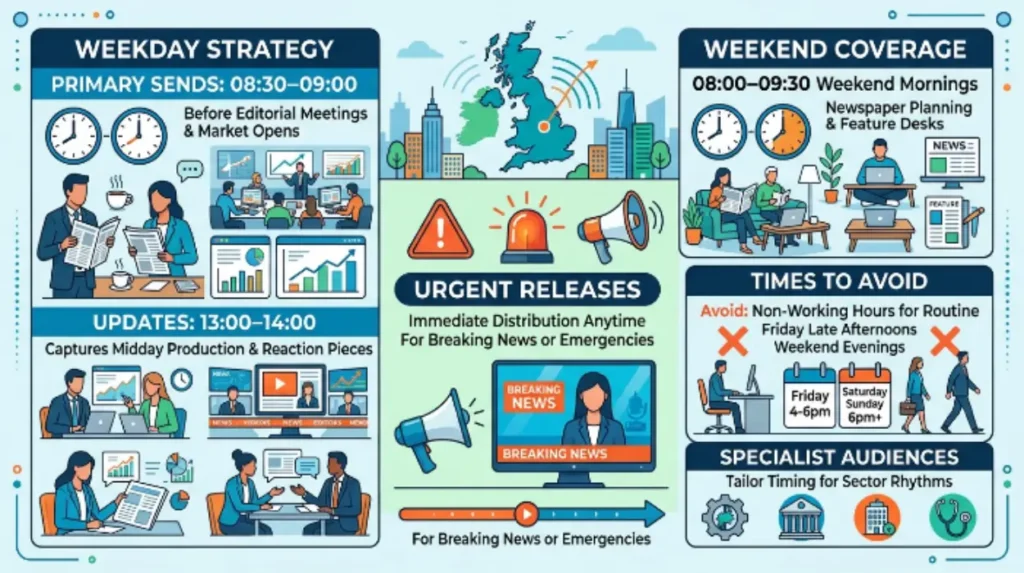
An 08:30–09:00 send arrives before most editorial meetings and market opens. An early afternoon update captures midday production and reaction pieces. Immediate distribution suits breaking news or emergencies. Avoid non-working hours for routine announcements. For weekend coverage, send between 08:00 and 09:30 on weekend mornings for newspaper planning and feature desks. Tailor timing for specialist audiences using their sector rhythms.
Discover More Insights:
What to Look for in a UK PR Distribution Report (and the Metrics That Mislead)
The strongest single window for UK press release pickup is weekday mornings between 09:00 and 11:00, with a secondary window at 13:00–15:00. Align releases to newsroom editorial meetings, respect embargo conventions, and measure pickup with consistent metrics to refine timing. For sector-specific coverage, match distribution to market opens and specialist desk schedules.
Explore the Complete Guide:
How Time Intelligence Media Group Guarantees UK National Media Reach