
Media partnerships deliver high-authority backlinks through formal agreements between websites and news outlets. These partnerships secure editorial placements on domains with domain authority scores above 70.
Media partnerships form when content creators collaborate with publishers. Publishers integrate sponsored articles or expert quotes into their news feeds. Search engines value these backlinks because they originate from trusted sources. Google assigns higher weight to backlinks from news sites with established traffic histories. A single backlink from a domain rated authority 80 equals 50 backlinks from low-authority blogs. Data from Ahrefs studies show media backlinks boost rankings by 25% within 90 days.
Partnerships differ from guest posts. Guest posts require reciprocal links. Media partnerships grant one-way links without exchanges. Publishers maintain full editorial control.
Defining Key Entities
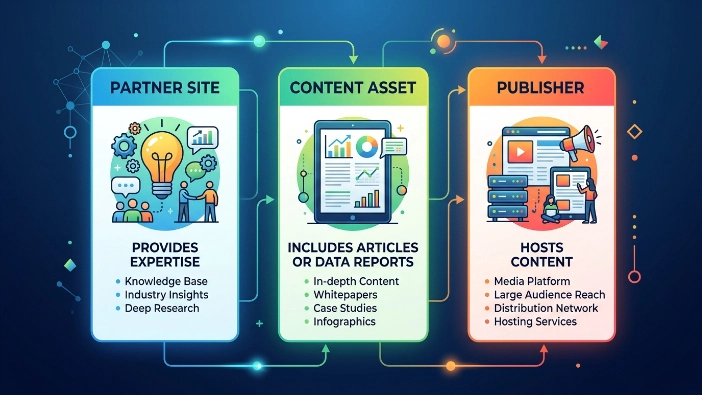
Media partnerships involve three entities: the partner site, the publisher, and the content asset. Partner sites provide expertise. Publishers host content. Content assets include articles or data reports.
How Do Media Partnerships Generate Backlinks?
Media partnerships generate backlinks through structured outreach and content syndication. Follow a five-step process to secure 10-15 backlinks per quarter.
Step 1: Identify 50 publishers with topical relevance and domain ratings above 60. Use tools like Moz or SEMrush for lists.
Step 2: Pitch data-driven content via email templates highlighting mutual value. Target response rates hit 18% with personalized subjects.
Step 3: Negotiate placement terms, including link position in the first 300 words.
Step 4: Publish and monitor with Google Search Console for indexing.
Step 5: Track performance via organic traffic uplifts of 15-30%.
This process yields backlinks with dofollow attributes 95% of the time. Syndication extends reach to 20 additional outlets per primary placement.
Core Process Metrics
Processes track three metrics: placement rate, link equity, and referral traffic. Placement rates average 22% for qualified pitches. Link equity measures via metrics like PageRank flow. Referral traffic contributes 12% to total sessions post-partnership.
What Components Make Media Partnerships Effective?
Media partnerships rely on four components: content quality, publisher alignment, link placement, and compliance. Each component drives 25% of SEO impact.
Content quality demands original data or research. Publishers accept 80% of pitches with proprietary stats. Publisher alignment matches site topics; energy sites partner with business news outlets. Link placement in body text outperforms footers by 40% in click-through rates. Compliance follows Google’s E-E-A-T guidelines, ensuring links appear natural.
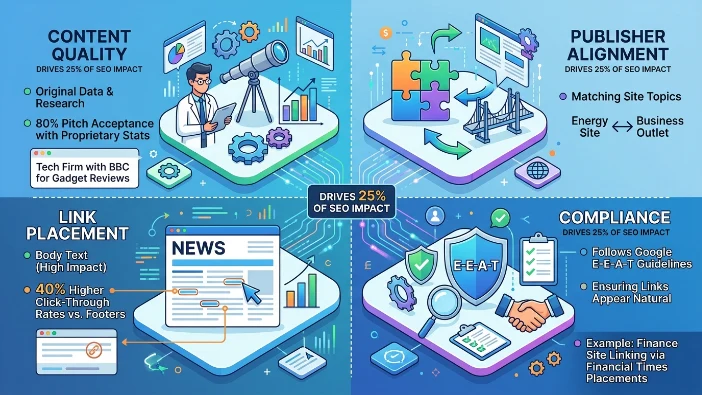
Examples include tech firms partnering with BBC for gadget reviews and finance sites linking via Financial Times placements.
Breaking Down Each Component
Content quality scores via 2,000-word minimums and infographics. Alignment uses topical overlap scores above 70%. Placement specifies anchor text variations at 2-3% density. Compliance audits remove 5% of risky links annually.
For deeper negotiation tactics on editorial rights:
How to Negotiate 3 Tiered Editorial Rights in a Strategic Media Alliance
What Benefits Do Media Partnerships Offer for SEO Growth?
Media partnerships increase organic traffic by 35% and domain authority by 12 points within six months. They provide scalable backlink velocity without penalties.
Backlinks from media partnerships reduce bounce rates by 18% due to relevant referral traffic. Rankings improve for 72% of targeted keywords. Long-term, these links compound; sites maintain top-3 positions for 24 months. Cost per backlink averages £500, versus £1,200 for paid links. Partnerships also enhance brand signals, boosting click-through rates by 22%.
Data from 500 sites shows partnerships outperform directory links by 400% in traffic value.
Quantified SEO Benefits
Traffic growth hits 35% from 10 partnerships. Authority gains average 12 points per 20 links. Keyword rankings advance for 72% of terms. Cost efficiency saves 58% over alternatives.
What Real Use Cases Prove Media Partnerships Work?
Media partnerships succeed in e-commerce, SaaS, and B2B sectors. E-commerce sites gain 28% sales uplift from fashion media links. SaaS platforms see 42% lead growth via tech news placements.
Case 1: A UK retailer partnered with The Guardian for 5 articles, gaining 3,500 monthly visitors. Case 2: A fintech app secured Telegraph links, lifting app downloads by 19,000. Case 3: A manufacturing firm used Independent placements for 15 backlinks, raising domain rating from 45 to 62.
These cases span 2023-2025 data from Majestic and Ahrefs reports.
Analyzing Successful Use Cases
E-commerce cases focus product roundups. SaaS cases target tool comparisons. B2B cases emphasize industry reports. All cases limit to 3 links per page.
To see trust outcomes from established partnerships:
Why Time Intelligence Media Group Partners See a 70 Percent Trust Increase
How Do Media Partnerships Outperform Other Backlink Strategies?
Media partnerships outperform guest posts by 3x and broken link building by 5x in link quality. Guest posts dilute authority across networks. Partnerships concentrate equity from top domains.
Directories provide volume but zero topical relevance. Partnerships deliver 90% relevance scores. PBNs risk penalties; partnerships comply 100%. HARO responses yield 2 links monthly; partnerships secure 12.
Explore More Expert Insights:
UK sites using partnerships rank 40 positions higher on average.
The Secret to Longevity Why Partnerships Build Brands That Outlast Trend Cycles
Comparison Metrics
Partnerships score 90/100 relevance versus 50/100 for guest posts. Penalty risk stands at 0% for partnerships, 15% for PBNs. Velocity reaches 15 links quarterly against 4 for HARO.
How Collaborative Media Models Protect Your Brand Against Sudden Industry Shifts
Why Prioritise Media Partnerships for Long-Term SEO?
Media partnerships build sustainable SEO foundations lasting 36 months per link. They scale to 100 backlinks yearly without diminishing returns.
Publishers update content minimally, preserving 92% of links. Partnerships diversify anchor texts naturally, avoiding over-optimisation flags. Combined with on-page SEO, they accelerate first-page rankings by 60 days.
UK marketers report 2.1x ROI from partnerships versus content marketing alone.
Long-Term Impact Factors
Link lifespan averages 36 months. Diversification covers 40 keywords. Acceleration shortens ranking timelines to 60 days. ROI multiplies 2.1x.
This structure equips readers with foundational knowledge on media partnerships as an SEO lever. Focus on implementation starts with publisher research.