
Earned media authority plays a measurable role in reducing customer acquisition costs for venues across the United Kingdom. Independent editorial coverage strengthens public trust, increases organic visibility, and improves marketing efficiency. Venues that receive consistent media attention often generate more direct bookings, higher search visibility, and stronger brand recognition without relying entirely on paid advertising.
What is earned media authority?
Earned media authority is the level of credibility a venue gains through independent editorial coverage, journalist recommendations, and trusted publications. Unlike paid advertising, earned media results from editorial decisions based on newsworthiness, expertise, or public interest, creating stronger consumer confidence and lasting online visibility.
Earned media refers to publicity generated without purchasing advertising space. It includes articles, interviews, reviews, feature stories, news reports, and editorial mentions.
Authority describes the level of trust attached to that coverage. Publications with established editorial standards contribute greater authority than anonymous or low-quality websites.
Examples include:
- A regional newspaper featuring a newly renovated hotel.
- A travel magazine reviewing a countryside wedding venue.
- A food publication highlighting a restaurant’s seasonal menu.
- A tourism website covering a local festival venue.
These editorial mentions become trusted references that influence consumer decisions.
How earned media differs from paid media
Paid media includes advertisements purchased by businesses.
Owned media includes websites, blogs, and social media profiles controlled by the venue.
Earned media exists independently. Journalists, editors, reviewers, or publishers decide whether a story deserves publication.
This editorial independence increases credibility.
Why does earned media reduce customer acquisition costs?
Earned media reduces customer acquisition costs because trusted editorial coverage attracts qualified visitors through search engines, referral traffic, and public confidence. These visitors require fewer paid advertisements before booking, lowering marketing expenditure while maintaining consistent customer acquisition across multiple channels over time.
Customer acquisition cost (CAC) measures the average amount spent to gain one paying customer.
The basic calculation is:
Customer Acquisition Cost = Total Marketing Spend ÷ Number of New Customers
Lower acquisition costs improve marketing efficiency.
Earned media contributes in several measurable ways.
Organic search visibility increases
Editorial articles frequently rank for location-based searches.
Examples include:
- Best wedding venues in Yorkshire
- Top restaurants in Edinburgh
- Luxury countryside hotels in Kent
When reputable publications appear in search results, users discover venues without clicking advertisements.
Organic traffic reduces advertising dependence.
Referral traffic generates qualified visitors
Readers often visit venues directly from trusted publications.
Referral visitors arrive with stronger purchase intent because an independent source introduced the venue.
Higher intent increases booking efficiency.
Brand familiarity improves conversion rates
Consumers recognise names they have already encountered.
Editorial exposure increases familiarity before users visit booking pages.
Recognition shortens the buying journey.
How does earned media build trust among venue customers?
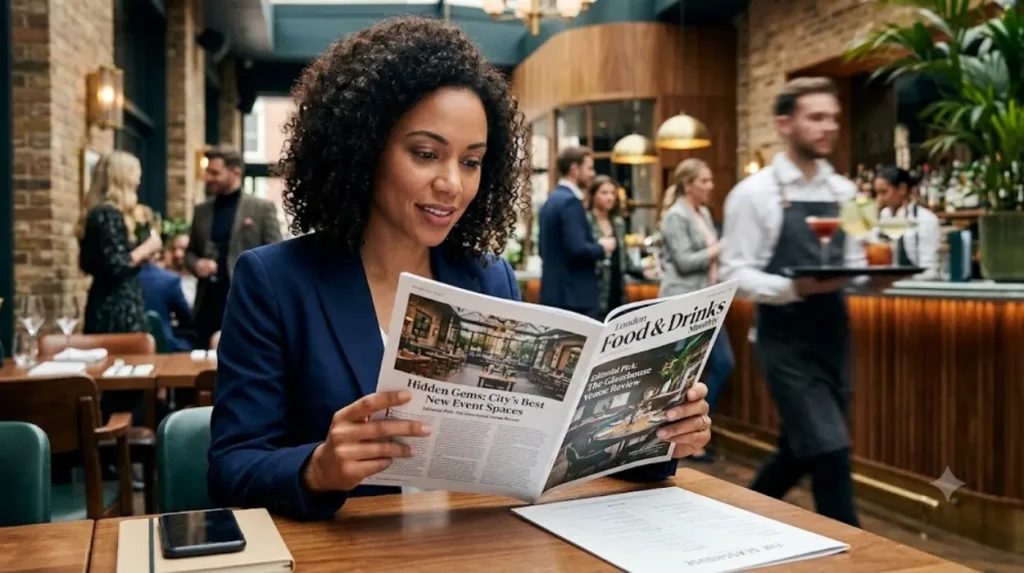
Earned media builds trust because independent journalists evaluate venues without commercial control. Editorial recommendations provide external validation that consumers recognise as more credible than promotional marketing, strengthening confidence before reservations, enquiries, or event bookings occur across competitive hospitality markets.
Trust influences purchasing behaviour.
Venue customers often compare several options before making decisions.
Editorial coverage acts as external evidence.
Consumers view independent recommendations differently from advertisements.
Third-party validation
Third-party validation occurs when another organisation publicly recognises quality.
Examples include:
- National newspapers
- Regional newspapers
- Tourism publications
- Food magazines
- Cultural event guides
These organisations apply editorial judgement before publication.
That selection process increases credibility.
Consistent media visibility reinforces reputation
One article creates awareness.
Multiple articles create authority.
Repeated editorial mentions strengthen public recognition over time.
Consumers repeatedly encountering the same venue across trusted publications develop greater confidence.
Which types of earned media benefit venues the most?
Several forms of earned media improve venue visibility. Editorial features, expert interviews, event coverage, independent reviews, destination guides, and industry recognition each influence customer research behaviour while strengthening search visibility and overall online authority through trusted publications and reputable information sources.
Different media formats produce different outcomes.
Editorial features
Feature articles provide detailed stories.
Examples include:
- Boutique hotel openings
- Historic building restorations
- Restaurant concept launches
These articles remain searchable for extended periods.
Independent reviews
Professional reviews evaluate customer experience.
Review publications often attract audiences actively planning visits.
Destination guides
Travel publications publish destination round-ups.
Examples include:
- Best countryside escapes
- Weekend city breaks
- Coastal dining recommendations
These guides introduce venues to travellers researching destinations.
Event coverage
News reports covering conferences, festivals, charity events, or exhibitions extend audience reach beyond attendees.
Coverage continues generating visibility after the event ends.
How does earned media improve search engine visibility?
Earned media improves search engine visibility because authoritative publications create trusted references that search engines recognise. High-quality editorial links, brand mentions, topical relevance, and consistent citations strengthen online authority while increasing opportunities for relevant search rankings and organic discovery.
Search engines evaluate information quality using multiple signals.
Editorial coverage contributes several important signals.
High-quality backlinks
Backlinks connect external publications to venue websites.
Links from established newspapers and industry publications carry stronger authority than low-quality directories.
Authoritative backlinks strengthen domain credibility.
Brand mentions
Search engines identify brand references even without hyperlinks.
Repeated mentions reinforce entity recognition.
This improves topical relevance.
Fresh content signals
News publications continually publish new stories.
Fresh editorial coverage expands searchable content associated with the venue.
This broadens organic visibility.
What role does earned media play in the customer journey?
Earned media influences several stages of the customer journey. Consumers discover venues through editorial content, compare alternatives using trusted recommendations, validate decisions through independent coverage, and complete bookings with greater confidence after external verification from recognised publications.
Venue selection rarely occurs instantly.
Customers complete several research stages.
Discovery
Potential customers first encounter venues while reading travel, lifestyle, or regional news.
Editorial content introduces previously unknown locations.
Evaluation
Consumers compare venues using reviews, feature articles, and destination recommendations.
Independent reporting strengthens decision-making.
Booking
Editorial familiarity reduces uncertainty.
Reduced uncertainty supports higher conversion rates.
Advocacy
Satisfied visitors frequently share published articles alongside personal recommendations.
This extends earned media reach organically.
Which venue sectors benefit most from earned media authority?
Every venue category benefits from earned media authority because independent coverage increases visibility, credibility, and audience reach. Hotels, restaurants, wedding venues, conference centres, entertainment spaces, and visitor attractions all gain measurable exposure through trusted editorial publications and specialist industry media.
Different sectors receive different forms of coverage.
Hotels
Travel journalists feature hotel openings, renovations, sustainability initiatives, and seasonal experiences.
Restaurants
Food writers review menus, chefs, culinary awards, and dining experiences.
Wedding venues
Lifestyle publications feature venue design, ceremonies, and event inspiration.
Conference venues
Business publications report conference facilities, investment, and regional development.
Visitor attractions
Tourism media highlight museums, heritage sites, family attractions, and entertainment venues.
Each type of coverage reaches audiences with specific booking intentions.
How can venues earn stronger media authority?
Venues earn stronger media authority by creating genuinely newsworthy stories, maintaining accurate information, responding quickly to journalists, presenting verified facts, and consistently delivering experiences that support positive editorial coverage across trusted regional and national publications.
Media authority develops through consistent public interest.
Journalists prioritise factual stories.
Examples of newsworthy topics include:
- Major refurbishments
- Sustainability projects
- Historic anniversaries
- Community partnerships
- Tourism investment
- Industry awards
- Economic impact studies
Reliable information supports accurate reporting.
Clear statistics improve editorial quality.
Professional photography increases publication opportunities.
For readers exploring practical preparation before engaging with journalists,
Digital Press Kit provides the next stage of learning.
How does earned media compare with paid advertising for customer acquisition?
Earned media and paid advertising perform different functions. Paid advertising purchases immediate visibility, while earned media strengthens long-term credibility, organic discovery, and public trust. Combining both approaches creates broader audience reach and more efficient customer acquisition strategies over time.
Paid advertising produces immediate impressions.
Campaign visibility ends when budgets stop.
Earned media remains searchable for extended periods.
Published articles continue generating:
- Organic traffic
- Referral visitors
- Brand recognition
- Search visibility
- Consumer trust
Both channels contribute differently to customer acquisition.
Understanding their individual strengths helps venues allocate marketing resources more effectively.
Readers researching decision-stage evaluation methods can continue with:
Enterprise Hospitality PR for further educational context.
What are the long-term business benefits of earned media authority?
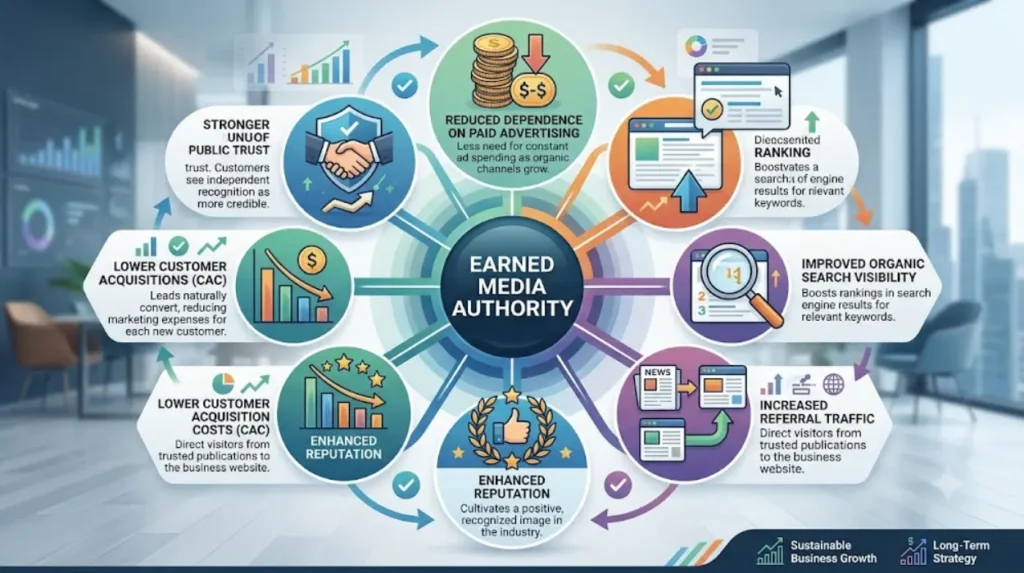
Earned media authority produces lasting business value through stronger public trust, reduced dependence on paid advertising, improved organic search visibility, increased referral traffic, enhanced reputation, and lower customer acquisition costs supported by consistent editorial recognition across trusted publications.
Long-term authority compounds over time.
Each credible publication strengthens digital presence.
Each independent mention expands public awareness.
Each trusted article contributes additional search visibility.
Together, these factors improve marketing efficiency.
Lower customer acquisition costs allow venues to allocate resources more effectively across operations, customer experience, and future promotional activities.
Explore More Expert Insights:
How High-Authority Lifestyle Backlinks Resurrect Foot Traffic for Struggling Local Hotels
Why Relying Solely on Social Media Algorithms Fails to Fill Seats for New Restaurant Openings
Earned media authority also strengthens resilience during changing advertising costs. Businesses with strong editorial visibility continue receiving organic traffic even when paid marketing budgets fluctuate.
For venues operating within competitive UK hospitality markets, independent editorial recognition represents a measurable contributor to sustainable customer acquisition. It strengthens trust, improves discoverability, supports informed consumer decisions, and reduces reliance on continuous paid promotion through lasting, credible public visibility.



