
New restaurant openings depend on consistent visibility before, during, and after launch. Many restaurant owners focus heavily on social media platforms to attract customers. Social media plays an important role in modern marketing, but algorithm-driven content distribution limits predictable reach. Understanding these limitations helps hospitality businesses build stronger awareness strategies and improve attendance at opening events.
Why do social media algorithms limit visibility for new restaurant openings?
Social media algorithms prioritise user engagement, relevance, and platform activity instead of chronological publishing. New restaurant content competes against thousands of daily posts, reducing organic reach and limiting consistent visibility among local audiences before opening day and throughout the launch period.
A social media algorithm is an automated ranking system. It decides which posts appear in a user’s feed based on signals such as previous interactions, viewing time, comments, shares, and content relevance.
Restaurant announcements do not automatically reach every follower. A business with 2,000 followers rarely receives 2,000 organic views on a single post.
Algorithms constantly evaluate content performance. Posts with low early engagement receive less distribution. This creates reduced visibility during the most important promotional period.
How do algorithms rank restaurant content?
Algorithms commonly evaluate:
- User engagement history
- Viewing duration
- Comments
- Shares
- Saves
- Recent account activity
- Content freshness
- Geographic relevance
These ranking factors determine how widely opening announcements appear within local communities.
Why does organic social media reach continue to decline?
Organic reach represents the percentage of followers who naturally see unpaid content. Platform competition has increased significantly, resulting in fewer restaurant announcements appearing in follower feeds despite regular posting schedules and frequent content publication throughout launch campaigns.
Every minute, millions of new posts enter social media platforms.
Restaurants compete with:
- Friends and family updates
- Entertainment creators
- News publishers
- Local businesses
- National brands
- Paid advertisements
This competition reduces available space in users’ feeds.
Opening announcements receive limited exposure unless strong engagement occurs immediately after publication.
Why does follower count differ from actual audience reach?
Follower numbers represent potential visibility.
Actual reach represents users who see the content.
A restaurant with 5,000 followers often reaches only a fraction of that audience organically because algorithms filter content before displaying it.
Why does local audience targeting remain difficult through algorithms alone?
Restaurant openings require visibility among nearby residents, workers, commuters, and visitors. Social media algorithms distribute content according to engagement signals instead of guaranteed geographic exposure, creating gaps between restaurant locations and intended local audiences across surrounding neighbourhoods.
Restaurants primarily serve customers within practical travelling distance.
Algorithms recognise location information, but location tags alone do not guarantee local distribution.
A restaurant located in Manchester benefits from reaching nearby office workers, families, students, and shoppers. Algorithmic delivery often extends beyond these audiences while missing nearby potential diners.
What affects local discovery?
Local visibility depends on:
- User location settings
- Recent browsing behaviour
- Community engagement
- Local hashtags
- Existing connections
- Platform recommendations
Each factor influences content exposure independently.
Why is launch-day success difficult to achieve through social media alone?
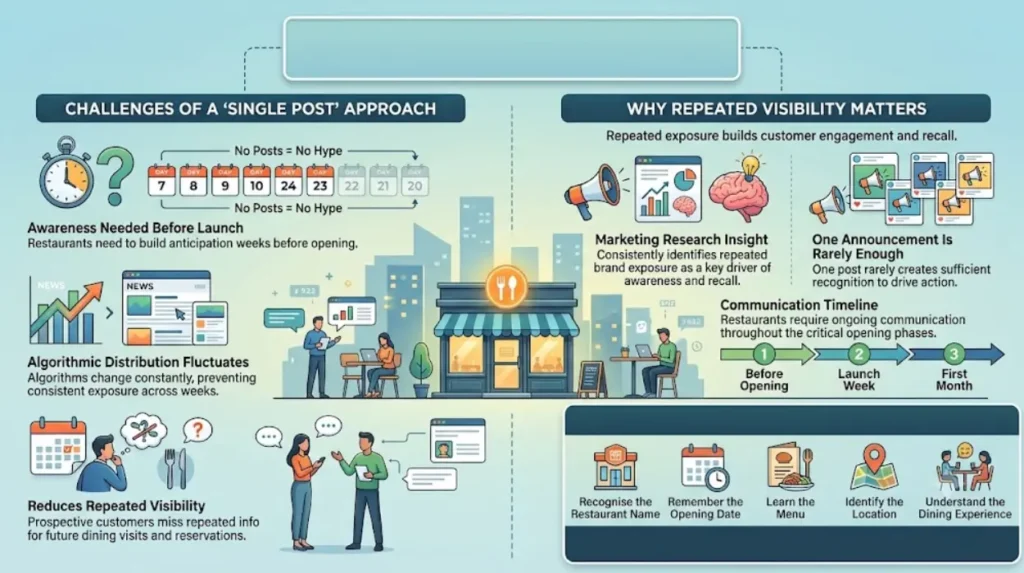
Restaurant openings require awareness before launch day. Algorithmic distribution changes continuously, preventing consistent exposure across multiple weeks and reducing repeated visibility among prospective customers planning future dining visits and reservations.
Restaurant launches depend upon repeated customer exposure.
Marketing research consistently identifies repeated brand exposure as an important driver of awareness and recall.
One announcement rarely creates sufficient recognition.
Restaurants require communication before opening, during launch week, and throughout the first month of operation.
Why does repeated visibility matter?
Repeated exposure helps customers:
- Recognise the restaurant name
- Remember the opening date
- Learn the menu
- Identify the location
- Understand the dining experience
Consistent awareness supports stronger attendance during launch periods.
How does content saturation reduce restaurant discovery?
Content saturation occurs when large volumes of similar material compete simultaneously for audience attention. Restaurant announcements frequently appear alongside promotional offers, entertainment videos, trending discussions, and sponsored advertisements, reducing discoverability despite regular publishing activity.
Food photography dominates many social platforms.
Restaurants publish:
- Menu photographs
- Interior images
- Chef introductions
- Opening countdowns
- Promotional offers
- Customer testimonials
Similar content competes continuously for limited user attention.
Why do trends influence visibility?
Algorithms reward current engagement.
Trending topics often receive priority distribution.
Restaurant opening announcements compete against national events, sporting fixtures, entertainment stories, and seasonal content, reducing available visibility.
Why do engagement metrics not always reflect customer demand?
Likes, comments, shares, and reactions measure digital interaction instead of physical restaurant visits. High engagement statistics do not automatically translate into bookings, walk-in customers, or fully occupied dining areas during restaurant launches.
Engagement measures online behaviour.
Customer attendance measures physical behaviour.
The two measurements represent different outcomes.
A restaurant announcement receiving 1,000 likes does not guarantee hundreds of diners on opening day.
Which business metrics matter more?
Restaurants benefit from measuring:
- Reservations
- Walk-in visitors
- Table occupancy
- Customer enquiries
- Telephone bookings
- Website visits
- Menu downloads
These indicators connect marketing activity with operational performance.
What communication channels complement social media awareness?
Restaurants achieve broader public awareness through multiple communication channels instead of relying upon a single platform. Combining different information sources creates more consistent visibility across varied audience groups and different stages of the customer decision process.
Integrated communication expands audience reach.
Examples include:
- Local news coverage
- Community event listings
- Search engine visibility
- Email newsletters
- Local partnerships
- Printed promotional materials
- Business directories
Each communication channel reaches different audience segments.
Why does diversification improve awareness?
Multiple channels reduce dependence on one algorithm.
Customers discover restaurants through different journeys.
Some search online.
Others notice community announcements.
Others receive recommendations from local networks.
This diversified approach creates stronger market awareness.
Readers seeking practical guidance on structured restaurant announcement planning can explore:
How does search behaviour differ from social media browsing?
Search users actively seek information using specific keywords. Social media users browse personalised feeds selected by algorithms. These behaviours produce different discovery patterns and influence how customers find newly opened restaurants within their local areas.
Search behaviour begins with intent.
Examples include:
- “New restaurants in Birmingham”
- “Italian restaurant near me”
- “Best brunch Leeds”
- “Family restaurant Bristol”
These searches reflect immediate customer interest.
Social media browsing follows entertainment and personalised recommendations rather than direct information seeking.
Why does search intent matter?
Search intent connects customer needs with relevant information.
Restaurant visibility improves when accurate information appears where customers actively search.
Search complements social discovery rather than replacing it.
What lessons can new restaurant owners learn from algorithm changes?

Algorithm updates occur regularly across major social platforms. Businesses relying exclusively on platform visibility experience changing audience reach, unpredictable performance, and inconsistent promotional outcomes following each ranking adjustment introduced by the platform.
Algorithms evolve continuously.
Ranking priorities change.
Content formats change.
Recommendation systems change.
Restaurants cannot control these platform updates.
Understanding this environment helps businesses avoid depending upon one communication method.
How does adaptability support long-term awareness?
Adaptable marketing strategies include several communication channels.
This approach maintains consistent public awareness despite changing platform behaviour.
Restaurants that understand audience discovery patterns make informed promotional decisions throughout growth stages.
Readers exploring distribution-focused decision making later in the buying journey can continue with:
Independent Hospitality PR Distribution
What is the key takeaway for restaurant opening visibility?
Social media algorithms represent one communication channel rather than a complete awareness strategy. Restaurant openings achieve broader public visibility through diversified communication, consistent messaging, measurable business objectives, and understanding how customers discover local dining experiences across multiple information sources.
Social media remains valuable for hospitality marketing.
Its algorithm-driven distribution limits predictable reach.
Restaurant openings depend upon sustained public awareness before launch, during opening week, and throughout early trading periods.
Explore More Expert Insights:
Why Relying Solely on Traditional Listing Portals is a Risky Strategy for New Property Developers
How Modern Real Estate Industry Analysts and Joint-Venture Partners Discover Breakthrough Startups
Understanding algorithm behaviour helps restaurant owners interpret performance accurately.
Combining multiple communication methods improves overall visibility, supports stronger local awareness, and creates more opportunities for customers to discover new dining venues.



