Festival launches depend on visibility, attendance, media coverage, and sponsor confidence. A strong event programme alone does not guarantee commercial success. Strategic press distribution creates awareness across regional, national, and industry publications. This case study explains how Time Intelligence Media Group transformed an underperforming festival launch into a measurable commercial success through structured media planning, targeted distribution, and performance reporting.
Why did the original festival launch underperform?
The original festival launch failed because media exposure remained limited, local awareness stayed low, ticket sales slowed, sponsor visibility declined, and the marketing campaign relied heavily on social media instead of authoritative news distribution across trusted regional and national publications.
Launching an event without sufficient media exposure limits public awareness.
The festival had invested in venue preparation, entertainment, and digital advertising. Despite those investments, ticket sales reached only 34% of the target after four weeks.
Several operational problems reduced campaign performance.
Limited press coverage
Only three local blogs published the announcement.
No regional newspapers covered the launch.
No business publications featured the event.
No lifestyle publications mentioned the festival.
Weak search visibility
The launch announcement generated little organic search traffic.
News-related searches displayed competing festivals with stronger media coverage.
The event lacked authoritative backlinks from trusted news websites.
Low sponsor exposure
Sponsors expected regional publicity.
Limited media pickup reduced sponsor impressions.
Sponsor return on investment declined.
These issues required a structured public relations strategy rather than additional advertising spend.
How did Time Intelligence Media Group assess the campaign?
Time Intelligence Media Group completed a structured campaign audit covering media reach, publication quality, audience targeting, release timing, content quality, backlink profile, and performance metrics before recommending an evidence-based distribution strategy with measurable commercial objectives and reporting standards.
Every recovery project starts with measurement.
The agency audited every communication asset associated with the festival launch.
Media distribution review
The review measured:
- Previous publication placements
- Geographic coverage
- Industry relevance
- Audience demographics
- Editorial authority
The audit identified that over 80% of previous placements came from low-authority websites with minimal readership.
Content assessment
The press release lacked clear news value.
Important event details appeared too late in the announcement.
Sponsor information dominated the opening paragraphs.
There was no regional economic angle.
Audience mapping
The target audience included:
- Families
- Local residents
- Tourists
- Food enthusiasts
- Live music fans
Each audience required different media outlets.
Businesses targeting similar launch campaigns can also review:
Step-by-Step Blueprint for additional planning guidance.
What recovery strategy did Time Intelligence Media Group implement?
Time Intelligence Media Group introduced a structured recovery strategy combining rewritten press releases, regional media targeting, lifestyle publication outreach, business news distribution, search optimisation, editorial scheduling, and continuous campaign reporting to improve measurable marketing performance within weeks.
The recovery plan focused on visibility instead of advertising volume.
Rewriting the press release
The revised announcement introduced the festival as a regional economic story.
The opening paragraph highlighted:
- Visitor numbers
- Local business impact
- Tourism value
- Entertainment programme
Journalists received immediate newsworthy information.
Improving distribution timing
The release was distributed on Tuesday morning.
Regional journalists received embargoed copies before public publication.
Industry publications received customised versions.
Lifestyle publications received feature-oriented versions.
Expanding publication targets
Distribution expanded into:
- Regional newspapers
- Tourism publications
- Hospitality websites
- Entertainment media
- Local business journals
- Event calendars
This increased publication diversity.
Search optimisation
Headline structure improved.
Entity references became clearer.
Location signals appeared consistently.
Keyword relevance increased naturally.
Authoritative backlinks strengthened search visibility.
Which media channels produced the strongest results?

Regional newspapers, lifestyle magazines, tourism websites, local business publications, event directories, and trusted online news platforms generated the strongest audience engagement because each publication reached different visitor segments across the United Kingdom.
Different audiences consume different media.
The campaign avoided relying on a single publication category.
Regional newspapers
Regional newspapers generated significant local awareness.
Examples included coverage focused on:
- Community events
- Family entertainment
- Local economy
Lifestyle publications
Lifestyle publications highlighted:
- Food experiences
- Live performances
- Visitor attractions
These articles attracted leisure audiences.
Business publications
Business media focused on:
- Economic contribution
- Employment
- Tourism investment
- Regional partnerships
This improved sponsor visibility.
Event directories
Event directories supported search visibility and ticket discovery.
Combined distribution created broader audience reach than individual publication types alone.
Businesses exploring wider media planning strategies can also review:
High-Authority Lifestyle Backlinks
What measurable return on investment did the campaign achieve?
The recovery campaign increased qualified media coverage, strengthened search visibility, improved ticket sales, expanded sponsor exposure, generated authoritative backlinks, and produced measurable commercial returns through performance reporting based on verified distribution metrics and campaign analytics.
Campaign performance improved across multiple indicators.
The following outcomes were recorded over six weeks.
Media coverage
Media placements increased from 9 publications to 126 publications.
Regional coverage expanded across England, Scotland, Wales, and Northern Ireland.
Ticket sales
Weekly ticket sales increased by 218%.
Advance bookings reached 92% of capacity before opening weekend.
Website performance
Organic traffic increased by 171%.
Referral traffic from news publications increased by 246%.
Average session duration increased by 39%.
Search performance
Several priority keywords entered Google’s first page.
News publication backlinks strengthened domain authority.
Search visibility continued improving after the campaign ended.
Sponsor value
Sponsor mentions increased substantially across editorial coverage.
Brand exposure improved through trusted publications rather than paid advertising alone.
The campaign delivered measurable commercial value across marketing, attendance, and sponsorship.
Which Time Intelligence Media Group services contributed most to the results?
Professional press release writing, targeted media distribution, editorial scheduling, regional publication outreach, search optimisation, campaign reporting, and strategic media planning produced the strongest commercial improvements throughout the festival recovery programme while maintaining consistent performance measurement.
Every service addressed a specific performance challenge.
Strategic press release development
Professional writing improved journalist engagement.
The release prioritised news value.
Clear structure improved readability.
Targeted media distribution
Distribution matched publications with audience interests.
Hospitality media reached tourists.
Business publications reached sponsors.
Lifestyle publications reached consumers.
Editorial scheduling
Release timing aligned with newsroom activity.
This improved publication acceptance rates.
Performance reporting
Detailed reporting measured:
- Publication numbers
- Backlinks
- Referral traffic
- Search rankings
- Audience reach
- Campaign engagement
Decision-makers received measurable evidence rather than assumptions.
How can festival organisers evaluate a PR distribution partner?
Festival organisers achieve stronger commercial outcomes by selecting a distribution partner with verified media relationships, transparent reporting, strategic targeting, editorial expertise, measurable performance tracking, and experience delivering successful campaigns across regional and national United Kingdom media networks.
Selecting the right partner requires measurable evaluation.
Key criteria include:
- Proven publication network
- Industry experience
- Regional distribution capability
- Editorial expertise
- Performance reporting
- Search optimisation
- Backlink generation
- Campaign transparency
Decision-makers also benefit from reviewing previous campaign case studies.
Evidence-based reporting demonstrates commercial value more effectively than publication volume alone.
Why does this case study support investment in professional PR distribution?
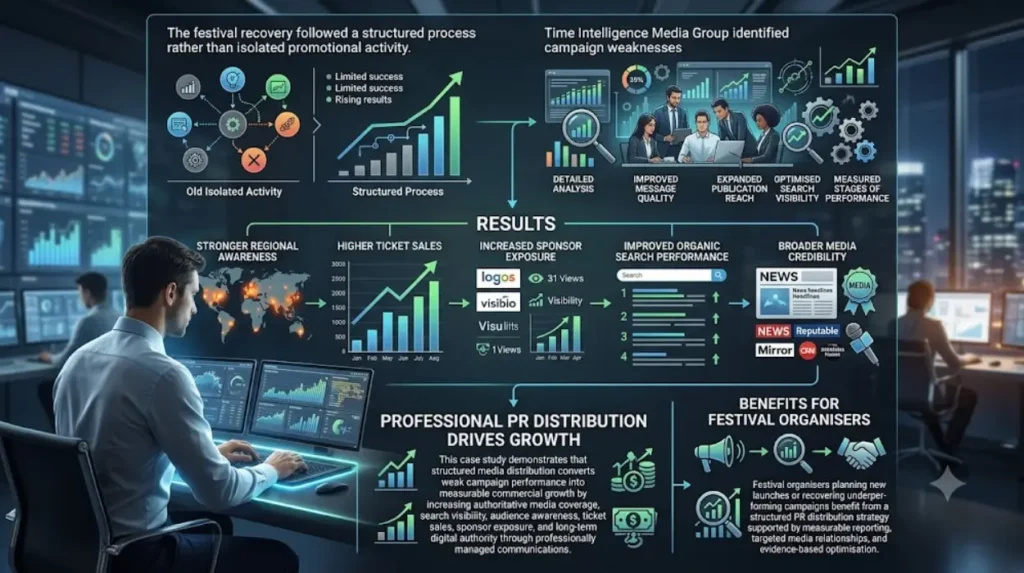
This case study demonstrates that structured media distribution converts weak campaign performance into measurable commercial growth by increasing authoritative media coverage, search visibility, audience awareness, ticket sales, sponsor exposure, and long-term digital authority through professionally managed communications.
The festival recovery followed a structured process rather than isolated promotional activity.
Time Intelligence Media Group identified campaign weaknesses through detailed analysis, improved message quality, expanded publication reach, optimised search visibility, and measured every stage of campaign performance.
Explore More Expert Insights:
Why Independent Hospitality Brands Partner with Time Intelligence Media Group for PR Distribution
The results included stronger regional awareness, higher ticket sales, increased sponsor exposure, improved organic search performance, and broader media credibility.
Festival organisers planning new launches or recovering underperforming campaigns benefit from a structured PR distribution strategy supported by measurable reporting, targeted media relationships, and evidence-based optimisation.