A digital press kit is a central online resource that gives journalists immediate access to verified information, images, facts, and media assets. For hospitality businesses, restaurants, hotels, attractions, and tourism brands, a well-structured digital press kit reduces research time and increases the likelihood of accurate media coverage.
Food and travel journalists receive hundreds of pitches every week. They prioritise stories supported by reliable information, high-quality visuals, and clear contact details. A digital press kit delivers these requirements in one accessible location.
For businesses preparing larger media campaigns, understanding:
The Direct Impact of Earned Media Authority on Slashing Customer Acquisition Costs for Venues provides useful background before creating journalist resources. Organisations comparing professional distribution options can also review:
Enterprise Hospitality PR during the evaluation stage.
What is a digital press kit?
A digital press kit is an organised online collection of verified media resources that enables journalists to understand a business quickly, download approved assets, verify facts, and produce accurate stories without requesting additional information through multiple email exchanges.
A digital press kit replaces traditional printed press packs with an online version that remains available at any time.
It contains information that journalists regularly request before writing a story.
Examples include:
- Company overview
- Brand facts
- Executive biographies
- High-resolution photography
- Logos
- Press releases
- Contact details
- Awards
- Fact sheets
Why does a digital format matter?
Food and travel journalists often work under tight publication deadlines.
A downloadable online resource allows immediate access from any device.
This removes delays caused by large email attachments or repeated file requests.
Why do food and travel journalists use digital press kits?
Food and travel journalists use digital press kits because they provide verified facts, publication-ready photography, location information, executive contacts, and supporting resources that reduce research time while improving reporting accuracy across print, digital, broadcast, and online publications.
Hospitality stories depend heavily on factual information.
Journalists verify:
- Opening dates
- Menu launches
- Hotel facilities
- Chef appointments
- Tourism experiences
- Sustainability initiatives
When these details appear in one organised location, reporting becomes faster.
Information journalists expect
Food writers frequently look for:
- Chef biography
- Signature dishes
- Seasonal menus
- Ingredient sourcing
- Restaurant history
Travel journalists commonly require:
- Destination overview
- Accommodation information
- Visitor experiences
- Accessibility details
- Local attractions
Providing these resources together supports different editorial needs.
Which components belong in a professional digital press kit?
A professional digital press kit includes clearly structured business information, leadership biographies, approved visual assets, current press releases, company facts, contact information, media permissions, awards, and downloadable documents presented in formats suitable for immediate editorial use.
Each section serves a specific purpose.
Business overview
Include:
- Business name
- Year established
- Location
- Core services
- Business mission
- Key milestones
Keep this section below 250 words.
Executive biographies
Introduce leadership with factual information.
Examples include:
- Founder
- Managing Director
- Executive Chef
- Head Sommelier
- Hotel General Manager
Each biography benefits from:
- Professional photograph
- Career highlights
- Qualifications
- Industry achievements
High-resolution photography
Include professionally edited images.
Examples:
- Restaurant interiors
- Hotel rooms
- Dining experiences
- Signature dishes
- Local attractions
- Staff portraits
Provide JPEG files at publication quality.
Brand logos
Offer logos in:
- PNG
- SVG
- EPS
Include both colour and monochrome versions.
Fact sheet
Summarise important business information.
Typical facts include:
- Number of rooms
- Seating capacity
- Opening hours
- Michelin recognition
- Sustainability certifications
- Annual visitor numbers
Press releases
Maintain an archive of recent announcements.
Examples:
- New menu launches
- Hotel renovations
- Award wins
- Partnership announcements
- Seasonal campaigns
How should a digital press kit be organised?
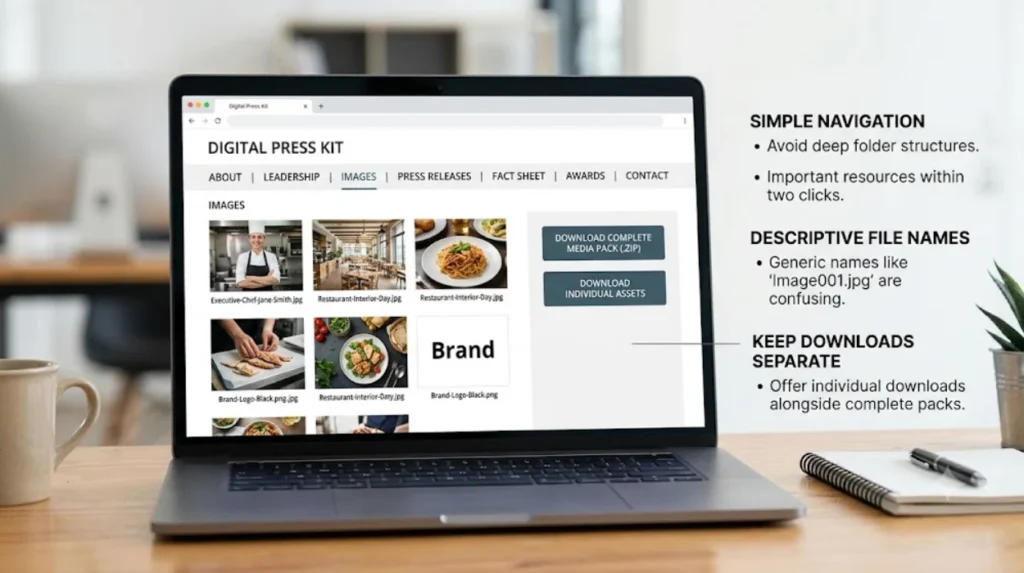
A logical digital press kit structure enables journalists to locate information within minutes through consistent navigation, clearly labelled sections, downloadable files, searchable content, and organised folders that reduce unnecessary browsing and repeated information requests.
Organisation directly affects usability.
Create a simple navigation structure
Common navigation includes:
- About
- Leadership
- Images
- Press Releases
- Fact Sheet
- Awards
- Contact
Avoid deep folder structures.
Important resources remain accessible within two clicks.
Use descriptive file names
Examples:
- Executive-Chef-Jane-Smith.jpg
- Restaurant-Interior-Day.jpg
- Brand-Logo-Black.png
Avoid generic names such as Image001.jpg.
Keep downloads separate
Journalists often require only one resource.
Offer individual downloads alongside complete media packs.
What makes photography attractive to food and travel journalists?
Professional photography strengthens editorial value by providing publication-ready visuals that accurately represent destinations, accommodation, dining experiences, architecture, people, and local culture using consistent quality, composition, lighting, and accurate image descriptions for editorial reference.
Food and travel coverage depends heavily on visuals.
Images often determine whether an editor selects one story over another.
Food photography
Include:
- Signature dishes
- Seasonal menus
- Preparation process
- Chef portraits
- Dining environment
Travel photography
Include:
- Exterior views
- Guest rooms
- Public spaces
- Landscapes
- Nearby attractions
- Guest experiences
Image specifications
Provide:
- Minimum 300 dpi
- Landscape orientation where appropriate
- Accurate captions
- Photographer credit
- Usage permissions
How can businesses write journalist-friendly company information?
Journalist-friendly company information presents factual statements, measurable achievements, verified dates, operational details, and industry context using concise language that supports accurate reporting without promotional wording, exaggerated claims, or unnecessary marketing terminology.
Journalists rewrite information into editorial style.
Simple factual content improves accuracy.
Include measurable facts
Examples:
- Established in 2015
- 84 guest rooms
- 120-seat restaurant
- Three event spaces
- Five regional locations
Numbers improve credibility.
Avoid promotional language
Replace:
“Luxury world-class experience”
With:
“Four-star hotel overlooking the Lake District.”
Objective descriptions support factual reporting.
How often should a digital press kit be updated?
A digital press kit remains valuable only when information stays accurate through scheduled updates covering photography, leadership profiles, awards, press releases, contact details, facilities, pricing references, and downloadable media resources throughout the calendar year.
An outdated press kit creates confusion.
Journalists often verify publication dates before using information.
Update after major announcements
Examples include:
- Restaurant refurbishment
- New executive chef
- Hotel expansion
- Award recognition
- Sustainability certification
- Seasonal campaign
Review quarterly
Every three months verify:
- Contact details
- Leadership information
- Images
- Download links
- Statistics
- Brand assets
Routine maintenance prevents outdated content.
Which mistakes reduce the effectiveness of a digital press kit?
Several common mistakes reduce journalist engagement by increasing research time, limiting asset usability, creating factual uncertainty, and making editorial verification more difficult during fast-moving publication schedules across hospitality and tourism reporting.
Small issues often discourage media use.
Missing contact information
Always include:
- Media contact name
- Email address
- Telephone number
- Response hours
Low-quality images
Avoid:
- Mobile screenshots
- Watermarked photographs
- Small file sizes
- Blurry images
Outdated facts
Remove obsolete:
- Awards
- Staff profiles
- Menus
- Opening hours
- Statistics
Broken download links
Test every download before major campaigns.
Broken resources create unnecessary delays.
How does a digital press kit support wider hospitality PR activity?
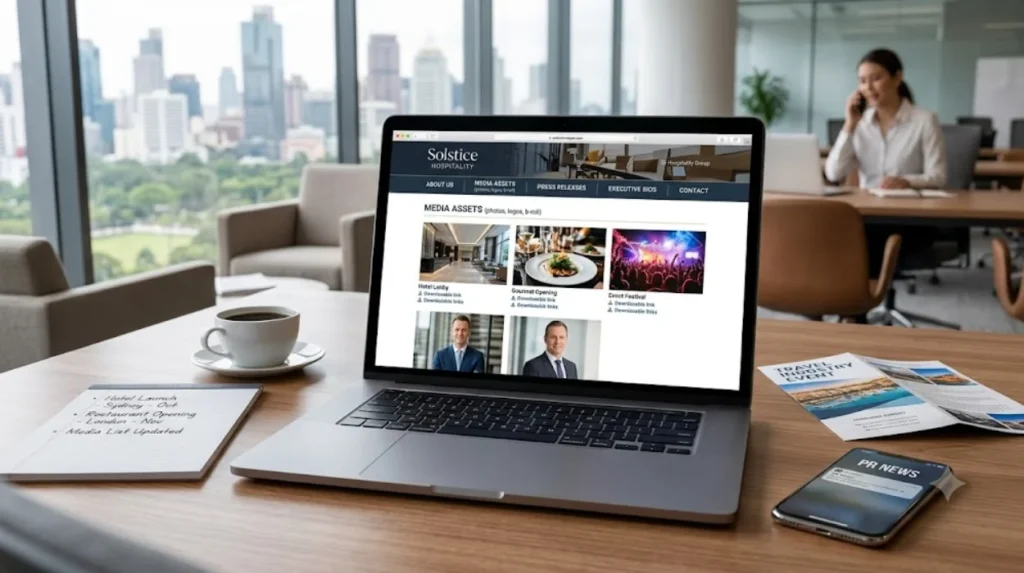
A comprehensive digital press kit supports broader public relations activity by improving media readiness, strengthening campaign consistency, supporting product launches, simplifying journalist research, and providing verified resources across multiple communication channels throughout ongoing media engagement.
A press kit becomes a long-term communication asset.
It supports:
- Restaurant openings
- Hotel launches
- Tourism campaigns
- Festival announcements
- Award submissions
- Executive interviews
Journalists frequently revisit previous resources for follow-up stories.
A consistently maintained press kit therefore supports continued media visibility rather than one-off publicity.
Businesses planning larger hospitality campaigns often combine an updated digital press kit with structured media outreach, targeted journalist lists, and professionally managed distribution strategies. Comparing available distribution approaches becomes increasingly relevant as campaign scale grows, making Enterprise Hospitality PR a useful next step for organisations evaluating broader communication options.
Explore More Expert Insights:
Step-by-Step Blueprint: Turning a Boutique Hotel Launch into a Major Regional Media Event
The Venue Owner’s Guide to Crafting High-Impact Press Releases for Grand Openings
A digital press kit gives food and travel journalists immediate access to verified information, professional photography, leadership profiles, company facts, and downloadable media assets. Clear organisation, factual writing, current resources, and publication-ready visuals reduce research time and improve reporting accuracy.
For hospitality businesses across the United Kingdom, maintaining a structured digital press kit supports ongoing media engagement, strengthens campaign preparation, and provides a reliable foundation for future press releases, destination stories, restaurant features, hotel coverage, and wider public relations activity.