
Retargeting advertising for restaurants is a digital method that shows ads to people who already visited a restaurant’s website or engaged with its digital profile, with the aim of bringing them back to place an order.
Retargeting uses tracking pixels, cookies, or mobile identifiers to recognise previous visitors. Restaurants place a small tracking code on order pages or menu pages. When a visitor leaves without completing an order, the code records a unique identifier. Ad platforms use that identifier to show tailored ads across social media, display networks, and search partners. Retargeting controls ad frequency, duration, and creative to avoid overexposure. It separates new audiences from return prospects and targets only those with prior interest.
How do restaurants collect the data needed for retargeting?
Restaurants collect retargeting data by installing website pixels, using server-side event tracking, and capturing identifiers from email lists and app installs.
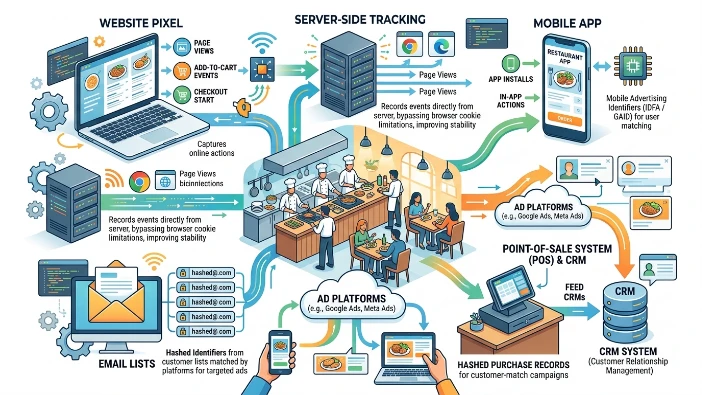
Website pixels capture page views, add-to-cart events, and checkout starts. Server-side tracking records the same events without relying solely on browser cookies, improving stability when browsers block cookies. Mobile apps use advertising identifiers (IDFA or GAID) to match users for in-app retargeting. Email lists provide hashed identifiers that platforms match to user accounts for targeted ads. Point-of-sale systems do not directly feed ad platforms unless integrated, but they feed CRMs that can provide hashed purchase records for customer-match campaigns.
What steps create a retargeting campaign that drives online orders?
A retargeting campaign follows steps, install tracking, segment audiences by behaviour, create tailored creatives, set frequency and bid rules, and measure conversions on orders.
First, install the platform pixel and verify event firing for page views, product views, and cart events. Next, segment visitors into groups such as viewed menu, started checkout, or completed order within a selected lookback window (commonly 7, 14, or 30 days). Then, design creatives aligned to each segment: menu highlights for browsers, limited-time discounts for checkout abandoners, and loyalty reminders for past purchasers. Configure frequency capping to limit impressions per user per day, and set bid strategies that prioritise conversions or revenue per click. Finally, attribute orders using last-click or multi-touch windows and track return-on-ad-spend (ROAS) to evaluate performance.
What audience segments do restaurants use in retargeting?
Common audience segments include site visitors, cart abandoners, menu viewers, previous purchasers, and mobile-app users, each defined by specific behaviours and time windows.
Site visitors include anyone who loaded the website within a chosen lookback period, typically 7–30 days. Cart abandoners triggered an add-to-cart or checkout-start event without purchase within 1–7 days. Menu viewers opened menu or product pages within 7–14 days. Previous purchasers completed an order within 30–365 days. Mobile-app users installed or opened the app within 7–90 days. Each segment receives a different creative and offer aligned to their buying stage. For example, cart abandoners see checkout incentives, while previous purchasers see new-menu notifications.
What creative elements increase the chance of online orders?
Effective creatives present clear menu items, price or delivery information, an order-focused message, and a single visual call-to-action per ad.
Use high-resolution images of specific dishes with consistent lighting. Include clear text that shows delivery options, average delivery time in minutes, and minimum order values where relevant. Use concise headlines that reference the action, such as “Order: 30-minute delivery” or “Reorder favourite dish.” Choose formats that match behaviour: short video clips for social feeds, carousel cards for multiple menu items, and static display banners for quick impressions. Avoid including multiple unrelated CTAs in the same creative.
How do restaurants set budgets and bidding for retargeting?
Restaurants allocate 10–40% of their digital ad budgets to retargeting and use conversion-focused bidding with daily caps and frequency limits.
Allocate a higher share of ad spend to retargeting when historical data shows strong conversion rates from return visitors. Use cost-per-acquisition (CPA) or target-return-on-ad-spend (tROAS) bidding when platforms allow, and set daily budgets aligned to expected order value and margin. Apply frequency capping such as 2–5 impressions per user per day to avoid ad fatigue. Monitor cost metrics weekly and reallocate budget between audience segments by observed ROAS.
How is attribution measured for retargeting-driven orders?
Attribution uses tracked events tied to unique identifiers and applies windows such as 1-day click or 7-day view-to-conversion to link ads to orders.
Install conversion tracking on order confirmation or post-purchase pages to record successful orders. Use unique order IDs to deduplicate events across platforms. Common attribution windows include 1-day click, 7-day click, and 1-day view for short-decision purchases like food orders. Use multi-touch reporting to view the role of retargeting across the funnel. Reconcile platform conversion reports with backend sales data weekly to correct for measurement gaps and to calculate true ROAS.
What privacy rules affect retargeting in the UK?
UK retargeting follows data protection laws that require lawful bases for processing and clear consent when using cookies for advertising.
Websites must present cookie banners that obtain consent for non-essential cookies, including most advertising pixels. Legitimate interest cannot replace consent for advertising cookies under common practice; obtain explicit consent for behavioural advertising. Hash customer data for customer-match lists before uploading to ad platforms. Provide clear opt-out methods and honour users’ tracking preferences. Keep cookie retention windows and data deletion routines documented for audits.
What performance metrics indicate retargeting success?
Key metrics include conversion rate, cost per order (CPO), return-on-ad-spend (ROAS), average order value (AOV), and repeat-order rate for retargeted audiences.
Conversion rate measures the percentage of retargeted clicks that convert into orders. Cost per order divides ad spend by orders attributed to the campaign. ROAS divides revenue from retargeted orders by ad spend. AOV shows the average revenue per order from retargeted customers. Repeat-order rate tracks the share of customers who place more than one order within a defined period after retargeting. Track these metrics per audience segment and creative to identify high-performing combinations.
What common challenges occur and how are they addressed?
Challenges include cookie loss, ad fatigue, inaccurate attribution, and low creative relevance; solutions use server-side tracking, frequency caps, conversion modelling, and tailored creatives.
Browsers and privacy settings block third-party cookies. Address cookie loss with server-to-server event tracking to maintain signal fidelity. Reduce ad fatigue by limiting impressions and rotating creatives every 7–14 days. Correct attribution gaps by comparing platform reports with first-party order records and applying probabilistic or deterministic modelling. Improve relevance by mapping creative to explicit user behaviour, for example showing delivery-only options to users who viewed the delivery fee page.
Explore More Expert Insights:
How Food Brands Promote Offers Using Banner Campaigns
How Cafes Increase Foot Traffic Using Display Ads
What real-world use cases show retargeting driving online orders?
Examples show retargeting converting menu browsers to buyers, cart abandoners to completed orders, and past purchasers to repeat orders through tailored ad flows.
A restaurant detects users who viewed a late-night menu between 20:00–23:00 and serves ads featuring late-night combos with delivery times. Cart abandoners who entered checkout but left receive an ad with a limited-time discount valid for 24 hours. Customers who ordered in the last 90 days receive ads about new seasonal dishes and a reorder reminder. Each sequence uses a narrow lookback window and a specific creative tied to the recorded behaviour.
How do restaurants scale retargeting while maintaining efficiency?
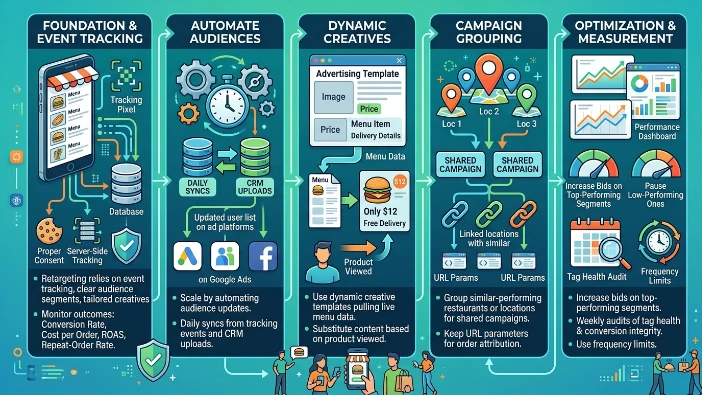
Scale by automating audience updates, using dynamic creatives that pull live menu data, and grouping similar-performing restaurants or locations for shared campaigns.
Automate audience lists with daily syncs from tracking events and CRM uploads. Use dynamic creative templates that substitute images, prices, and delivery details based on the product viewed. Group locations with similar menus into shared campaigns while keeping URL parameters for order attribution. Increase bids on top-performing segments and pause low-performing ones. Maintain measurement governance by running weekly audits of tag health and conversion integrity.
Check Out the Full Article:
How Restaurants Improve Repeat Order Intent Using Retargeting Ads
Retargeting ads for restaurants rely on event tracking, clear audience segments, tailored creatives, and strict measurement. Proper cookie consent and server-side tracking protect data integrity. Key outcomes to monitor are conversion rate, cost per order, ROAS, and repeat-order rate. Use frequency limits and relevance-based creatives to convert prior visitors into online orders without oversaturating audiences.
Get Detailed Information Here:
Retargeting Restaurant Ads That Turn Past Orders Into Repeat Purchases