
Institutional trust determines whether an emerging crypto brand gains long-term credibility with professional investors, financial institutions, regulators, and business partners. In highly volatile markets, trust depends on transparency, governance, security, regulatory alignment, and consistent communication rather than market performance alone.
Why is institutional trust important for emerging crypto brands?
Institutional trust enables crypto brands to establish credibility with professional stakeholders through transparent governance, verifiable operations, regulatory alignment, robust security, and consistent communication. These factors reduce uncertainty, improve confidence, strengthen business relationships, and support sustainable growth despite market volatility and rapid industry changes.
Institutional trust refers to the confidence that regulated organizations, investment firms, banks, family offices, asset managers, and corporate partners place in a crypto business.
Unlike retail investors, institutional participants evaluate operational quality before making financial decisions. They examine governance structures, compliance frameworks, financial reporting, cybersecurity controls, and executive accountability.
High market volatility increases scrutiny. Price fluctuations expose weaknesses in communication, operational resilience, and risk management.
Emerging crypto brands benefit from demonstrating stable business operations regardless of short-term token prices.
What defines an institutional-grade crypto business?
An institutional-grade crypto business demonstrates measurable operational maturity.
Core characteristics include:
- Clearly documented governance policies
- Independent financial reporting
- Public leadership information
- Strong cybersecurity controls
- Regulatory compliance documentation
- Transparent treasury management
- Consistent stakeholder communication
Examples include regulated crypto exchanges, digital asset custody providers, blockchain infrastructure companies, and tokenization platforms.
How does transparency strengthen institutional confidence?
Transparency strengthens institutional confidence by providing accurate, verifiable, and timely information about governance, finances, security, operations, leadership, and regulatory activities. Transparent organizations reduce information gaps, allowing institutional stakeholders to evaluate risks using documented evidence instead of speculation or market sentiment.
Transparency begins with information accessibility.
Institutions expect publicly available documentation that explains how an organization operates.
What information improves transparency?
Important information includes:
- Executive leadership profiles
- Corporate registration details
- Business location
- Regulatory status
- Security architecture
- Audit reports
- Token allocation
- Treasury disclosures
- Risk policies
Each document answers specific due diligence questions.
For example, a blockchain infrastructure provider publishing quarterly operational reports gives institutional analysts measurable data instead of assumptions.
Regular updates also demonstrate organizational discipline.
Silence during market volatility often increases uncertainty.
What governance practices improve credibility?

Strong governance improves credibility by establishing clear decision-making structures, executive accountability, independent oversight, documented policies, conflict management, and transparent reporting. Effective governance demonstrates that operational decisions follow formal processes instead of individual discretion or market pressure during volatile conditions.
Governance defines how an organization makes decisions.
Institutional investors examine governance before evaluating products.
Key governance components
Effective governance includes:
- Defined executive responsibilities
- Board oversight
- Internal approval processes
- Risk committees
- Compliance officers
- Documented operational policies
Decision-making authority becomes visible through organizational structure.
For example, a token issuer with separate finance, compliance, legal, and technology leadership demonstrates operational maturity.
Governance documentation also supports accountability during unexpected market events.
How does regulatory compliance influence institutional trust?
Regulatory compliance demonstrates that a crypto organization operates within applicable legal frameworks through documented policies, reporting obligations, anti-money laundering procedures, customer verification, and financial controls. Compliance reduces operational uncertainty and improves confidence among regulated institutions evaluating potential business relationships and investments.
Compliance is a measurable operational function.
It includes following financial regulations applicable to the business jurisdiction.
Common compliance areas
Important compliance areas include:
- Anti-Money Laundering (AML)
- Know Your Customer (KYC)
- Financial reporting
- Data protection
- Consumer protection
- Corporate governance
- Tax reporting
United Kingdom crypto businesses also monitor guidance issued by financial regulators and government authorities.
Compliance documentation demonstrates preparation rather than reaction.
Institutional partners frequently request compliance evidence during due diligence.
Why does cybersecurity affect institutional credibility?
Cybersecurity affects institutional credibility because security incidents directly influence operational reliability, financial protection, customer confidence, and business continuity. Documented security controls, independent testing, incident response planning, and continuous monitoring demonstrate organisational readiness against evolving digital threats across blockchain ecosystems and infrastructure.
Security failures rapidly damage trust.
Institutions evaluate cybersecurity alongside financial performance.
Essential cybersecurity controls
Important controls include:
- Multi-factor authentication
- Independent penetration testing
- Secure key management
- Multi-signature wallet protection
- Continuous monitoring
- Backup systems
- Incident response procedures
Independent security audits provide external validation.
For example, blockchain protocols publishing smart contract audit reports offer objective evidence of security testing.
Security communication also matters.
Organizations that explain security improvements using factual updates reduce uncertainty.
How do consistent communications improve trust during volatile markets?
Consistent communications improve trust by delivering factual, timely, and verifiable updates throughout changing market conditions. Regular communication reduces speculation, clarifies organisational decisions, supports transparency, and demonstrates leadership accountability even when cryptocurrency markets experience significant price volatility or industry disruption.
Communication extends beyond marketing.
Institutional audiences evaluate factual business updates.
Effective communication practices
Organizations communicate through:
- Quarterly reports
- Operational updates
- Security announcements
- Governance reports
- Regulatory disclosures
- Executive interviews
- Technical documentation
Consistency matters more than frequency.
Organizations that publish scheduled updates establish predictable information flows.
Unexpected silence creates unnecessary uncertainty.
Educational content also improves understanding of technical developments.
Readers seeking practical implementation approaches can continue with:
Designing an Omnichannel PR Strategy.
What role does independent verification play?
Independent verification strengthens institutional trust through external audits, certifications, legal reviews, financial assessments, and third-party security testing. Independent evidence provides objective validation that internal claims align with documented operational standards, reducing information asymmetry during institutional due diligence and investment evaluation processes.
Independent verification introduces external accountability.
Institutions rely on evidence produced by qualified third parties.
Common verification methods
Examples include:
- Financial audits
- Smart contract audits
- Security certifications
- Legal opinions
- Compliance assessments
- Reserve attestations
Independent documentation strengthens credibility because external specialists evaluate operational controls using recognized standards.
Organizations that publish verification reports improve transparency.
How do leadership visibility and expertise influence institutional relationships?
Leadership visibility improves institutional relationships by demonstrating executive accountability, industry expertise, operational responsibility, and strategic consistency. Public leadership engagement enables institutional stakeholders to evaluate experience, governance quality, decision-making capability, and long-term organizational commitment through documented communication and professional participation.
Leadership represents organizational accountability.
Institutions assess executive credibility before establishing partnerships.
Important leadership indicators
Institutional stakeholders evaluate:
- Professional experience
- Public interviews
- Industry conference participation
- Regulatory discussions
- Published research
- Governance statements
Visible leadership reduces uncertainty about organisational direction.
Executive accountability also improves crisis communication during periods of market instability.
What operational evidence supports institutional due diligence?
Operational evidence supports institutional due diligence through documented financial controls, governance records, compliance procedures, cybersecurity reports, technical documentation, customer protection policies, and measurable performance metrics. Evidence enables structured risk assessment using verified operational information rather than assumptions or promotional statements alone.
Due diligence relies on documentation.
Institutions review operational evidence before entering partnerships.
Frequently requested documents
Typical due diligence documentation includes:
- Financial statements
- Compliance manuals
- Security reports
- Corporate registration records
- Risk management policies
- Insurance documentation
- Technical architecture
- Executive biographies
Comprehensive documentation shortens evaluation processes.
Incomplete documentation increases review complexity.
Structured information also supports internal investment committees.
Explore More Expert Insights:
The Role of Strategic Press Distribution in Helping Bootstrapped FinTechs Secure Venture Capital
Why Regulatory Compliance and Data Accuracy Matter for Vulnerable Financial Startups
How can emerging crypto brands maintain trust during market volatility?
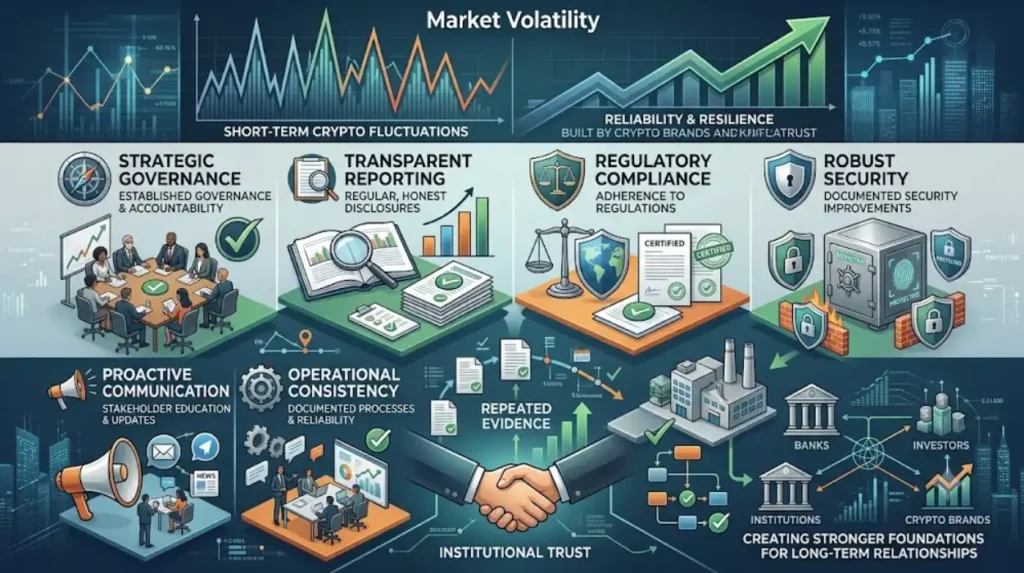
Emerging crypto brands maintain trust through operational consistency, transparent reporting, strong governance, regulatory compliance, documented security, proactive communication, and measurable accountability. Stable organizational behavior demonstrates resilience, allowing institutional stakeholders to evaluate long-term business quality independently from short-term cryptocurrency market fluctuations.
Volatile markets test operational maturity.
Organizations that continue established governance and reporting practices demonstrate resilience.
Long-term trust-building priorities
Successful organizations focus on:
- Consistent governance
- Transparent reporting
- Security improvements
- Compliance updates
- Leadership accountability
- Independent verification
- Documented operational processes
- Stakeholder education
Institutional trust develops through repeated evidence over time.
Every published report, governance update, security improvement, and compliance disclosure contributes to a documented record of operational reliability.
Organizations that maintain these practices create stronger foundations for institutional relationships regardless of changing market conditions.
Readers interested in decision-stage considerations can explore:
Time Intelligence Media Group Service Guide to understand how specialized distribution strategies support communication for financial technology organizations.