
Times Intelligence Media Group provides research and report services that organise complex information into accurate, structured, plain-English content for UK business audiences, combining research, statistical interpretation, report writing, editing, factual review, and publication-ready formatting within one workflow.
Research and report services cover the stages between information collection and final publication. The process focuses on evidence quality, factual accuracy, clear structure, consistent terminology, and accessible language.
For business research, the final report needs to communicate findings without changing their statistical meaning. A professional research report also needs consistent definitions, transparent methodology, relevant evidence, and clear conclusions based on the available data.
Times Intelligence Media Group supports this process through research writing, report development, plain-English editing, content restructuring, and quality review.
The service is relevant when an organisation has technical research material but needs a publication-ready report for executives, business stakeholders, clients, investors, professional audiences, or wider UK readers.
How does Times Intelligence Media Group turn research into a publication-ready report?
Times Intelligence Media Group converts source material into structured reports through research review, evidence organisation, statistical interpretation, plain-English drafting, editorial checking, factual validation, and final refinement, ensuring the published document retains the original findings while improving clarity, consistency, and usability.
The workflow begins with source assessment. Research papers, datasets, survey findings, interviews, technical documents, internal research notes, and existing reports are reviewed for relevance and structure.
The next stage identifies the main findings and supporting evidence. Quantitative findings remain connected to their original measurements, sample information, percentages, averages, trends, and statistical relationships.
Research review
Research review establishes:
- The research objective
- The target audience
- The evidence base
- Key findings
- Supporting statistics
- Research limitations
- Required report structure
Report development
The information is then organised into logical sections. A business research report can include an executive summary, methodology, findings, analysis, implications, recommendations, and references.
Each section has a defined purpose. This prevents background information from obscuring the main findings.
Plain-English editing
Plain-English editing simplifies sentence construction without removing technical meaning. Complex terminology is retained when it has a specific research meaning. Unnecessary jargon is removed.
This approach supports the requirements discussed in plain English for UK business research, where accessibility directly affects how effectively complex findings reach professional readers.
How does plain-English writing preserve statistical accuracy?
Plain-English writing preserves statistical accuracy by retaining original values, measures, relationships, sample details, and research conditions while simplifying sentence structure, terminology, explanations, and presentation for readers without specialist statistical training.
Statistical accuracy depends on more than retaining numbers. The surrounding language must also represent what those numbers demonstrate.
For example, a survey reporting that 62% of respondents selected a specific option does not automatically establish that 62% of the entire UK population holds the same view.
A professionally edited report distinguishes between the sample and the wider population.
Statistical terminology
Terms such as mean, median, correlation, confidence interval, response rate, sample size, and statistical significance have specific meanings. Editing preserves these meanings.
A sentence containing several technical concepts can be divided into shorter sentences without changing the underlying finding.
Numerical consistency
Figures must remain consistent throughout the report. If the findings section reports 4,250 respondents, later references must use the same sample unless a different subgroup is explicitly identified.
Percentages, totals, dates, units, currencies, and decimal values also require consistency.
Context preservation
Statistical findings require context. A percentage without its denominator, timeframe, population, or sample description can create an incomplete interpretation.
The editing process therefore connects numerical findings with the information required to understand them accurately.
Explore More Expert Insights:
Time Intelligence Media Group Research and Reports Services for Rapid-Response Data Reports in 2026
Time Intelligence Media Group Research and Reports Services for Refreshing Existing Reports in 2026
What components are included in research and reports services?
Research and reports services include research analysis, source evaluation, report writing, plain-English editing, statistical presentation, structural editing, factual review, executive summaries, visual content guidance, consistency checks, and final publication preparation for defined business audiences.
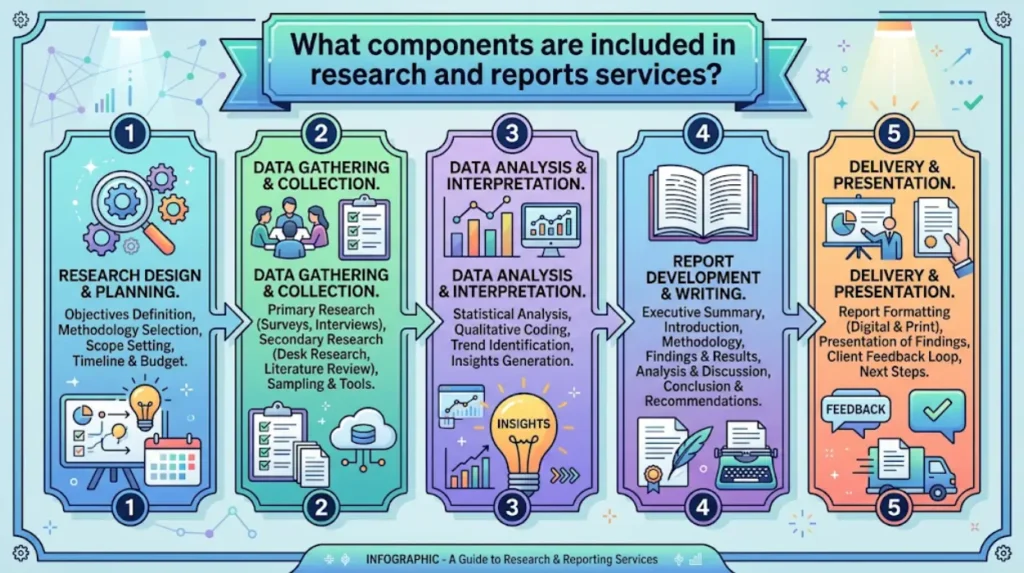
The exact service combination depends on the report requirement. Core components include the following.
Research and evidence review
Source material is examined for relevance, factual support, research objectives, and information gaps. Evidence is organised around the central research questions.
Research report writing
Findings are developed into structured sections using direct language and consistent terminology. The writing remains aligned with the evidence.
Plain-English rewriting
Technical content is rewritten for accessibility while preserving specialist meaning. Long sentences, unnecessary jargon, passive constructions, and unclear references are reduced.
Structural editing
Structural editing examines the order and relationship between sections. Repeated findings are consolidated. Supporting evidence is placed close to the claims it supports.
Statistical presentation
Statistical findings are presented with appropriate figures, percentages, measurements, timeframes, and explanatory context.
Executive summaries
An executive summary presents the purpose, key findings, significant evidence, and relevant implications without reproducing the full report.
Final editorial review
The final review checks grammar, terminology, factual consistency, numerical consistency, headings, formatting, references, and readability.
Who uses research and report writing services?
Research and report writing services support businesses, research teams, professional organisations, media groups, consultancies, analysts, and decision-makers that need accurate evidence converted into structured reports for defined UK business audiences.
Different organisations use report services at different points in the research lifecycle.
Research teams
Research teams often produce technical findings that require editorial restructuring before publication. Plain-English editing creates a version that remains technically accurate while becoming easier for non-specialist stakeholders to understand.
Business and management teams
Business teams use reports to communicate market research, customer research, workforce findings, operational analysis, and performance information.
Media and publishing organisations
Media organisations require research content that is factually controlled, clearly structured, and suitable for publication. Editing also supports consistency across multiple reports and research outputs.
Professional services organisations
Consultancies and specialist firms use reports to present research findings, industry analysis, benchmarking, survey results, and client research.
Executive audiences
Senior decision-makers typically require concise findings and clearly defined evidence. Report structure helps readers locate the information relevant to business decisions without removing supporting detail.
What benefits does professional research and report editing provide?
Professional research and report editing improves clarity, numerical consistency, structural organisation, audience accessibility, factual presentation, and publication readiness while maintaining the original evidence, research methodology, statistical meaning, and documented findings.
A professionally edited report provides a controlled connection between research evidence and its intended audience.
Clearer communication
Plain-English writing reduces unnecessary complexity. Readers can identify the research purpose, findings, and supporting evidence more efficiently.
Consistent terminology
Consistent terminology prevents different names from being used for the same concept. This is particularly important in reports containing technical, financial, scientific, or industry-specific language.
Improved evidence presentation
Well-structured sections connect claims with supporting evidence. Tables, figures, percentages, and explanatory text can be positioned according to their role in the report.
Greater publication readiness
A final editorial review identifies errors before publication. This includes inconsistent figures, unclear sentences, duplicated information, formatting issues, and terminology inconsistencies.
Better accessibility
Accessible business writing allows readers with different levels of technical knowledge to understand the findings without removing essential research detail.
How can technical research findings be translated into plain-English report sections?
Technical research findings become clear report sections when statistical results, methodology, evidence, and limitations are retained while complex sentences are reorganised into direct statements that explain what was measured, what was found, and what the findings mean.
A structured translation process helps prevent oversimplification.
First, the original finding is identified. Second, its statistical or factual meaning is established. Third, the sentence structure is simplified. Fourth, the revised statement is checked against the source.
For example, a technical statement containing a percentage, sample size, timeframe, and statistical relationship can be separated into individual sentences. The resulting section becomes easier to scan while retaining the same information.
This process aligns with translating technical findings into plain-English report sections, where accuracy remains the primary editorial requirement.
When should a business use Times Intelligence Media Group research and reports services?
A business can use Times Intelligence Media Group when research material requires professional interpretation, structured report writing, plain-English editing, statistical accuracy checks, audience adaptation, or publication preparation for UK business and professional readers.
Common service requirements include:
- Turning survey findings into business reports
- Editing technical research for non-specialist audiences
- Converting research notes into structured publications
- Preparing executive summaries
- Reviewing statistical language
- Editing market research reports
- Improving report readability
- Standardising terminology and figures
- Preparing research content for publication
- Refining existing reports before distribution
The service also supports organisations working with large volumes of research content. Consistent editorial processes help maintain the same terminology, structure, and quality standards across multiple publications.
What should businesses provide before commissioning a research and report project?
Businesses should provide the research material, intended audience, report purpose, source data, required format, publication requirements, deadline, and relevant terminology so the research and editorial workflow aligns with the evidence and final communication objective.
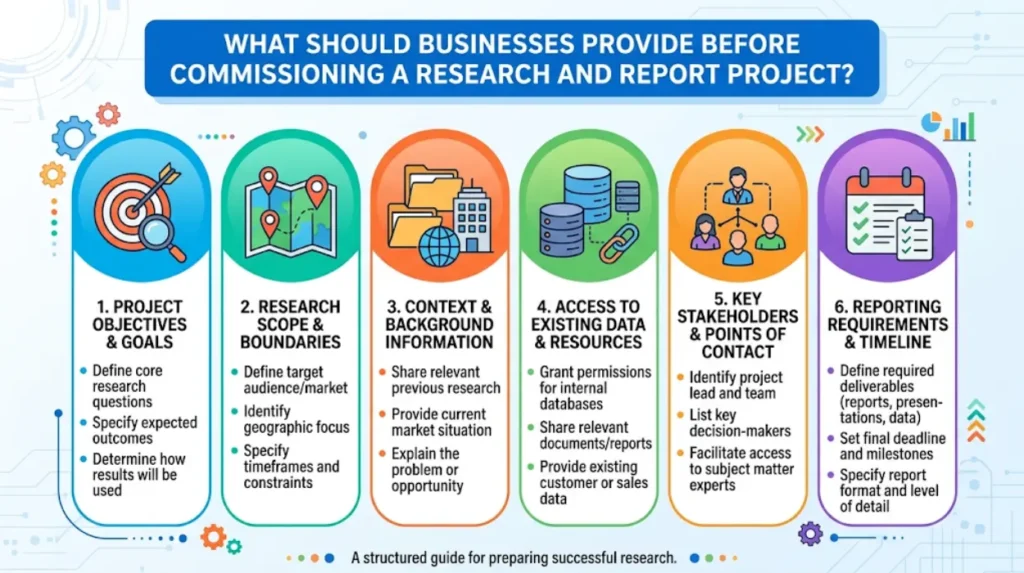
Useful project information includes the original research documents, datasets where relevant, existing drafts, methodology information, source references, brand or editorial guidelines, and publication specifications.
The intended audience also needs to be defined. A report for senior executives requires a different information structure from a technical report for analysts.
The required output format matters as well. A report designed for web publication has different structural requirements from a downloadable research report or internal corporate document.
Clear project inputs establish the editorial scope before writing begins.
How can businesses start a Times Intelligence Media Group research and reports project?
Businesses can begin by defining the report objective, supplying the available research evidence, identifying the intended UK audience, and specifying the required output, allowing Times Intelligence Media Group to structure the research, writing, editing, and final report preparation around those requirements.
The decision stage starts with the existing material. Organisations do not need to convert technical findings into finished business prose before requesting professional support.
The research documents, datasets, draft reports, tables, findings, and editorial requirements establish the working source material.
Times Intelligence Media Group can then apply a structured workflow covering research assessment, report development, plain-English writing, statistical accuracy, structural editing, and final quality control.
The result is a report designed around evidence rather than unnecessary complexity. The research remains traceable to its source material, while the language and structure are prepared for the intended audience.
For organisations seeking research and report services that combine research writing, plain-English editing, statistical accuracy, and publication preparation, Times Intelligence Media Group provides a defined workflow from source material to final report.
FAQs
Q1: What research and report writing services does Times Intelligence Media Group provide?
Ans: Times Intelligence Media Group provides research and report services that can include research support, report development, plain-English writing, editing, and presentation of complex findings. These services help turn detailed research data and technical information into clear business reports.
Q2: Why is plain-English writing important for business research reports?
Ans: Plain-English writing makes complex research findings easier for business readers to understand and apply. It can improve clarity by replacing unnecessary technical language while preserving the accuracy and meaning of the research.
Q3: Can research reports be edited for clarity and readability?
Ans: Yes, research reports can be edited to improve structure, readability, grammar, consistency, and clarity without changing the underlying findings. Professional report editing can also help ensure that technical results are communicated in accessible language.
Q4: How can technical research findings be presented in a business report?
Ans: Technical findings can be presented through clear explanations, structured sections, concise summaries, and appropriately explained data. Plain-English report writing helps decision-makers understand statistical or technical results without removing important evidence.
Q5: Who can benefit from research and report writing services?
Ans: Businesses, research teams, consultants, analysts, and organisations that need clear, evidence-based reports can benefit from these services. Research and report writing support is particularly useful when complex findings need to be communicated to non-specialist business audiences.