
Plain English makes complex research findings easier to understand, interpret, verify, and apply without removing essential evidence, statistical detail, context, or limitations from the published information for business readers.
Plain English means using familiar words, direct sentence structures, precise definitions, and clear explanations. It does not mean removing technical information. It means presenting technical information in a form that readers can understand without unnecessary linguistic barriers.
The Office for National Statistics states that its publications use plain language so readers can understand information clearly. Its guidance also reports that 80% of people prefer sentences written in plain language, including users with specialist knowledge.
For UK business readers, research findings often support decisions about workforce planning, investment, operations, customer behaviour, technology, risk, and market performance. These readers need the evidence and its meaning to be visible quickly.
The UK Statistics Authority also identifies plain English as an important feature of statistical reporting. Its standards call for an impartial narrative that explains the main messages, context, strengths, limitations, and uncertainty of statistics.
Plain English therefore improves access to complex findings without changing the underlying evidence.
What does plain English mean in research publishing?
Plain English in research publishing uses familiar vocabulary, active sentence structures, defined technical terms, precise statistics, and logical organisation so readers understand both what the research found and what the findings actually mean.
Plain English is not simplified research. It is clear research communication.
A research report can contain statistical tests, confidence intervals, regression results, sample sizes, research methods, technical terminology, and data limitations. These elements remain necessary when they affect interpretation.
The writing changes around the evidence.
For example, a technical statement can present a statistical result first and then explain its meaning in direct language. A sentence such as ” The analysis identified a statistically significant association between employee tenure and retention provides a technical finding. The following explanation can state that employees with longer tenure showed different retention patterns in the analysed dataset.
The statistical claim remains intact. The explanation gives readers a clearer route to interpretation.
What is the difference between plain English and simplified research?
Simplified research removes information that readers need. Plain English removes unnecessary complexity from the presentation.
This distinction matters because statistical accuracy depends on preserving the original meaning.
A research publisher can simplify:
- Long sentence structures
- Unnecessary jargon
- Repeated explanations
- Abstract introductions
- Undefined acronyms
- Passive constructions
- Excessive nominalisations
A research publisher must preserve:
- Sample size
- Measurement definitions
- Statistical results
- Data sources
- Research methods
- Relevant limitations
- Confidence intervals
- Statistical significance where applicable
- Time periods
- Population definitions
How can complex research findings be explained clearly without losing accuracy?
Clear research writing separates the statistical result from its explanation, defines technical terms at first use, states numbers precisely, preserves uncertainty, and gives readers enough context to interpret findings correctly.
The process begins with identifying the central finding.
A complex research project can produce dozens of measurements. The published article does not need to give every result equal prominence. The main findings need clear presentation, followed by supporting evidence.
The Office for National Statistics recommends concise main points and states that up to six bullets can communicate the most important trends or findings before detailed analysis.
Start with the finding.
Lead with the measurable result.
For example:
A survey of 2,400 UK employees found that 62% reported using automated tools at least once a week.
This sentence establishes the population, sample size, measurement, and result.
The following sentence can explain the relevance:
The finding indicates that automated tools are already part of weekly work practices for a majority of respondents in the surveyed group.
The second sentence does not replace the statistic. It interprets it.
Define technical terms when they first appear.
Terms such as confidence interval, regression coefficient, statistical significance, sample bias, and response rate have specific meanings.
A reader should not need to search a separate glossary to understand an important finding.
For example:
A 95% confidence interval of 58% to 66% indicates the range associated with the reported estimate under the statistical method used.
The definition needs to match the actual statistical method. Plain English does not permit inaccurate simplification.
Separate association from causation
Research writing must distinguish between variables being associated and one variable causing another.
If research identifies an association between training participation and employee retention, the article must not state that training caused higher retention unless the research design supports a causal conclusion.
The UK Statistics Authority specifically highlights the need to avoid misleading interpretation of statistical relationships and to consider whether a reported relationship actually demonstrates causation.
Which components make complex research findings easier to understand?
Effective research communication combines clear headings, concise summaries, precise numbers, definitions, source information, methodological context, visual evidence, and explicit explanations of limitations and uncertainty.
Each component performs a specific communication function.
Clear headings
Headings tell readers what information follows.
A heading such as Research Sample and Methodology identifies the content directly. A heading such as What Did the Research Measure? frames the same information around the reader’s question.
Main findings
The main findings identify the most important results.
They use specific numbers rather than vague expressions such as a large increase or a substantial proportion.
For example:
Customer complaints decreased from 1,850 to 1,420 between January and June.
This provides a measurable change.
Definitions
Definitions prevent readers from assigning different meanings to the same term.
A report using employee turnover needs to explain whether turnover includes voluntary departures, involuntary departures, internal transfers, or another defined category.
Context
Numbers require context.
A result of 4.2% has a different meaning depending on the population, measurement period, historical baseline, and comparison group.
The Office for Statistics Regulation states that statistical communication needs relevant context, comparisons, explanations of meaning, and information about possible misinterpretations.
Limitations and uncertainty
Research findings contain methodological boundaries.
A report needs to explain relevant limitations, including sampling limitations, missing data, measurement constraints, and uncertainty in estimates.
The UK Statistics Authority recommends explaining the strengths and limitations of statistics in relation to their potential uses.
How does plain English improve the interpretation of statistical findings?
Plain English helps readers distinguish measured results from interpretation, understand statistical terminology, recognise uncertainty, compare relevant figures, and identify the practical meaning of research without confusing clarity with statistical certainty.
Statistical accuracy depends on more than reporting the correct number.
The surrounding language also affects interpretation.
Consider a result showing that 72% of respondents selected a particular option. The report needs to state who responded, how many people participated, what question was asked, when the data were collected, and whether the result represents a wider population.
A percentage without its denominator creates incomplete information.
For example, 72% of 50 respondents and 72% of 50,000 respondents represent different quantities of observations. The statistical meaning also depends on sampling and research design.
Plain English makes these distinctions visible.
How should uncertainty be explained?
Uncertainty needs direct wording.
Confidence intervals, margins of error, prediction intervals, and other statistical measures describe different forms of uncertainty. Each term needs an accurate explanation based on the method used.
The Office for Statistics Regulation states that public statistical communication needs clear information about limitations and uncertainty and warns against placing undue certainty on statistical findings.
Plain English therefore supports statistical integrity when it explains uncertainty rather than hiding it behind technical terminology.
Explore More Expert Insights:
What Is a Rapid-Response Data Report and When Does Reacting to Breaking Industry News Make Sense in 2026?
When Should a Brand Update an Existing Research Report Rather Than Publish a New One in 2026?
Why is plain English important for UK business research?
UK business readers use research across management, finance, marketing, human resources, operations, technology, and risk, so clear language enables faster interpretation while preserving the evidence required for informed organisational decisions.

Business research often crosses professional boundaries.
A financial analyst can understand financial terminology. A human resources leader can understand workforce terminology. A technology manager can understand technical metrics. A senior decision-maker can still require information from all three areas.
Research publishing therefore needs language that supports readers with different specialist backgrounds.
GOV.UK guidance states that plain English is required for its content because information needs to remain accessible and understandable to people with different levels of literacy and expertise. It also notes that specialists prefer plain English because it allows them to understand information more quickly.
This principle applies to complex business research because specialist knowledge does not eliminate the need for efficient communication.
Where is plain English most useful when publishing research findings?
Plain English is useful in research reports, executive summaries, business articles, press materials, statistical releases, white papers, market studies, policy documents, and analytical content where readers need accurate findings without unnecessary language complexity.
Different publication formats require different levels of detail.
Executive summaries
Executive summaries present the central findings before detailed methodology.
They need precise numbers, clear conclusions supported by the evidence, and relevant limitations.
Business research articles
Research articles need enough context for readers to understand why the findings matter.
A structured article can introduce the research question, explain the methodology, present key results, interpret the findings, and identify limitations.
Statistical reports
Statistical reports require particularly careful language because wording directly affects interpretation.
The UK Statistics Authority recommends plain English narratives, explanations of technical terms, contextual information, and clear descriptions of statistical strengths and limitations.
Research summaries
Short summaries need prioritisation.
A summary cannot reproduce an entire research paper. It needs to identify the research purpose, population, principal finding, supporting evidence, and relevant limitations.
How should publishers structure complex research for business readers?
A clear structure moves from the research question to the evidence, then to interpretation, context, limitations, and implications, allowing readers to understand the finding before examining the technical detail behind it.
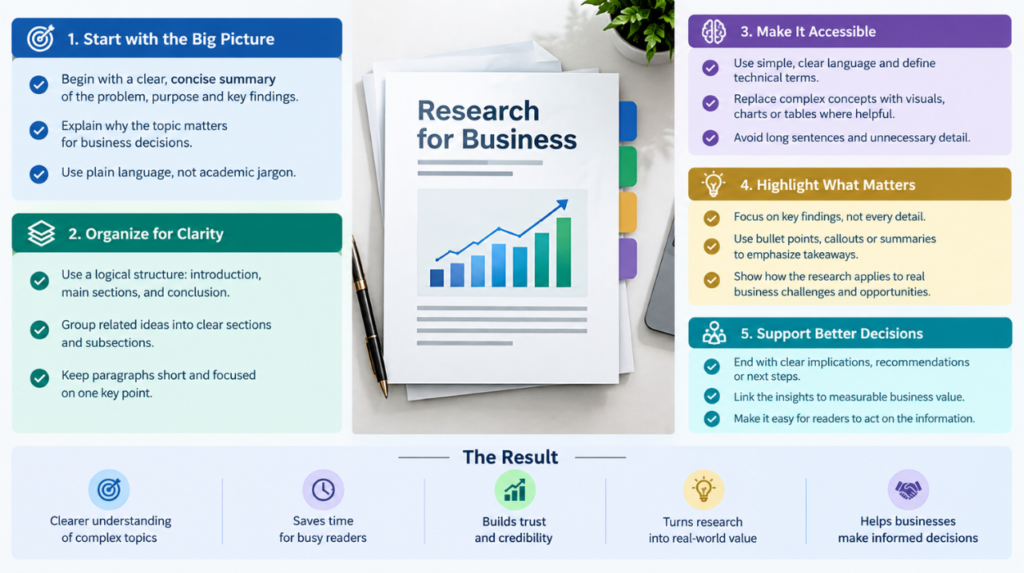
A practical structure is:
- Research question
- Research population
- Methodology
- Main finding
- Supporting statistics
- Interpretation
- Context and comparison
- Limitations and uncertainty
- Relevant implications
This structure keeps factual evidence visible.
It also separates what the research measured from what the findings mean.
The next stage of this topic examines how to translate technical findings into individual report sections while preserving statistical accuracy. That process focuses on converting technical research language into readable business content without changing the underlying evidence.
What are the main benefits of using plain English in research publishing?
Plain English improves accessibility, supports accurate interpretation, reduces unnecessary cognitive effort, clarifies statistical evidence, strengthens transparency, and helps readers identify the main research findings without removing essential technical information.
The benefits are directly connected to how research is consumed.
Clear language helps readers locate the main result. Precise definitions reduce ambiguity. Context supports interpretation. Explicit limitations prevent excessive certainty. Structured presentation helps readers distinguish evidence from explanation.
The result is not less technical research.
It is research that communicates its technical content more efficiently.
For UK business readers, this distinction is important because complex research frequently informs decisions across different professional functions. Clear publication allows each reader to access the evidence without requiring the entire audience to share the same specialist vocabulary.
Plain English therefore works as a communication standard for complex findings. It preserves numbers, methods, definitions, uncertainty, and limitations while presenting them in language that readers can understand and use accurately.
FAQs
Q1: Why is plain English important for UK business research?
Ans: Plain English makes complex research findings easier for UK business readers to understand and apply. It improves clarity without removing essential evidence, context, or statistical meaning.
Q2: How does plain English improve research reports?
Ans: Plain English improves research reports by presenting technical findings in a clear and structured way. It helps business readers identify key insights, evidence, limitations, and practical implications more efficiently.
Q3: Can complex research findings be written in plain English without losing accuracy?
Ans: Yes, technical and statistical findings can be translated into plain English while preserving their original meaning. Careful editing should retain important figures, methodology, assumptions, and limitations.
Q4: Who benefits from plain-English research reports?
Ans: Business leaders, managers, analysts, policymakers, and other non-specialist readers can benefit from plain-English research reports. Clear language helps readers interpret research evidence without requiring advanced technical knowledge.
Q5: How does Times Intelligence Media Group use plain English in research reporting?
Ans: Times Intelligence Media Group can use plain-English writing and editing to make complex research findings more accessible to UK business audiences. The approach focuses on clear explanations while retaining important evidence, terminology, and analytical context.