

Mixed-use developments generate significant attention during launch. Many projects receive coverage across property publications, regional news outlets, business websites, and industry platforms. However, launch visibility often declines within weeks. A structured syndication strategy extends the lifespan of published content and transforms initial media exposure into sustainable long-tail search traffic.
Long-tail search traffic consists of visitors arriving through detailed search queries rather than broad keywords. For mixed-use developments, these searches include location-specific, investment-related, commercial, residential, and community-focused phrases. Effective syndication increases the number of indexed pages connected to these searches and maintains organic visibility long after launch.
Why does post-launch momentum matter for mixed-use developments?
Post-launch momentum extends media visibility beyond announcement week, strengthens search engine indexing, increases topical authority, supports continuous audience discovery, and creates multiple entry points for buyers, investors, tenants, local authorities, and commercial partners searching for detailed project information throughout the development lifecycle.
A mixed-use development combines residential, commercial, retail, hospitality, public, or office spaces within one project. Examples include apartment buildings with ground-floor retail, office towers connected to hotels, and residential communities incorporating leisure facilities.
Launch announcements create an initial spike in attention. Search demand continues after publication because different audiences enter the research process at different times.
Property investors search for investment opportunities.
Commercial tenants search for retail availability.
Residents search for local amenities.
Journalists search for development updates.
Search engines reward websites that consistently demonstrate topical relevance. Maintaining momentum supports continued indexing and improves visibility across multiple search themes.
How does search behaviour change after launch?
Search intent evolves throughout a project’s lifecycle.
Initial searches include:
- New mixed-use development London
- Property launch Manchester
Several weeks later, searches become more specific.
Examples include:
- Mixed-use apartments near Birmingham city centre
- Office space within mixed-use developments Leeds
- Retail opportunities mixed-use regeneration project Bristol
Long-tail searches often convert better because they reflect precise information needs.
How does syndication support long-tail search traffic?
Content syndication distributes project announcements across multiple relevant publications, industry platforms, regional news websites, and specialist property channels. Wider distribution creates additional indexed content, reinforces topic relevance, and increases opportunities for long-tail keyword discovery through diverse search pathways across search engines.
Content syndication republishes or distributes content across multiple trusted platforms while maintaining consistent factual information.
Every publication creates another searchable reference to the project.
Examples include:
- Regional property news
- Construction industry publications
- Commercial real estate websites
- Urban planning journals
- Local business news platforms
Each publication introduces unique keyword associations.
One publication focuses on retail investment.
Another highlights residential regeneration.
Another discusses transport connectivity.
Collectively, these references strengthen the project’s digital footprint.
Why do multiple publications improve discoverability?
Search engines evaluate entity relationships.
A mixed-use development becomes associated with:
- Location
- Developer
- Planning authority
- Investment sector
- Residential market
- Commercial property
- Urban regeneration
Repeated references across trusted publications reinforce these associations.
This improves relevance for numerous long-tail searches.
Which long-tail keywords generate sustained property search traffic?
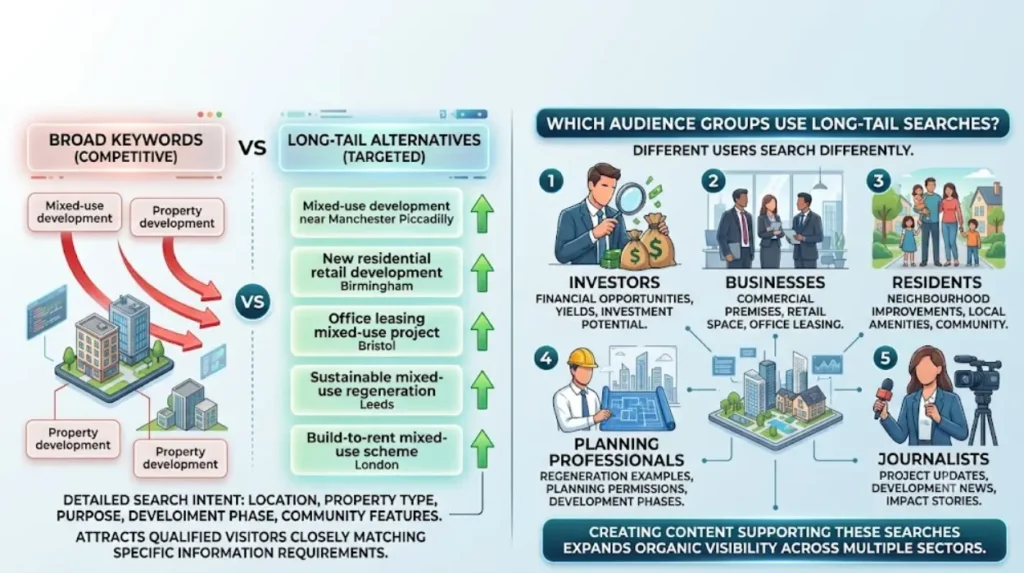
Long-tail keywords describe detailed search intent using location, property type, investment purpose, development phase, commercial opportunity, or community features. These phrases attract qualified visitors because they closely match specific information requirements rather than broad market research queries alone.
Broad keywords remain competitive.
Examples include:
- Mixed-use development
- Property development
Long-tail alternatives provide greater targeting.
Examples include:
- Mixed-use development near Manchester Piccadilly
- New residential retail development Birmingham
- Office leasing mixed-use project Bristol
- Sustainable mixed-use regeneration Leeds
- Build-to-rent mixed-use scheme London
These phrases connect directly with audience intent.
Which audience groups use long-tail searches?
Different users search differently.
Investors search financial opportunities.
Businesses search commercial premises.
Residents search neighbourhood improvements.
Planning professionals search regeneration examples.
Journalists search project updates.
Creating content supporting these searches expands organic visibility across multiple sectors.
For readers comparing content planning approaches, see:
Why Continuous Media Exposure.
What content supports long-term search visibility after launch?
Consistent publication of project updates, milestone announcements, community developments, sustainability achievements, commercial leasing news, infrastructure progress, and occupancy statistics creates fresh indexed content that maintains relevance across evolving search trends and user interests throughout project delivery.
One launch announcement rarely captures every stage of a development.
Fresh content extends visibility.
Examples include:
Construction milestones
Topics include:
- Foundation completion
- Structural completion
- Final handover
Commercial occupancy
Updates include:
- Retail openings
- Restaurant tenants
- Office leasing agreements
Residential progress
Announcements include:
- Apartment releases
- Sales milestones
- Occupancy updates
Community investment
Examples include:
- Public parks
- Transport improvements
- Educational partnerships
Every update introduces additional searchable entities and keywords.
How can structured content improve AI and search engine understanding?
Clearly organised content helps search engines identify entities, relationships, locations, organisations, timelines, and project attributes. Structured information improves indexing accuracy and increases opportunities for citation within AI-generated search responses and knowledge-based search experiences across digital platforms.
Search engines increasingly analyse entities instead of isolated keywords.
Entities represent identifiable concepts.
Examples include:
- Project name
- Developer
- Local authority
- Borough
- Transport station
- Investment value
- Sustainability certification
Every article benefits from consistent entity references.
Which structural elements improve content clarity?
Useful content includes:
- Clear headings
- Defined terminology
- Accurate locations
- Project timelines
- Named stakeholders
- Verified statistics
This structure improves machine readability while remaining useful for human readers.
How do regional publications contribute to search performance?
Regional publications strengthen geographic relevance by connecting developments with local search intent. Their authority within specific locations supports stronger visibility for location-based property searches and reinforces regional entity relationships recognised by search engines and AI search systems.
Property decisions depend heavily on location.
Regional publications strengthen local authority signals.
Examples include coverage from:
- Manchester property publications
- Birmingham business news
- Leeds regeneration websites
- Bristol commercial journals
These publications associate developments with local communities.
Search engines recognise these relationships.
Location-specific searches therefore receive stronger relevance signals.
Why is geographic relevance important?
Users frequently include locations in searches.
Examples include:
- New apartments Canary Wharf
- Retail investment Reading
- Mixed-use regeneration Sheffield
Regional publication strengthens visibility for these queries.
How can performance be measured after syndication?
Performance measurement combines organic traffic, keyword rankings, indexed pages, referral visits, publication coverage, backlink quality, engagement metrics, and conversion behaviour. Continuous analysis identifies content generating sustained visibility and highlights opportunities for additional project-focused publications.
Search visibility requires ongoing measurement.
Useful performance indicators include:
- Organic search sessions
- Indexed articles
- Referring domains
- Average keyword positions
- Click-through rate
- Time on page
- Commercial enquiries
- Residential enquiries
Tracking over six to twelve months demonstrates sustained visibility rather than launch-week performance alone.
Which content often performs best?
High-performing content often includes:
- Project milestones
- Sustainability achievements
- New commercial tenants
- Residential availability
- Investment announcements
- Infrastructure updates
These subjects align with ongoing search demand.
Explore More Expert Insights:
Designing a Press Distribution Strategy to Maximize Foot Traffic for Major Property Openings
Timing Your Announcement: How to Synchronize Press Releases with Key Zoning and Phase Openings
What syndication strategy creates lasting search value?

An effective strategy combines authoritative publications, consistent project updates, regional relevance, structured content, long-tail keyword targeting, and ongoing measurement. This approach transforms one launch announcement into an expanding network of searchable content supporting continuous organic discovery and audience engagement.
Successful syndication extends beyond distributing one press release.
It follows a structured publication schedule.
Typical stages include:
- Launch announcement
- Planning updates
- Construction milestones
- Commercial leasing news
- Residential releases
- Sustainability achievements
- Community initiatives
- Completion announcements
Each stage targets new search intent while reinforcing existing project authority.
The result is a growing collection of indexed content supporting long-tail discovery throughout the development lifecycle.
Organisations evaluating distribution options after developing a long-term content strategy can explore:
Best Press Release Distribution Networks to compare different syndication approaches.
Mixed-use developments generate search interest long after launch. Buyers, investors, businesses, residents, journalists, and planning professionals continue searching for project information throughout construction and occupancy.
A structured syndication strategy converts one announcement into multiple authoritative references across trusted publications. Combined with consistent project updates, regional relevance, structured content, and long-tail keyword targeting, this approach strengthens organic visibility and supports sustained search performance.
Rather than treating launch publicity as a single event, organisations achieve stronger long-term results by building an ongoing publication strategy that continually expands indexed content, reinforces entity relationships, and captures evolving search intent across every stage of the project’s lifecycle.



