
Property openings depend on public awareness, media visibility, and audience engagement. A press distribution strategy is a structured plan for delivering announcements to relevant media outlets, industry publications, local news organisations, and digital platforms. The objective is to increase attendance by ensuring the right people receive accurate information at the right time. A well-planned distribution strategy supports stronger event visibility, greater community engagement, and higher visitor numbers.
What is a press distribution strategy for a major property opening?
A press distribution strategy is a planned communication process that delivers property opening announcements to selected media channels, industry publications, local audiences, and digital platforms using scheduled releases, targeted messaging, and measurable distribution activities that increase public awareness before an opening event.
A press distribution strategy defines how a property announcement reaches its intended audience. It includes message development, audience segmentation, media selection, timing, and performance measurement.
For a property opening, the strategy focuses on attracting prospective buyers, investors, tenants, local residents, retailers, and business stakeholders.
Examples include:
- Residential housing developments
- Retail parks
- Commercial office buildings
- Mixed-use developments
- Shopping centres
Each audience requires different information. Investors look for commercial value. Local residents want community benefits. Buyers focus on available properties and facilities.
This targeted approach improves communication efficiency.
Why does press distribution increase foot traffic?
Press distribution increases foot traffic because repeated media exposure expands audience awareness, builds event recognition, improves local visibility, and encourages attendance through trusted news channels before the official property opening takes place across multiple communication platforms.
People attend events they know about.
Local newspapers, property publications, regional business media, community websites, and online news portals all contribute to awareness.
Repeated exposure strengthens recognition.
For example:
- A regional newspaper introduces the opening date.
- A property magazine explains development features.
- A local radio station promotes community activities.
- Business media highlights investment opportunities.
Each publication reaches a different audience segment.
Greater reach results in higher attendance potential.
Developers also benefit from increased online visibility because many news outlets publish digital versions of press releases.
Those articles continue attracting visitors before and after the launch.
Readers exploring broader awareness strategies can also review:
Massive Construction Giants for additional planning guidance.
How do you build an effective press distribution strategy?
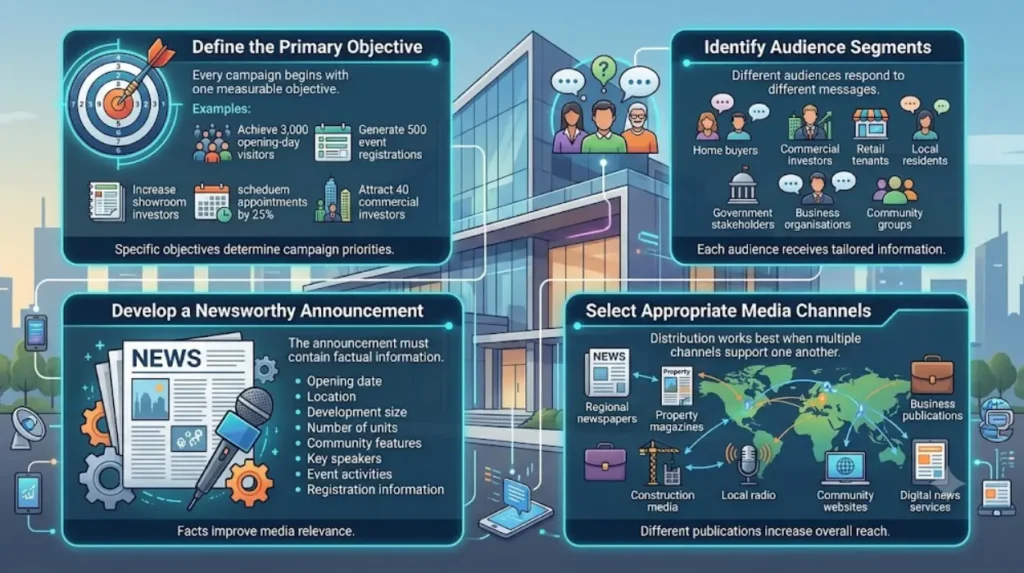
An effective press distribution strategy combines audience research, newsworthy messaging, publication selection, release scheduling, multimedia assets, and campaign measurement into one coordinated communication framework that supports strong attendance before the property officially opens to visitors.
Define the primary objective
Every campaign begins with one measurable objective.
Examples include:
- Achieve 3,000 opening-day visitors.
- Generate 500 event registrations.
- Increase showroom appointments by 25%.
- Attract 40 commercial investors.
Specific objectives determine campaign priorities.
Identify audience segments
Different audiences respond to different messages.
Typical groups include:
- Home buyers
- Commercial investors
- Retail tenants
- Local residents
- Government stakeholders
- Business organisations
- Community groups
Each audience receives tailored information.
Develop a newsworthy announcement
The announcement must contain factual information.
Include:
- Opening date
- Location
- Development size
- Number of units
- Community features
- Key speakers
- Event activities
- Registration information
Facts improve media relevance.
Select appropriate media channels
Distribution works best when multiple channels support one another.
Examples include:
- Regional newspapers
- Property magazines
- Business publications
- Construction media
- Local radio
- Community websites
- Digital news services
Different publications increase overall reach.
When should a property opening press campaign begin?
Most property opening campaigns begin six to eight weeks before launch because consistent communication provides sufficient time for journalists, community organisations, potential visitors, and industry stakeholders to plan attendance and share information across multiple channels.
Timing determines visibility.
A structured schedule improves consistency.
Six to eight weeks before opening
Release the initial announcement.
Focus on:
- Development overview
- Opening date
- Economic significance
- Community impact
Four weeks before opening
Publish detailed project information.
Include:
- Retail tenants
- Facilities
- Visitor attractions
- Public transport
- Parking availability
Two weeks before opening
Issue reminder announcements.
Highlight:
- Event programme
- Guest appearances
- Family activities
- Registration deadlines
Opening week
Distribute final reminders.
Focus on attendance information.
Include:
- Event schedule
- Opening times
- Access routes
- Live activities
Regular communication maintains audience attention throughout the campaign.
Which media channels produce the strongest local awareness?
Local awareness increases when regional newspapers, business publications, property media, digital news websites, community organisations, trade publications, and social media channels publish coordinated information using consistent messages and accurate event details throughout the campaign period.
No single channel reaches every audience.
Effective campaigns combine several communication platforms.
Regional newspapers
These publications reach local communities.
Examples include city newspapers covering housing developments and regeneration projects.
Property publications
Property journalists report development news for buyers, investors, and professionals.
These publications provide industry credibility.
Business publications
Business media highlight investment, employment, and commercial growth.
Commercial property developments benefit significantly from this audience.
Community organisations
Community associations often promote local events.
They introduce developments to nearby residents.
Digital media
Online publications improve discoverability through search engines.
Digital articles remain accessible long after publication.
Combining these channels creates broader public awareness.
What information makes a property opening announcement more newsworthy?
Newsworthy property announcements contain measurable facts, community benefits, economic impact, project milestones, visitor information, and verified development statistics presented using clear language that enables journalists to publish accurate reports without requiring significant editorial revisions.
Journalists prioritise factual information.
Useful announcement components include:
- Opening date
- Total investment value
- Building size
- Number of residential units
- Retail occupancy
- Employment created
- Sustainability certifications
- Public amenities
- Transport access
- Community partnerships
Examples strengthen reporting.
For example:
A housing development includes 320 homes.
A retail centre creates 180 permanent jobs.
A commercial office building accommodates 2,500 employees.
Specific figures improve reporting accuracy.
How do multimedia assets improve press distribution?
Multimedia assets improve press distribution because professional photographs, site maps, architectural images, executive quotations, videos, and downloadable press materials provide journalists with ready-to-publish content that strengthens coverage across print, broadcast, and digital media platforms.
Visual content increases publication quality.
Useful assets include:
- High-resolution exterior photography
- Interior images
- Architectural renderings
- Drone photography
- Location maps
- Executive headshots
- Event schedules
- Fact sheets
Video content also supports digital publications.
Journalists often prefer complete media packages because they reduce preparation time.
Organised press resources improve reporting efficiency.
How can campaign performance be measured?
Campaign performance is measured using media coverage, website traffic, event registrations, search visibility, referral sources, visitor attendance, social engagement, and post-event reporting to evaluate whether communication objectives achieved planned public awareness outcomes successfully.
Performance measurement begins before distribution.
Important metrics include:
- Number of published articles
- Media reach
- Website sessions
- Event registrations
- Telephone enquiries
- Property viewings
- Visitor attendance
- Search impressions
Comparing these metrics against campaign objectives identifies successful communication activities.
Analytics also reveal which publications generate the strongest audience response.
Future campaigns become more efficient using historical performance data.
How do different press distribution options compare?
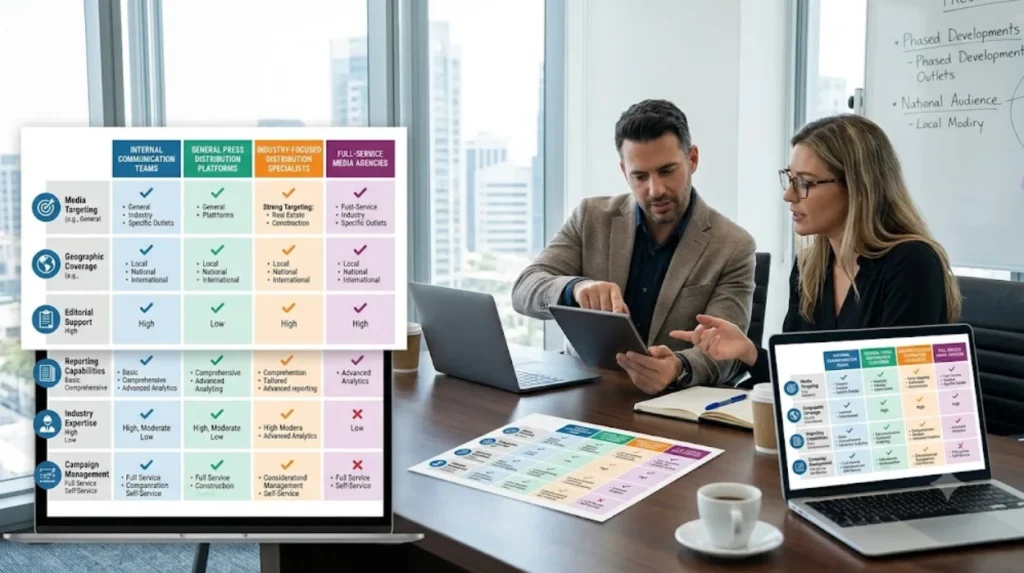
Different press distribution approaches vary according to media targeting, geographic coverage, editorial support, reporting capabilities, industry expertise, and campaign management, allowing property developers to select solutions that align with project objectives and communication requirements.
Property developers generally choose between several approaches.
These include:
- Internal communication teams
- General press distribution platforms
- Industry-focused distribution specialists
- Full-service media agencies
Selection depends on campaign scale, audience complexity, and reporting requirements.
Projects involving multiple locations, phased developments, or national audiences often benefit from broader distribution planning.
Organisations evaluating specialised property communication services can explore:
Time Intelligence Media Group Service Guide to understand how tailored distribution models differ from general news distribution options.
How does a structured press distribution strategy support long-term property marketing?
A structured press distribution strategy establishes consistent public visibility, strengthens media relationships, improves search presence, supports future announcements, and creates a documented communication framework that benefits property developments beyond their initial opening events through sustained public engagement.
Property openings represent only one milestone.
Future announcements often include:
- Phase completions
- Retail tenant launches
- Award recognition
- Sustainability achievements
- Community initiatives
- Expansion projects
A documented communication strategy provides continuity across every announcement.
Consistent media engagement builds stronger relationships with journalists and industry publications.
Repeated visibility also strengthens search engine presence as multiple trusted publications reference the development over time.
This ongoing exposure supports brand recognition, investor confidence, and community awareness throughout the lifecycle of the project.
Explore More Expert Insights:
Timing Your Announcement: How to Synchronize Press Releases with Key Zoning and Phase Openings
How to Build a Comprehensive Digital Press Kit That Captures the Attention of Property Journalists
A press distribution strategy is a structured communication framework that increases awareness before a major property opening. It combines audience targeting, newsworthy messaging, coordinated timing, appropriate media selection, multimedia resources, and measurable reporting. When these elements operate together, property developers create stronger public visibility, attract larger audiences, and establish a repeatable communication process for future project milestones across the United Kingdom.