
Display retargeting in university enrollment marketing is a digital advertising system that shows program-specific visual ads to users who previously interacted with university websites, course pages, or academic content, with the purpose of converting initial program awareness into final enrollment actions through repeated exposure and structured decision reinforcement mechanisms.
Display retargeting operates after a student has already shown interest in a program. This interest can include visiting a course page, checking admission requirements, or exploring degree details. The system records these interactions using tracking signals such as cookies and platform identifiers.
Universities in the United Kingdom use display retargeting to reconnect with prospective students across multiple websites and mobile applications. These advertisements appear while users read news, browse educational content, or use social platforms.
The function of retargeting is not awareness creation. It is decision completion. It ensures that previously interested students receive consistent reminders about specific academic programs until enrollment occurs.
This system supports structured conversion pathways across undergraduate, postgraduate, and professional education programs.
Students exploring broader funnel systems can also review:
How Universities Improve Program Awareness Using Mid-Funnel Advertising
How does display retargeting convert interest into enrollment?
Display retargeting converts interest into enrollment by tracking prior student engagement with academic content, segmenting users based on behavior, and delivering structured program reminders that reinforce application readiness, reduce uncertainty, and maintain consistent exposure to enrollment-relevant information across digital environments conversion pathway optimization system.
The process begins with behavioral tracking. When a student visits a university program page, the system records that interaction.
After tracking, students enter segmented audiences. These segments include course viewers, application starters, and incomplete application users.
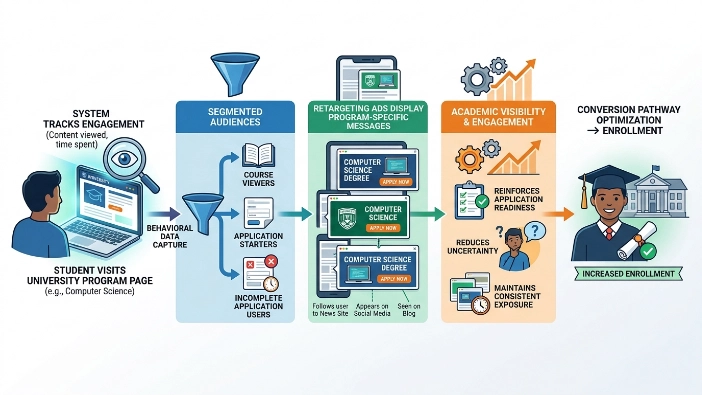
Retargeting ads then display program-specific messages. A student who viewed a computer science degree receives repeated exposure to that same program across different websites.
This repetition maintains academic visibility. It prevents interest loss caused by distraction or delayed decision-making.
The system also reduces informational gaps. Students receive reminders about entry requirements, course structure, and application deadlines through visual advertisements.
Conversion occurs when students return to the program page and complete application steps. This process transforms passive interest into active enrollment behavior.
For Online Learning Platforms, readers can explore:
How Online Learning Platforms Drive Signups Using Banner Ads
What data is used in university retargeting campaigns?
University retargeting campaigns use behavioral data, website interaction data, academic interest signals, and engagement tracking identifiers to build audience segments that represent varying levels of enrollment intent and program consideration across digital touchpoints user activity mapping system framework.
Behavioral data includes page visits, click activity, and navigation paths. A student visiting multiple engineering pages signals strong technical interest.
Website interaction data tracks actions such as course comparisons, syllabus downloads, and application page visits.
Academic interest signals identify subject-level focus. These signals categorize users into groups such as business, healthcare, computing, or arts.
Engagement tracking identifiers store anonymized user activity through cookies or platform-based IDs. These identifiers enable repeated advertisement delivery.
Universities also track time spent on program pages. Longer engagement duration indicates deeper evaluation behavior.
Application funnel data captures partial completion actions. A student who starts an application but does not submit becomes a high-priority retargeting segment.
This structured data ensures accurate targeting and reduces irrelevant advertisement exposure.
What types of display retargeting ads are used by universities?
Universities use static reminder ads, dynamic program ads, deadline-based enrollment ads, application completion ads, and testimonial-based academic ads to guide prospective students through final enrollment stages using structured visual reinforcement formats conversion-driven display system architecture.
Static reminder ads display simple program messages. These include program name, degree type, and university identification.
Dynamic program ads automatically adjust content based on user behavior. A student viewing psychology programs sees psychology-focused advertisements across websites.
Deadline-based ads highlight application timelines. These advertisements display structured admission deadlines such as “Application closes in 14 days.”
Application completion ads target students who started but did not finish enrollment forms. These ads focus on continuation of the application process.
Testimonial-based academic ads present structured student outcomes. These include graduation statistics, career pathways, and alumni progression data.
Each advertisement type plays a role in reinforcing enrollment decisions. The variation ensures continuous engagement across different decision stages.
How does retargeting improve enrollment conversion rates?
Retargeting improves enrollment conversion rates by maintaining continuous visibility of academic programs, reinforcing decision-making through repeated exposure, reducing application abandonment, and guiding students back to university program pages until final enrollment completion occurs conversion performance optimization cycle.
Continuous visibility ensures that academic programs remain present in student decision environments. Students often compare multiple institutions before applying.
Repeated exposure strengthens memory retention of program details. A student repeatedly seeing a business degree advertisement becomes more familiar with its structure.
Application abandonment is a major challenge in university enrollment systems. Retargeting reduces this issue by bringing students back to incomplete applications.
Decision reinforcement occurs through structured messaging. Students receive reminders about program value, structure, and academic outcomes.
Conversion rates improve when students revisit program pages multiple times. Each visit increases familiarity and reduces uncertainty.
In the United Kingdom, universities use retargeting to stabilize enrollment pipelines during peak admission cycles such as September and January intake periods.
What role does audience segmentation play in BOFU retargeting?
Audience segmentation in BOFU retargeting divides prospective students into high-intent categories such as program viewers, application starters, and incomplete applicants, enabling universities to deliver precise enrollment-focused advertisements aligned with specific decision stages and academic commitment levels segmentation-driven conversion modeling system.
Program viewers represent students who explored academic pages but did not begin applications. These users require structured reminders.
Application starters represent users who began enrollment forms. These users receive continuation-focused advertisements.
Incomplete applicants represent users who partially submitted applications. These users receive completion-focused messages.
Segmentation ensures that each student group receives relevant information. This increases engagement efficiency.
Universities in the United Kingdom apply segmentation across undergraduate and postgraduate programs. Each category receives distinct enrollment messaging.
Behavioral segmentation also identifies subject-specific interests. Engineering, business, healthcare, and arts programs receive tailored retargeting messages based on user activity.
This structured segmentation improves enrollment targeting accuracy.
Explore More Expert Insights:
How Coaching Centers Turn Exam Prep Interest Into Paid Registrations Using Conversion Ads
How Education Brands Convert Program Interest Into Student Applications Using Banner Ads
How do universities measure success in retargeting campaigns?
Universities measure retargeting success using conversion rate tracking, return visit frequency, application completion rates, cost per enrollment, click-through performance, and enrollment attribution data to evaluate how effectively display advertising converts program interest into final student registrations performance analytics framework system.
Conversion rate tracking measures the percentage of retargeted users who complete enrollment actions.
Return visit frequency measures how often students revisit program pages after seeing retargeting ads.
Application completion rates track the number of finished applications compared to started applications.
Cost per enrollment measures the financial efficiency of converting one student through advertising systems.
Click-through performance measures how many users engage with retargeting advertisements.
Enrollment attribution connects final student registrations back to specific advertising exposures.
These metrics provide structured insight into campaign performance. Universities adjust advertising frequency, audience segments, and message structure based on this data.
Why is display retargeting essential in university enrollment funnels?
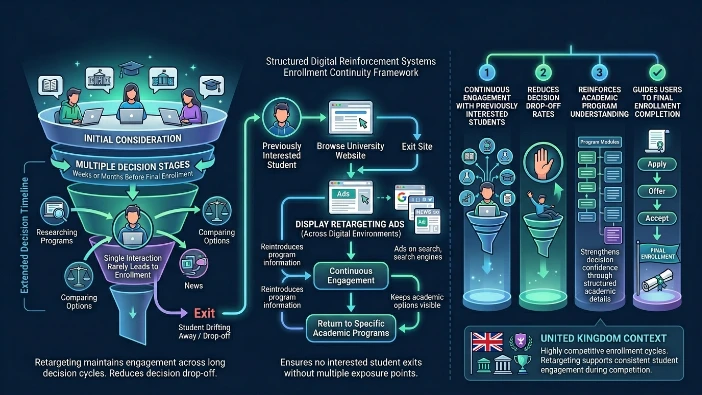
Display retargeting is essential in university enrollment funnels because it ensures continuous engagement with previously interested students, reduces decision drop-off rates, reinforces academic program understanding, and guides users from initial consideration to final enrollment completion through structured digital reinforcement systems enrollment continuity framework.
University enrollment funnels involve multiple decision stages. Students rarely enroll after a single interaction. Retargeting maintains engagement across extended decision timelines. Students often take weeks or months before final enrollment.
It reduces drop-off rates by reintroducing program information across digital environments. This keeps academic options visible. It also strengthens decision confidence. Students receive repeated exposure to structured academic details.
In the United Kingdom, enrollment cycles are highly competitive across universities. Retargeting supports consistent student engagement during this competition period. The system ensures that no interested student exits the funnel without multiple exposure points.