
Smaller development firms often compete against established construction groups with larger budgets, broader recognition, and longer project portfolios. Credibility becomes the deciding factor when investors, planning authorities, buyers, tenants, and local communities evaluate competing developments.
Credibility is measurable. It comes from consistent project delivery, transparent communication, regulatory compliance, financial stability, professional leadership, and visible industry recognition. These factors allow lesser-known developers to establish trust without matching the scale of national construction businesses.
Why does credibility matter for smaller development firms?
Credibility gives smaller development firms objective proof of reliability through transparent performance, regulatory compliance, consistent communication, successful project delivery, qualified leadership, and independent validation. These measurable indicators reduce uncertainty for investors, planning authorities, buyers, lenders, suppliers, and local communities across every development stage.
Property development involves significant financial commitments and long project timelines. Every stakeholder evaluates risk before making decisions.
A development firm is a business responsible for acquiring land, securing planning permission, arranging finance, managing construction, and delivering completed property assets.
Construction giants possess established reputations built over decades. Smaller firms build confidence by demonstrating measurable evidence instead of relying on brand recognition.
Which stakeholders evaluate credibility?
Several stakeholder groups examine a developer before engaging with a project.
These include:
- Planning authorities
- Institutional investors
- Private investors
- Mortgage lenders
- Contractors
- Architects
- Housing associations
- Commercial tenants
- Residential buyers
- Local communities
Each stakeholder uses different evidence to assess trustworthiness.
How do construction giants establish market trust?
Large construction companies establish trust through extensive project histories, recognised governance systems, national visibility, financial reporting, established supply chains, workforce capacity, accredited management systems, and repeated successful delivery across multiple property sectors within the United Kingdom.
Large organisations possess substantial operational records.
Their completed developments demonstrate long-term delivery capability.
Annual reports provide financial transparency.
Accreditations confirm compliance with recognised standards.
Repeated project completion strengthens confidence among procurement teams and investors.
Which characteristics increase trust?
Several measurable characteristics strengthen organisational credibility.
Examples include:
- More than 100 completed developments
- Multi-year audited financial statements
- ISO-certified management systems
- Public sustainability reporting
- Established health and safety performance
- Long-term contractor partnerships
These indicators provide independently verifiable evidence.
How can smaller development firms build credibility without matching corporate size?
Smaller development firms establish credibility by presenting verifiable evidence of competence, transparent governance, completed projects, experienced leadership, financial discipline, regulatory compliance, community engagement, and measurable delivery performance instead of relying on organisational scale or market dominance alone.
Organisational size does not determine project quality.
A developer with ten successful projects provides measurable evidence of capability.
Every completed scheme strengthens its professional record.
Each published milestone improves transparency.
Build an accessible project portfolio
A project portfolio documents completed developments.
It includes:
- Project location
- Completion date
- Development value
- Building type
- Delivery timeline
- Professional partners
- Planning outcomes
Specific information increases credibility.
Publish leadership experience
Leadership profiles explain who manages developments.
Relevant information includes:
- Professional qualifications
- Industry experience
- Previous developments
- Membership of recognised professional bodies
Named individuals create accountability.
Demonstrate regulatory compliance
Compliance confirms adherence to legal requirements.
Examples include:
- Planning approval
- Building Regulations compliance
- Environmental assessments
- Fire safety documentation
Published compliance records reduce uncertainty.
What evidence strengthens a developer’s reputation?

Independent evidence strengthens reputation because external verification demonstrates objective performance through completed developments, professional certifications, financial records, planning approvals, customer satisfaction, industry recognition, sustainability reporting, and documented project outcomes rather than unsupported marketing statements or promotional claims.
Evidence supports factual evaluation.
Independent verification carries greater weight than self-published claims.
Completed developments
Completed projects provide observable proof.
Each finished scheme demonstrates delivery capability.
Examples include residential estates, mixed-use developments, commercial offices, logistics facilities, and affordable housing projects.
Professional certifications
Professional certifications verify recognised standards.
Examples include:
- ISO 9001 Quality Management
- ISO 14001 Environmental Management
- ISO 45001 Occupational Health and Safety
These certifications involve structured external assessment.
Planning success
Planning approval demonstrates regulatory acceptance.
Successful applications indicate detailed preparation and compliance with local planning policy.
Financial transparency
Financial transparency includes published accounts, audited reports, and documented funding arrangements where applicable.
Financial evidence strengthens confidence among lenders and investors.
How does transparent communication improve public confidence?
Transparent communication improves confidence because stakeholders receive accurate project information, realistic timelines, planning updates, construction progress, environmental commitments, and leadership accountability through consistent factual reporting rather than incomplete or inconsistent public information across project phases.
Development projects affect communities for several years.
Residents expect reliable information.
Planning authorities require accurate documentation.
Investors expect measurable progress.
Publish regular project updates
Project updates explain:
- Construction progress
- Planning milestones
- Infrastructure works
- Completion schedules
- Community engagement
Regular reporting demonstrates accountability.
Explain project objectives
Every development exists for a defined purpose.
Clear explanations help stakeholders understand:
- Housing provision
- Commercial expansion
- Regeneration
- Infrastructure improvements
Defined objectives reduce misunderstanding.
How do community relationships influence developer credibility?
Community relationships strengthen credibility because developers demonstrate responsible engagement through consultation events, public feedback processes, local employment opportunities, environmental improvements, and transparent responses to concerns before, during, and after construction activity within affected neighbourhoods.
Property developments directly influence surrounding communities.
Residents evaluate developers throughout the planning and construction process.
Constructive engagement creates measurable public records.
Hold structured consultation events
Consultation events gather local feedback before construction begins.
Developers document attendance, questions, and responses.
This creates transparent engagement records.
Respond to community concerns
Common concerns include:
- Traffic
- Noise
- Parking
- Environmental impact
- Construction hours
Published responses demonstrate accountability.
Which professional partnerships increase industry confidence?
Professional partnerships improve credibility because recognised architects, engineers, surveyors, planners, legal advisers, contractors, and environmental consultants contribute specialist expertise supported by regulated qualifications, professional standards, and documented project responsibilities throughout property development.
Development projects involve multidisciplinary teams.
Professional collaboration demonstrates organised project management.
Work with regulated professionals
Examples include:
- Chartered surveyors
- Chartered architects
- Civil engineers
- Planning consultants
- Environmental specialists
- Structural engineers
Each profession operates within recognised standards.
Maintain consistent delivery teams
Long-term professional relationships improve operational consistency.
Repeated collaboration strengthens project management efficiency.
How does digital visibility support credibility?
Digital visibility supports credibility by providing accurate, accessible, and regularly updated information about projects, leadership, planning activity, completed developments, regulatory compliance, sustainability initiatives, and public communications through trusted digital channels and authoritative online sources.
Stakeholders research developers before making decisions.
Digital information often forms the first impression.
Accurate information improves transparency.
Maintain current project information
Published information includes:
- Active developments
- Completed projects
- Company leadership
- Contact information
- Planning documentation
- Sustainability commitments
Current information reduces uncertainty.
Publish factual educational content
Educational content explains planning processes, development stages, sustainability practices, and construction standards.
This improves public understanding of the development process.
Readers seeking practical planning after understanding credibility strategies can continue with:
Designing a Press Distribution Strategy to learn how communication planning supports major property openings.
Explore More Expert Insights:
Why New Real Estate Startups Fail to Secure Institutional Funding Without a Strategic Media Presence
The Direct Impact of Media Authority on Building Local Community Trust for Controversial Projects
How do long-term results create lasting credibility?
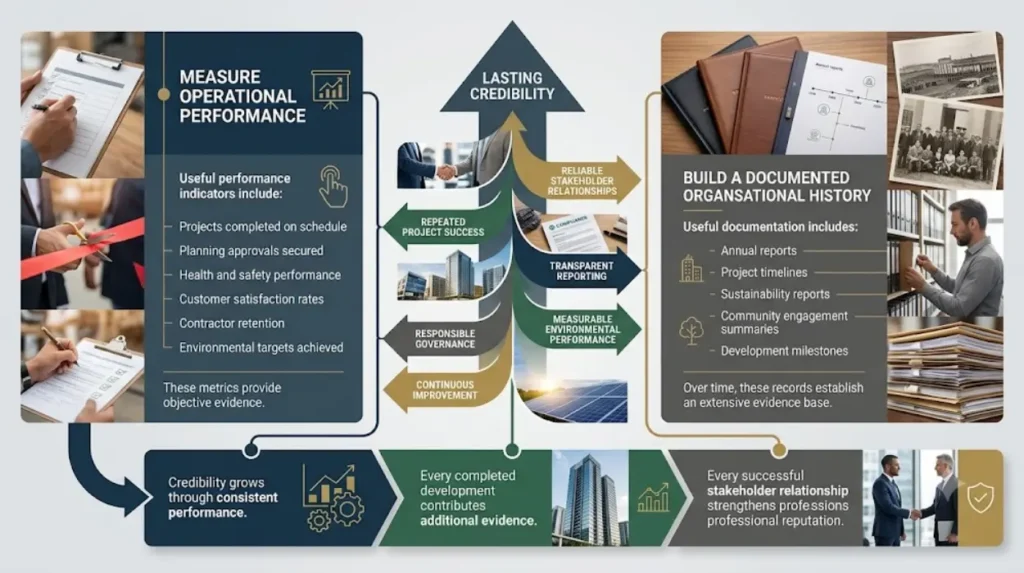
Long-term credibility develops through repeated project success, reliable stakeholder relationships, consistent regulatory compliance, transparent reporting, responsible governance, measurable environmental performance, and continuous improvement across multiple completed developments over several years of sustained operation.
Credibility grows through consistent performance.
Every completed development contributes additional evidence.
Every successful stakeholder relationship strengthens professional reputation.
Measure operational performance
Useful performance indicators include:
- Projects completed on schedule
- Planning approvals secured
- Health and safety performance
- Customer satisfaction rates
- Contractor retention
- Environmental targets achieved
These metrics provide objective evidence.
Build a documented organisational history
Historical records demonstrate continuity.
Useful documentation includes:
- Annual reports
- Project timelines
- Sustainability reports
- Community engagement summaries
- Development milestones
Over time, these records establish an extensive evidence base.
As organisations progress from educational understanding to evaluating structured communication approaches, the topic:
Custom PR Distribution provides further context about specialised distribution strategies within the property sector.
Smaller development firms build credibility through measurable performance rather than organisational size. Transparent governance, completed projects, regulatory compliance, professional leadership, community engagement, financial accountability, and consistent communication provide objective evidence that stakeholders use when assessing trust.
Construction giants benefit from established market recognition, but credibility remains evidence-based. A documented history of successful developments, verified standards, qualified professionals, and transparent reporting allows under-the-radar development firms to establish confidence with investors, planning authorities, buyers, lenders, suppliers, and local communities across the United Kingdom.