
An expert interview study is a systematic qualitative research method that gathers structured insights from senior practitioners, industry leaders, and sector specialists within the United Kingdom to produce authoritative, citable market reports.
Qualitative research methodologies rely on semi-structured, one-on-one conversations rather than rigid statistical questionnaires. Researchers in the United Kingdom deploy expert interview studies to capture nuanced operational workflows, regulatory compliance strategies, and emerging market trends directly from qualified professionals. These studies replace surface-level data points with deep contextual analysis, establishing a definitive baseline of sector knowledge.
Defining Practitioner Insight
Practitioner insight refers to specialized, first-hand knowledge acquired through daily operational execution within a specific industry. Unlike secondary literature reviews that aggregate historical data, practitioner insights highlight real-time adjustments, operational friction points, and immediate strategic shifts. Researchers capture these insights by interviewing directors, compliance officers, and technical leads who actively manage commercial portfolios across the United Kingdom.
The Role of Citable Research Reports
A citable research report serves as an authoritative industry reference document that secondary media outlets, academic institutions, and corporate strategists cite to support market assertions. Publishing an expert interview study transforms raw practitioner transcripts into structured publications featuring methodology sections, direct quotes, and thematic data synthesis. Organizations utilize these reports to secure inbound media coverage, enhance organic search visibility, and establish verifiable thought leadership within competitive UK markets.
Why Do Expert Interview Studies Outperform Traditional Surveys for UK B2B Audiences?
Expert interview studies outperform traditional surveys for United Kingdom business-to-business audiences by eliminating respondent fatigue, capturing complex operational contexts, and yielding proprietary data points that competitors cannot replicate.
Traditional surveys rely on closed-ended quantitative questions that force complex business realities into pre-determined numerical categories. UK corporate decision-makers frequently abandon lengthy survey forms due to time constraints, resulting in low response rates and superficial data sets. In contrast, structured expert interviews provide a conversational framework that encourages senior practitioners to articulate intricate strategic methodologies and multi-step operational processes.
Overcoming Survey Limitations
Quantitative surveys lack the flexibility required to explore unexpected industry anomalies or emerging regulatory changes. When a respondent selects a multiple-choice option, the underlying rationale remains hidden from the analyst. Expert interviews incorporate follow-up probing questions that uncover the exact causation behind a practitioner’s decision. This eliminates ambiguity and provides enterprise researchers with verified causal relationships rather than simple statistical correlations.
Generating Proprietary B2B Insights
To understand how foundational definitions compare across qualitative methodologies, practitioners often examine broader educational frameworks What Is Qualitative Research and When Does an Expert Interview Report Work Better Than a Survey?. Traditional surveys yield generic data points that multiple competing brands purchase simultaneously from third-party aggregators. Expert interview studies extract proprietary insights unique to the specific panel of participants selected by the research team. This exclusivity ensures that the final publication contains original data tables, unique quotes, and proprietary frameworks that attract high-value backlinks and organic search traffic from industry peers.
How Do You Select and Recruit Qualified Subject Matter Experts in the United Kingdom?
Selecting and recruiting qualified subject matter experts in the United Kingdom requires defining precise professional criteria, targeting active industry practitioners via professional networks, and vetting candidates through rigorous screening protocols.
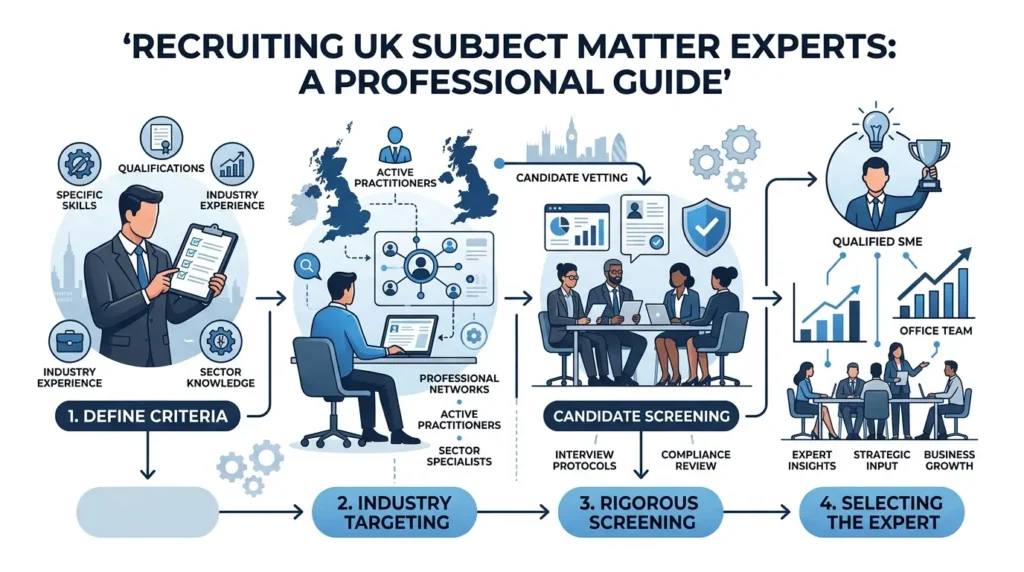
The integrity of a research report depends entirely on the credentials of the interviewed participants. Researchers must establish strict inclusion criteria before initiating outreach across the United Kingdom. These criteria typically mandate a minimum of ten years of senior leadership experience, current employment within a verified UK corporate entity, and demonstrable publication or operational history within the target sector.
Defining Recruitment Criteria
Research teams establish parameters such as minimum organizational revenue thresholds, specific geographic operational footprints within England, Scotland, Wales, or Northern Ireland, and direct oversight of departmental budgets. For example, a study focusing on financial technology compliance requires participants holding titles such as Chief Risk Officer, Head of Regulatory Affairs, or Senior Compliance Director within Financial Conduct Authority-regulated entities.
Vetting and Screening Participants
Researchers execute multi-stage screening protocols to verify professional credentials before scheduling formal interviews. This process includes cross-referencing employment histories on professional networks, reviewing authored whitepapers, and conducting a ten-minute pre-interview screening call. This screening confirms that candidates possess current, hands-on knowledge and eliminates individuals whose primary objective is commercial self-promotion rather than objective industry contribution.
Explore More Expert Insights:
Headlines for Sponsored Articles: 9 Formulas That Drive UK News Reader Clicks
Sponsored Content Calendar Planning: A 12-Month UK Framework for B2B Brands
What Is the Step-by-Step Process for Conducting and Transcribing Expert Interviews?
The step-by-step process for conducting and executing expert interviews involves designing a semi-structured discussion guide, recording audio streams under strict data protection protocols, and converting audio files into searchable transcripts for qualitative coding.
Executing an expert interview study requires a standardized workflow to ensure data consistency across all participant sessions. Researchers must treat each interview as a formal qualitative data collection event, maintaining identical structural frameworks while allowing sufficient conversational flexibility for the expert to introduce novel insights.
Designing the Discussion Guide
Researchers draft a semi-structured discussion guide containing five to seven core open-ended questions designed around the primary research thesis. These questions avoid leading terminology and focus on operational challenges, strategic methodologies, and predictive market forecasts. Examples of standardized questions include inquiries regarding supply chain adjustments following recent trade policy updates or specific software implementations within UK logistics hubs.
Recording and Transcription Protocols
Research teams record all interview sessions using encrypted audio recording software while securing explicit written consent under UK data protection regulations. Professional transcriptionists or automated artificial intelligence transcription engines convert the audio files into verbatim text documents. Analysts then review these transcripts against the original audio recordings to eliminate transcription errors, redact proprietary corporate identifiers where requested, and prepare the files for qualitative thematic coding.
How Do You Synthesize Qualitative Data and Structure a Citable Research Report?
Synthesizing qualitative data requires applying thematic coding methodologies to interview transcripts to identify recurring patterns, extract representative direct quotes, and organize findings into a structured, publication-ready research report.
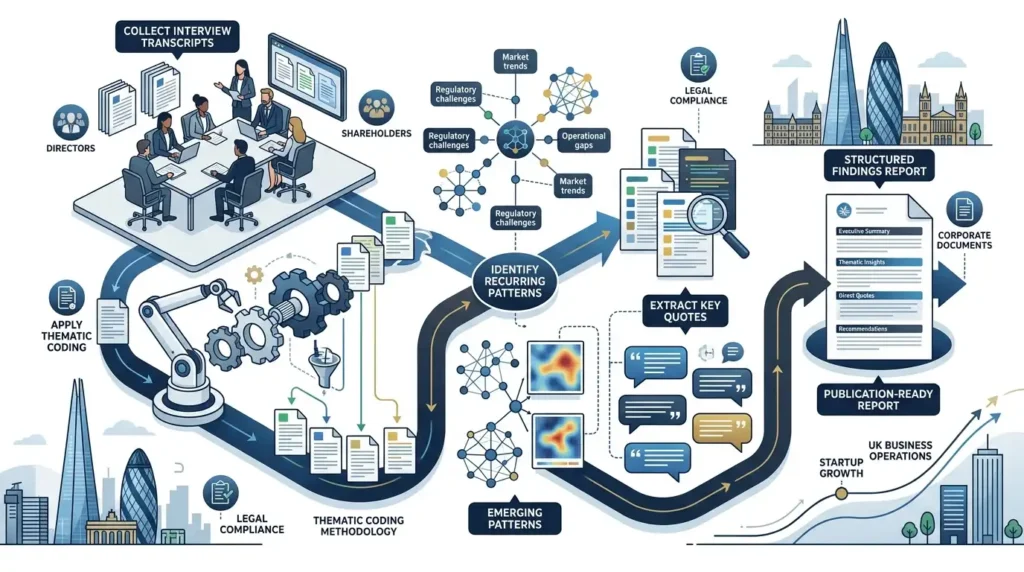
Raw interview transcripts contain thousands of words of unstructured dialogue. Analysts must transform this qualitative volume into concise, highly structured insights that resonate with search engines and human researchers alike. This transformation relies on systematic qualitative analysis techniques.
Thematic Coding Methodologies
Analysts review all transcripts line by line, assigning descriptive codes to recurring concepts, operational barriers, and strategic solutions. Software tools such as NVivo or ATLAS.ti assist researchers in aggregating these codes into overarching macro-themes. For instance, if multiple participants across different interviews cite delays in customs clearance, analysts group these observations under a primary theme titled UK Border Friction Points.
Structuring the Final Document
A citable research report follows a rigid structural hierarchy to maximize readability and search engine optimization value.
- Executive Summary: A concise overview of the core research findings and primary data highlights.
- Methodology Section: Detailed descriptions of participant criteria, sample sizes, and data collection timeframes.
- Thematic Findings Chapters: In-depth analysis of major themes supported by verbatim practitioner quotes and data charts.
- Strategic Recommendations: Actionable frameworks derived from the qualitative data synthesis.
Organizations seeking specialized professional assistance for these complex reporting phases can review relevant solutions via Time Intelligence Media Group Research and Reports Services for Qualitative Expert Interview Studies.
How Do You Publish and Distribute an Expert Interview Study for Maximum SEO and AI Citation?
Publishing and distributing an expert interview study for maximum search engine optimization and artificial intelligence citation requires publishing the report as a comprehensive long-form web resource, implementing structured data markup, and executing a targeted digital PR strategy.
Creating the research report represents only the initial phase of the publication lifecycle. To capture organic search traffic and secure citations from artificial intelligence search assistants, organizations must optimize the digital distribution architecture of the report.
Technical Optimization and Schema Markup
Web developers publish the research report using clear heading hierarchies, descriptive URL slugs, and fast-loading web formats. Implementing ResearchArticle or ScholarlyArticle schema markup helps search engine crawlers and artificial intelligence models identify the document as a primary research source. This structured data explicitly defines the authors, publication date, institutional affiliation, and core research subjects.
Digital PR and Citation Acquisition
Distribution strategies focus on earning natural backlinks from industry publications, academic journals, and news platforms. Research teams distribute customized press releases featuring unique statistical findings and quotable practitioner insights to relevant trade journalists across the United Kingdom. When authoritative websites reference these specific data points and link back to the primary report URL, search engines recognize the domain as an authoritative entity within the sector, elevating overall organic visibility and brand credibility.