
Qualitative research is a systematic scientific inquiry that gathers non-numerical data through methods such as interviews, observations, and focus groups to understand underlying social patterns, human experiences, and institutional behaviors.
Qualitative research focuses on depth of meaning, contextual nuances, and textual data rather than statistical significance or numerical frequency. Quantitative research relies on large sample sizes, standardized closed-ended questionnaires, and statistical analysis to test predetermined hypotheses across broad populations. Qualitative investigations explore why and how phenomena occur, whereas quantitative metrics measure how many or how often specific events take place. Researchers deploy qualitative designs when studying complex, poorly understood domains where variables remain undefined prior to data collection.
Core characteristics of qualitative methodologies
Qualitative frameworks operate within natural settings where researchers interact directly with participants. Investigators act as primary research instruments, observing verbal and non-verbal cues during live interactions. Data collection instruments evolve dynamically as fieldwork progresses, allowing researchers to pursue emerging themes and unexpected insights. Inductive data analysis permits researchers to build abstract concepts, categories, and theories directly from raw text, transcripts, and field notes.
What defines an expert interview report in academic and market research?
An expert interview report is a structured, synthesized document that compiles, analyzes, and contextualizes qualitative insights gathered from specialized practitioners, industry leaders, and academic authorities.

Expert interview reports transform unstructured conversational data into rigorous, citable evidence. Researchers recruit practitioners with verified domain expertise, such as senior NHS clinical directors, fintech compliance officers, or chartered civil engineers, to discuss specialized operational challenges. The resulting document presents direct thematic findings, verified operational frameworks, and critical industry commentary. Analysts categorize transcripts into distinct thematic codes to isolate high-value insights from standard industry chatter.
Key components of a professional expert interview report
Professional interview reports incorporate explicit methodological transparency, detailing participant inclusion criteria, recruitment protocols, and interview duration metrics. The structural core contains verbatim quotations paired with analytical commentary that explains the systemic relevance of each perspective. Reports conclude with synthesized strategic takeaways, risk assessments, and prospective industry forecasts derived from aggregate expert consensus.
Explore More Expert Insights:
How Online Retailers Recover Abandoned Carts Using Banner Advertising
How E-commerce Stores Boost Sales Using Retargeting Banner Ads
When does an expert interview report work better than a quantitative survey?
An expert interview report works better than a survey when investigating novel, highly complex, or heavily regulated industry topics where standard questionnaires fail to capture operational realities.
Surveys require respondents to select answers from predefined choices, which restricts responses to existing knowledge frameworks. When investigating emerging sectors, such as decentralized clinical trials or AI-driven municipal infrastructure in the United Kingdom, standard survey instruments miss critical nuances. Expert interviews allow adaptive probing, enabling interviewers to redirect questions based on real-time disclosures. Surveys produce superficial metrics when respondents lack deep domain literacy, whereas expert interviews target vetted specialists who possess authoritative, firsthand operational experience.
Comparative evaluation of research contexts
| Research Dimension | Expert Interview Report | Quantitative Survey |
| Primary Goal | Deep contextual understanding and causal mechanics | Statistical prevalence and population measurement |
| Participant Criteria | Vetted specialists with senior domain authority | Large random or stratified demographic samples |
| Data Format | Textual transcripts, thematic codes, verbatim quotes | Numerical datasets, percentages, frequency distributions |
| Adaptability | High flexibility for real-time exploratory probing | Fixed instrument with zero mid-stream modification |
What is the step-by-step process for executing a rigorous expert interview study?
Executing a rigorous expert interview study requires a systematic five-stage workflow encompassing research design, specialist recruitment, semi-structured interviewing, thematic transcription analysis, and formal report publication.
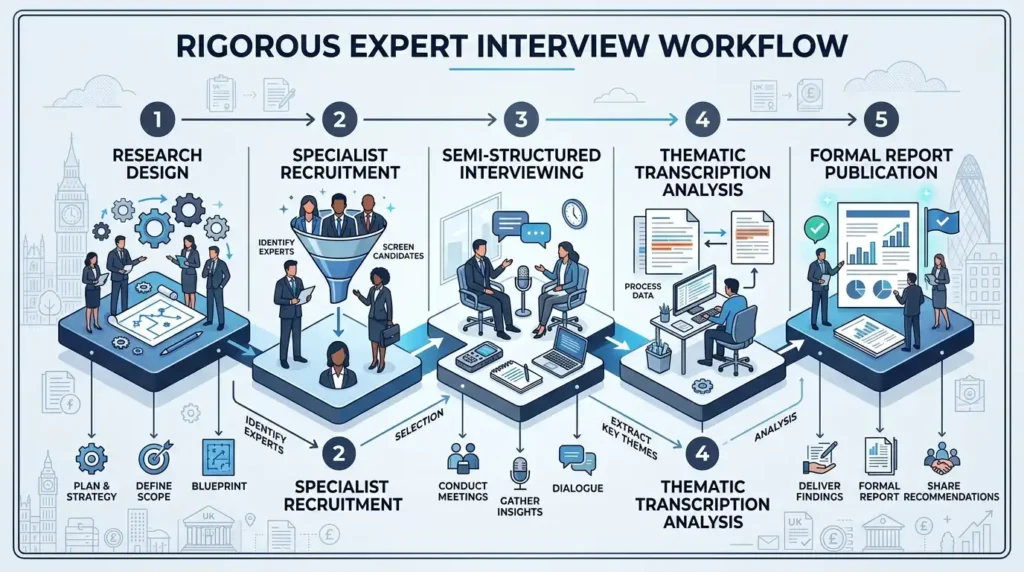
The process begins with defining precise research objectives and establishing strict inclusion criteria for prospective specialists. Researchers then draft a flexible discussion guide containing open-ended prompts designed to elicit detailed operational workflows and strategic insights. Fieldwork execution involves conducting recorded one-on-one sessions via secure digital platforms or in-person venues across British urban centers like London, Manchester, and Edinburgh. Transcripts undergo rigorous coding using qualitative data analysis software to isolate recurring themes, operational bottlenecks, and divergent perspectives.
Best practices for practitioner recruitment and data coding
Recruiting high-value professionals requires personalized outreach that clearly communicates research objectives, institutional value, and time commitments. Researchers achieve optimal validity by employing thematic saturation, concluding data collection only when subsequent interviews yield zero novel insights. Coders apply explicit codebooks to categorize textual data, ensuring high inter-coder reliability before drafting the final publication.
What are the primary benefits of publishing expert interview reports for UK organizations?
Publishing expert interview reports provides UK organizations with authoritative thought leadership, high-value media citations, strategic market clarity, and verifiable primary data assets.
Industry reports grounded in primary qualitative research attract high-value inbound links from trade publications, academic journals, and major news outlets. British businesses use these publications to establish regulatory credibility when operating within complex sectors like financial services, healthcare technology, and renewable energy. Furthermore, primary research assets replace generic content marketing with proprietary data that competitors cannot replicate, strengthening brand authority across search engine results pages and AI citation engines.