

A sponsored article needs clear authorship, relevant credentials and verifiable sources. The process starts by identifying the subject, assigning a qualified author, documenting expertise, citing reliable evidence and publishing transparent attribution that readers can independently verify.
Sponsored content sits between editorial communication and commercial communication. Its purpose is to communicate a defined message while providing useful information to the intended audience. Clear authorship and evidence help readers understand who created the content, what expertise supports it and where factual claims originate.
Google Search guidance emphasises clear authorship information, accurate bylines and accessible information about the creator. Google also states that E-E-A-T represents experience, expertise, authoritativeness and trustworthiness, with trust being the most important aspect. E-E-A-T itself is not a specific ranking factor.
For publishers and brands, the practical task is therefore straightforward: connect the article to a real person, connect that person to relevant expertise and connect important claims to evidence.
What information belongs in a sponsored article author profile?
A sponsored article author profile identifies the real author, relevant professional credentials, current role, subject expertise and an accessible profile that allows readers to verify the person behind the content.
Name and professional role
The byline needs the author’s real name. It identifies responsibility for the article and gives readers a clear answer to who created the content.
For example:
Written by Sarah Mitchell, Financial Services Researcher
The role needs to match the subject. A financial services article needs an author with relevant financial, economic, regulatory or research experience.
Credentials and expertise
Credentials explain why the author knows the subject. Relevant information includes:
- Professional qualifications
- Industry certifications
- Academic qualifications
- Current professional role
- Years of relevant experience
- Published research
- Specialist areas
- Professional memberships
Credentials need to be accurate. Google specifically warns against fabricated creator profiles, made-up names and false credentials.
Author profile
An author page provides additional context. It can include the person’s biography, professional history, specialist topics and previous publications.
Google’s article structured-data guidance recommends providing author information and using properties such as url or sameAs to help identify the author.
This creates a consistent connection between the visible byline, the author profile and the structured data.
How do you select a qualified author for sponsored content?
Select an author whose documented experience directly matches the article subject, then verify professional qualifications, published work, current expertise and identity before adding the byline to the sponsored article.
Step 1: Define the subject
Identify the exact subject before selecting the author.
A broad topic can contain multiple specialist areas. Digital transformation, for example, can involve artificial intelligence, cybersecurity, cloud computing, data management and organisational change.
Each area requires different subject knowledge.
Step 2: Match expertise to the subject
Create a direct relationship between the topic and the author’s background.
For example, a sponsored article about UK payroll compliance requires an author with relevant payroll, employment, accounting or HR knowledge. An article about enterprise cybersecurity requires a person with cybersecurity, information security or technology expertise.
Step 3: Verify the author
Check professional information before publication.
Useful verification points include the author’s professional profile, employer biography, published work, professional organisation membership and relevant qualifications.
Verification reduces ambiguity around authorship and prevents inaccurate credentials from entering the publication process.
For a broader explanation of the role of named authors and expert credentials, the related educational content provides additional context.
How should professional credentials be displayed beside the byline?
Display the author’s name first, followed by a concise role or credential statement and a link to a detailed author profile containing verifiable professional information relevant to the sponsored article.
A practical format is:
By James Carter, Chartered Data Analyst
James Carter is a data analyst specialising in business intelligence, statistical reporting and corporate data systems.
The author profile can then provide additional professional information.
Keep credentials relevant
A credential needs a clear relationship with the subject.
For example, a cybersecurity certification is relevant to an article about security operations. It does not establish expertise in UK employment law.
Relevant credentials provide contextual evidence. Irrelevant qualifications add information without establishing subject expertise.
Keep the profile factual.
Avoid exaggerated descriptions such as leading global authority or unmatched expert unless the statement has a specific and verifiable basis.
A professional profile works best when it states identifiable facts. The author role, specialist field, qualifications and published work provide concrete information.
How do you add verifiable sources to a sponsored article?
Add sources directly to factual claims, prioritise authoritative first-party and established sources, use descriptive links, and ensure every important statistic, regulation, study or market claim can be traced to its original evidence.
Use primary sources where available.
Primary sources provide direct evidence.
Examples include:
- UK government departments
- Office for National Statistics
- Regulators
- Universities
- Original research papers
- Official company reports
- Industry bodies
- Original datasets
For a UK employment article, an official government source provides stronger verification for statutory information than an unsourced secondary summary.
Match sources to claims
Each source needs to support the specific statement being made.
A source about UK employment statistics does not automatically support a claim about employee productivity. The source needs to contain evidence relevant to the claim.
Use current information
Check publication dates and update dates when dealing with changing subjects.
Regulations, market statistics, technology specifications and industry data can change. A sponsored article published in 2026 needs evidence appropriate to the current context.
Explore More Expert Insights:
How to Structure a Sponsored How-To Guide That Answers a Reader Question Before Mentioning Your Brand
How to Decide the Right Length, Section Count and Depth for a Research Report Aimed at UK Decision-Makers
What is the process for connecting authors, credentials and sources?
The process combines subject definition, author selection, credential verification, source research, claim checking, attribution, structured data and final editorial review before publication.
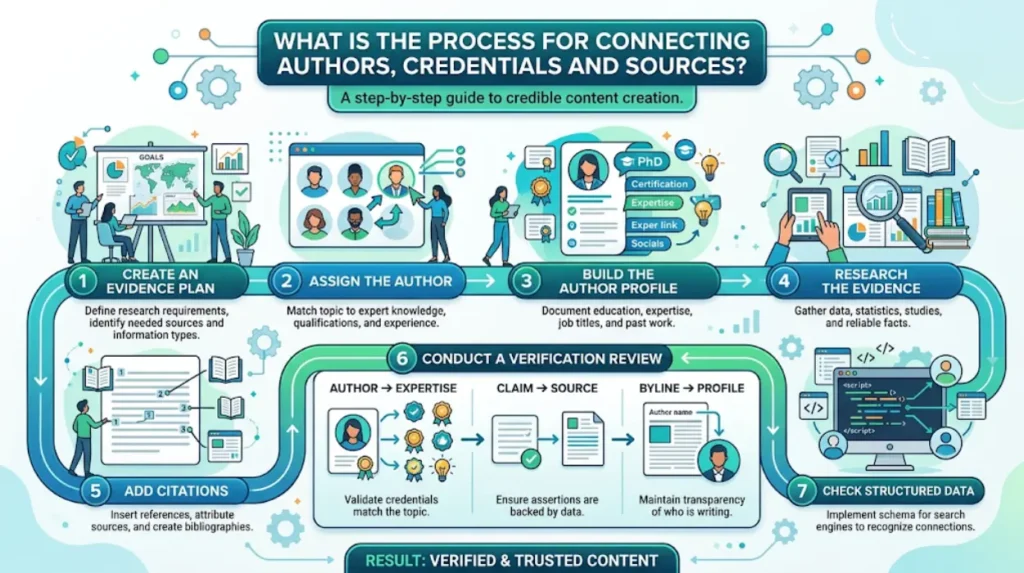
Step 1: Create an evidence plan
List the factual claims that require external support.
For example:
- Market statistics
- Regulatory requirements
- Research findings
- Industry data
- Technical specifications
- Survey results
Step 2: Assign the author
Choose a real author with relevant knowledge and document the professional basis for the selection.
Step 3: Build the author profile
Create an author page containing the person’s name, role, expertise, credentials and relevant professional background.
Step 4: Research the evidence
Locate authoritative sources for factual claims. Record the source title, publisher, publication date and URL during the research process.
Step 5: Add citations
Connect important claims to their supporting sources. Use descriptive anchor text where appropriate.
Step 6: Conduct a verification review
Check three relationships:
Author → Expertise
The author’s background matches the subject.
Claim → Source
The source supports the factual statement.
Byline → Profile
The published byline connects to the correct author information.
Step 7: Check structured data
Article structured data can provide Google with information about the article and its author. Google’s documentation recommends including all authors shown on the page and using author properties such as url or sameAs where appropriate.
Structured data does not replace visible authorship. The information in markup needs to correspond with the content presented to users.
Which sources provide strong evidence for sponsored articles?
Strong evidence comes from sources that directly originate, publish or maintain the information being cited, including government bodies, regulators, research institutions, official datasets, professional organisations and original corporate reports.
Government and regulatory sources
UK government departments and regulators provide authoritative information about legislation, regulatory requirements, public policy and official statistics.
Research institutions
Universities, research organisations and academic publications provide evidence for research-based claims.
Industry organisations
Professional bodies provide sector-specific standards, reports and technical information.
Corporate sources
Annual reports, financial statements, official research and corporate announcements provide primary information about individual organisations.
The source type needs to match the claim. A company report is a primary source for that company’s reported revenue. It is not automatically an independent source for an entire industry’s market size.
How can sponsored articles show the difference between commercial purpose and factual evidence?
A sponsored article can state its commercial purpose clearly while maintaining factual discipline through transparent attribution, relevant authorship, independent evidence and clear separation between promotional claims and externally verifiable information.
Identify promotional statements
Commercial statements describe the organisation, product or service being promoted.
For example, a company can state that it provides media distribution services. A claim about the number of publications reached needs supporting evidence when presented as a factual statistic.
Separate claims from evidence
An article can contain both commercial information and independently sourced facts.
The structure needs to make their roles clear. Promotional statements communicate the sponsor’s offering. External sources support factual statements that readers can independently verify.
Maintain editorial accuracy
Sponsored status does not remove the need for accurate information. Google recommends people-first content that provides useful information and demonstrates appropriate expertise.
What should be checked before publishing a sponsored article?
Before publication, verify the author’s identity, credentials, byline, author profile, source accuracy, citation links, publication dates, structured data and the consistency between visible page information and underlying markup.
A final review can use this checklist:
- Real author name confirmed
- Relevant professional expertise documented
- Credentials verified
- Author profile available
- Byline visible
- Author URL connected correctly
- Major factual claims sourced
- Sources accessible
- Statistics checked against original evidence
- Dates reviewed
- Promotional claims clearly identified
- Article structured data reviewed
- Author information consistent across page and markup
Google’s guidance specifically encourages accurate authorship information and asks publishers to consider whether it is clear who created content and whether bylines provide access to further author information.
How can publishers scale named-author and source verification?
Publishers can scale verification through standard author templates, credential checklists, source databases, editorial review stages and structured-data templates that create consistent authorship and evidence practices across sponsored content.
A standard workflow reduces repeated manual decisions.
An editorial team can maintain an author database containing names, roles, qualifications, specialist subjects, profile URLs and verification dates.
A source database can record authoritative sources for recurring subjects. UK employment content, financial reporting, technology and public policy each require different evidence libraries.
A publication checklist then confirms that every article meets the same attribution and sourcing requirements.
This approach also supports consistency across multiple sponsored articles without creating identical content structures or unsupported author claims.
For organisations evaluating implementation options, sponsored content services can provide a broader view of how author attribution, editorial preparation, source verification and publication workflows fit together.
Why do named authors, credentials and sources matter together?
Named authors identify responsibility, credentials establish relevant expertise, and verifiable sources support factual claims. Together, these elements create transparent content that readers can evaluate and that search systems can better understand.
The three elements perform different functions.
The named author answers who created the article.
The credentials explain why the author is relevant to the subject.
The sources show where important factual information comes from.
Removing one element creates an incomplete information structure. A name without relevant expertise provides limited context. Credentials without verifiable authorship create uncertainty. Sources without clear authorship provide evidence without clear responsibility.
A complete sponsored article therefore connects the author, expertise and evidence into one transparent publishing structure. This supports readers who want to understand who produced the information, why that person is qualified to discuss the topic and how factual claims can be independently checked.
FAQs
Q1: How do you add a named author to a sponsored article?
Ans: Add the author’s full name and a clear author byline near the article title or introduction. The author should have relevant expertise or experience that can be independently verified.
Q2: What credentials should a sponsored article author include?
Ans: Include relevant professional qualifications, industry experience, specialist roles, or subject expertise. Author credentials should accurately reflect the person’s background and support the topic covered in the sponsored content.
Q3: How can sources be made verifiable in sponsored content?
Ans: Use authoritative sources that readers can independently access, such as government publications, recognised organisations, research institutions, and original datasets. Cite the source clearly and link to the relevant page or document where appropriate.
Q4: Why are named authors important for sponsored content?
Ans: A named author establishes clear authorship and helps readers understand who is responsible for the information presented. Relevant author details also provide useful context when evaluating the expertise and credibility of sponsored content.
Q5: How should author credentials and sources be checked before publishing?
Ans: Verify the author’s stated qualifications and professional background using reliable public information. Check each citation against the source to confirm that the evidence supports the claims made in the sponsored article.



