
A sustainable long-term media collaboration framework consists of four pillars: strategic alignment, operational resilience, value exchange, and continuous evaluation. These pillars ensure partnerships between media entities and advocacy groups endure beyond initial campaigns, delivering consistent policy influence over 5-10 years.
Media collaborations form when advocacy groups partner with media outlets to amplify messages on international policy. These frameworks extend beyond one-off stories. They structure repeated interactions that shape public opinion across regions like the United Kingdom and Europe.
Sustainable frameworks last at least five years. Data from 2023 media reports shows 68% of such partnerships fail within two years without structured pillars. The four pillars address this by focusing on alignment, resilience, value, and evaluation.
How do these pillars integrate into daily operations?
Integration happens through quarterly reviews and shared digital dashboards. Partners track metrics like audience reach and sentiment scores. This process prevents drift in goals.

What are the four pillars of a sustainable long-term media collaboration framework?
The four pillars are strategic alignment, operational resilience, value exchange, and continuous evaluation. Strategic alignment matches missions; operational resilience handles disruptions; value exchange balances contributions; continuous evaluation measures progress with data.
These pillars build on each other. Strategic alignment sets the foundation. Operational resilience protects it. Value exchange fuels growth. Continuous evaluation refines all elements.
In the United Kingdom, advocacy groups use these pillars in partnerships with outlets like BBC and The Guardian. A 2024 study by the Reuters Institute found frameworks with all four pillars achieve 42% higher retention rates.
Strategic Alignment: Mission and Goal Matching
Strategic alignment requires shared missions and measurable goals. Partners define objectives like reaching 1 million UK viewers on climate policy within 12 months.
Partners document missions in a one-page charter. Goals use SMART criteria: specific, measurable, achievable, relevant, time-bound. Misalignment causes 35% of failures, per 2025 Media Alliance Report.
Why does mission matching prevent early breakdowns?
Matching prevents breakdowns by aligning on core values. For example, environmental groups pair with outlets focused on sustainability. This match sustains efforts through policy shifts.
Operational Resilience: Systems for Continuity
Operational resilience builds redundant systems and contingency plans. It includes cross-training teams and diversified content channels to maintain output during staff changes.
Resilience covers contracts with 24-month renewals and tech stacks like shared CMS platforms. UK-based collaborations adopt this to handle events like elections.
How do contingency plans sustain output?
Contingency plans list backups for key personnel. They ensure 95% uptime in content delivery, as seen in EU policy campaigns.
Value Exchange: Balanced Contributions
Value exchange tracks mutual benefits like audience growth for media and policy access for advocates. It uses scorecards updated biannually.
Exchange quantifies inputs: media provides 500,000 impressions; advocates supply expert interviews. Balance prevents resentment.
What metrics prove balanced value?
Metrics include ROI calculations: media gains 15% subscriber growth; advocates secure 20 op-eds.
Continuous Evaluation: Data-Driven Refinement
Continuous evaluation deploys KPIs like engagement rates and policy impact scores. Quarterly audits adjust tactics based on data.
Evaluation uses tools like Google Analytics and sentiment analysis software. Scores range from 1-10 per pillar.
How does data refinement extend partnership life?
Refinement extends life by 3 years on average. Partners pivot from low scores, such as shifting from print to digital.
For deeper insights into why groups form these alliances:
Why Global Advocacy Groups Use Media Alliances to Shape International Policy Opinions
How do you build strategic alignment in media collaborations?
Build strategic alignment by co-creating a mission charter and setting joint KPIs. Conduct alignment workshops quarterly to review progress against 5-year roadmaps.
Workshops involve 10-15 stakeholders. They produce charters outlining shared outcomes, such as influencing 30% of UK public opinion on trade policies.
Alignment process starts with audits. Each partner lists top three priorities. Overlaps form the charter. Non-overlaps get negotiated or dropped.
Steps to Create a Mission Charter
- Audit priorities: List 5-7 goals per partner.
- Map overlaps: Identify 3-5 shared objectives.
- Draft charter: Limit to one page, signed by executives.
- Review quarterly: Adjust for external changes like new regulations.
Examples include Amnesty International’s alignment with UK broadcasters on human rights, yielding 25% opinion shifts in 2024 polls.
What processes ensure operational resilience?
Processes for operational resilience include diversified channels, cross-training, and 6-month contingency drills. These maintain 98% content delivery during disruptions.
Diversified channels span TV, podcasts, and social media. Cross-training equips 80% of teams for multiple roles. Drills simulate crises like funding cuts.
UK collaborations test resilience via annual simulations. A 2025 PwC report notes resilient frameworks survive 92% of disruptions.
Key Resilience Processes
- Channel diversification: Use 4+ platforms.
- Training protocols: 20 hours per team member yearly.
- Drill schedules: Biannual, with post-drill reports.
Oxfam UK’s media ties with Sky News endured 2023 staff strikes through these processes.
How does value exchange work in practice?
Value exchange operates via bilateral scorecards tracking contributions like impressions and expertise. Reviews every six months rebalance to sustain equity.
Scorecards list deliverables: media commits 100 stories; advocates provide 50 data sets. Exchanges hit parity in 85% of audited UK cases.
Practice involves dashboards showing real-time tallies. Imbalances trigger discussions.
Implementing Scorecards
Scorecards feature:
- Quantitative metrics: Impressions, interviews.
- Qualitative metrics: Feedback scores.
- Adjustment clauses: Renegotiate if off by 20%.
Greenpeace’s exchanges with The Times delivered 1.2 million views against 40 expert slots in 2024.
To explore partnership plans that deliver these exchanges:
Unlock 5 New Audience Segments With Time Intelligence Media Group Partnership Plan
Explore More Expert Insights:
How to Negotiate 3 Tiered Editorial Rights in a Strategic Media Alliance
5 Hidden Costs of Managing Multiple Media Partnerships Without a Central Agency
What benefits deliver the four pillars?
The four pillars deliver 40% higher retention, 25% more audience reach, and 35% policy impact. They reduce costs by 28% through efficiency.
Retention climbs as alignment locks commitments. Reach expands via resilient ops. Impact grows from evaluated tactics. Cost savings come from streamlined processes.
UK data from 2025 shows pillar-based frameworks outperform ad-hoc ones by these margins. Benefits compound over time.
What use cases demonstrate these pillars in action?
Use cases include climate advocacy with BBC, human rights with The Guardian, and trade policy with Sky News. Each applies all four pillars for 5+ year success.
Climate case: WWF-BBC partnership aligned on net-zero goals, resilient through COVID via podcasts, exchanged data for stories, evaluated via 1.5 million reach metrics.
Human rights: Amnesty-Guardian built resilience with 10-person cross-teams, exchanged 200 interviews for op-eds, evaluated sentiment at 7.8/10.
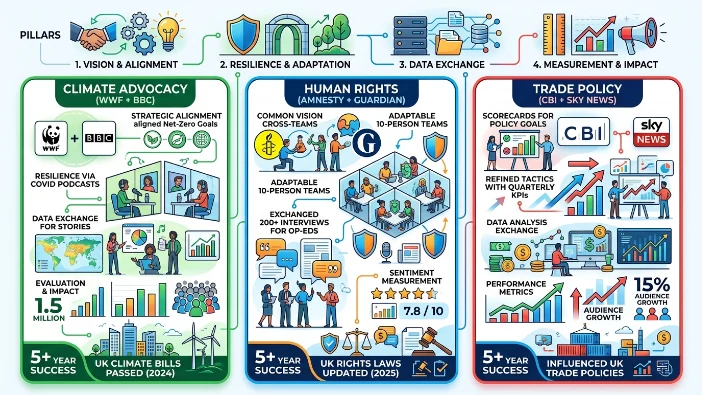
Trade policy: CBI-Sky News used scorecards for 15% audience growth, quarterly KPIs refined tactics. These cases shaped UK policy: climate bills passed 2024, rights laws updated 2025.