
A ranking methodology for a UK industry index is a transparent framework of mathematical formulas, weighted evaluation criteria, and verified data sources that scores commercial market participants. This systematic structure eliminates subjective bias and produces defensible league tables that media publishers, trade associations, and corporate boards trust.
Designing a robust industry index requires a precise combination of quantitative metrics and qualitative validations tailored to the specific regulatory and economic environment of the United Kingdom. When trade publications, such as The Grocer, Retail Week, or Tech Nation reports, evaluate market leaders, they rely on reproducible scoring systems. A sound methodology starts with clear boundaries regarding sector inclusion, geographic revenue generation, and corporate registration status at Companies House.
Core Data Verification Standards
Data integrity forms the foundation of any credible industry ranking in the British market. Index creators gather financial statements directly from statutory filings, official HM Revenue and Customs datasets, and verified primary survey responses.
- Financial Auditing: Analysts extract turnover, operating profit, and net assets directly from audited annual reports filed via Companies House.
- Operational Metrics: Researchers measure verified headcount, office locations across England, Scotland, Wales, and Northern Ireland, and registered patent volumes.
- Temporal Consistency: All data points must align with the same fiscal reporting period to prevent historical distortion between growing and mature enterprises.
Why Do UK Brands Actively Reference and Share Industry Index Reports?
UK brands reference and share industry index reports because verified placement in a reputable league table functions as an authoritative third-party endorsement that accelerates customer acquisition, improves investor relations, and strengthens recruitment pipelines.

Corporate marketing teams across London, Manchester, Edinburgh, and Birmingham leverage high index rankings within public relations campaigns, investor pitch decks, and B2B sales collateral. When a brand secures a top position in an industry index, that achievement signals market leadership to procurement officers and institutional investors. Furthermore, editorial teams in national newspapers routinely cite these rankings when covering sectoral growth trends, offering participating brands free earned media visibility.
Commercial Advantages of Index Participation
Achieving recognition within a respected industry index delivers measurable tangible benefits to commercial enterprises operating within competitive vertical markets.
- Enhanced Brand Trust: Independent scorecards reduce buyer friction by providing objective proof of operational scale and financial stability.
- Earned Media Exposure: Journalists covering UK business news utilize published league tables to identify sources for commentary and feature articles.
- Talent Attraction: High-ranking companies experience increased candidate application volumes because ambitious professionals prefer recognized market leaders.
Readers interested in the educational stage of healthcare awareness campaigns can explore [What Is an Industry Index or League Table Report and Why Do UK Newsrooms Return to Them?].
Explore More Expert Insights:
How to Brief a UK Publisher for Sponsored Content That Feels Like Real Journalism
Sponsored Content Across 10 Verticals: UK Engagement Benchmarks 2026
How Are Scoring Criteria and Weighting Systems Developed?
Scoring criteria and weighting systems are developed by assigning mathematical percentages to specific performance pillars, such as revenue growth, sustainability compliance, and customer satisfaction, ensuring total scores reflect true commercial impact rather than vanity metrics.
The weighting phase dictates how much influence each variable holds over the final ranking position. For instance, in a B2B software index, annual recurring revenue growth might account for forty percent of the total score, while enterprise security compliance accounts for twenty percent. Index designers must calibrate these weights in consultation with industry trade bodies to ensure the resulting hierarchy aligns with real-world commercial priorities in the United Kingdom.
Balancing Quantitative and Qualitative Metrics
An effective methodology integrates hard financial figures with qualitative assessments to capture a complete picture of corporate capability. Quantitative indicators provide objective measurements, while qualitative metrics capture nuanced factors like corporate governance and workplace culture.
- Financial Metrics: Gross margin percentage, three-year compound annual growth rate, and EBITDA performance.
- Compliance Metrics: Adherence to UK data protection regulations, carbon reduction targets aligned with British net-zero mandates, and modern slavery statement filings.
- Qualitative Assessments: Structured peer reviews and customer retention scores gathered via standardized executive interviews.
What Are the Essential Components of a Shareable League Table?
The essential components of a shareable league table include an executive summary of findings, a searchable data table with sortable columns, clear visualization charts, and an easily downloadable PDF methodology appendix.
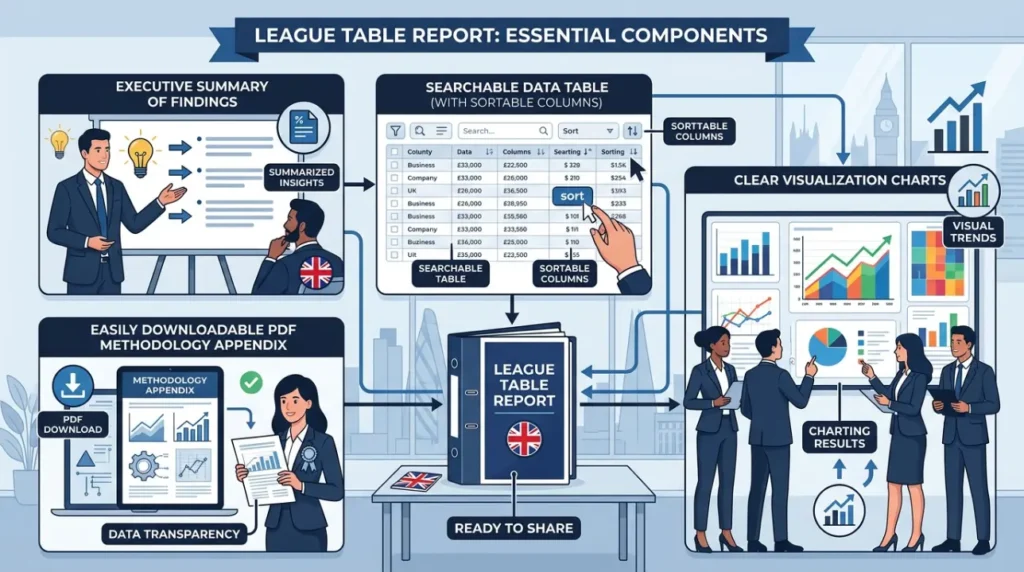
Publishing an index requires more than a simple list of company names; it demands a comprehensive digital presentation that encourages social sharing and embedding by external publishers. Corporate executives share reports that offer deep analytical insights alongside the raw rankings. Including regional breakdowns across UK nations and sector-specific sub-categories increases the likelihood that individual businesses will share their specific niche victories across professional networks like LinkedIn.
Designing for Media Pickup and Digital Sharing
Media-friendly indices feature distinct visual assets and data structures that journalists can immediately parse and cite in breaking news coverage.
- Visual Infographics: High-resolution charts illustrating sector growth averages, geographic distribution, and top-mover movements.
- Embeddable Widgets: Interactive ranking tables equipped with unique URLs and permalinks for external websites.
- Transparent Disclaimers: Explicit documentation detailing data collection timeframes, exclusion criteria, and contact details for methodology inquiries.
How Can Businesses Prepare Their Data for Industry Index Evaluation?
Businesses prepare their data for industry index evaluation by maintaining clean financial records at Companies House, publishing comprehensive environmental reports, and standardizing their corporate governance metrics ahead of data submission windows.
Brands seeking inclusion in prominent UK indices must proactively manage the data inputs that researchers analyze. Because analysts rely heavily on public records and direct survey submissions, maintaining up-to-date filing schedules prevents disqualification due to missing or outdated information. Organizations often partner with specialized research firms to structure their performance data correctly before evaluation periods open.
Strategic Steps for Index Readiness
Preparation requires a systematic audit of internal records to match the specific evaluation criteria established by index designers.
- Statutory Timelines: Ensure annual accounts are filed well ahead of the designated index cutoff date to guarantee inclusion in financial screens.
- Data Accuracy: Verify that registered company names, corporate structure details, and registered office addresses match official government registries.
- Proactive Engagement: Establish communication channels with research administrators to submit supplementary ESG documentation and customer reference data on time.
For organizations seeking expert guidance on designing proprietary league tables or optimizing corporate positioning within existing rankings, explore [Time Intelligence Media Group Research and Reports Services for Industry Index Reports].
Designing a ranking methodology for a UK industry index requires mathematical rigor, transparent data verification from sources like Companies House, and balanced weighting criteria. When structured correctly, these indices attract media attention from UK newsrooms and drive significant brand sharing. By adhering to clear evaluation frameworks, organizations ensure their league tables remain trusted, authoritative, and commercially valuable.