
An industry index or league table report is a structured, data-driven evaluation ranking commercial entities within a specific sector based on performance metrics, financial growth, or operational impact. UK newsrooms return to these publications because they deliver verified statistical data, eliminate manual desk research, and provide authoritative source material that appeals directly to professional readership demographics across national and regional media outlets.
What is an industry index report?
An industry index report is a formal research document that aggregates performance indicators across a defined business sector to establish objective rankings. These reports evaluate corporate metrics such as annual revenue growth, employee headcount expansion, technological adoption rates, and export volume. Analysts compile these data sets using audited financial records, regulatory filings from Companies House, and primary survey data collected from verified corporate leadership teams.
Core Characteristics of Business Benchmarking Reports
- Quantitative Metrics: Evaluations rely on numerical financial values rather than subjective qualitative reviews.
- Standardised Scoring: Every participating entity faces identical mathematical formulas and transparent weighting criteria.
- Temporal Boundaries: Research reflects specific financial years or rolling twelve-month reporting periods to ensure comparability.
How do league table reports function in the corporate ecosystem?
League table reports function by systematically sorting market competitors into numerical hierarchies that expose sector leaders, high-growth contenders, and structural market shifts. Commercial researchers extract raw data from national registries, standardise the financial inputs to account for currency fluctuations or corporate restructuring, and apply transparent scoring models. This operational process transforms unstructured financial data into structured tables that demonstrate relative market positioning across specific economic sectors.
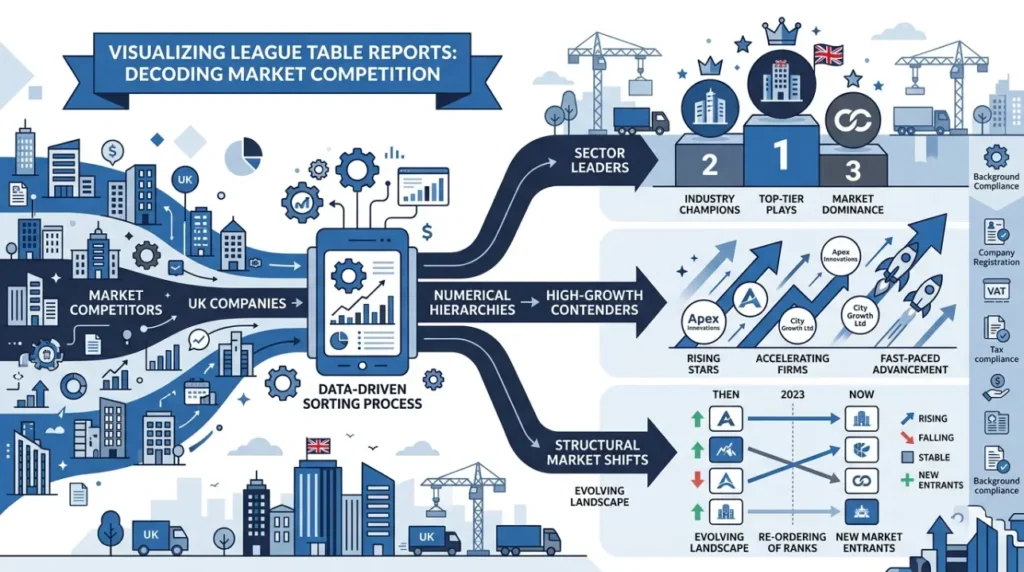
The Index Compilation Workflow
- Data Ingestion: Researchers aggregate balance sheets, profit-and-loss statements, and official registry filings.
- Metric Normalisation: Financial figures undergo standardisation to reconcile varying accounting periods and corporate structures.
- Algorithmic Ranking: Weighted scoring algorithms compute final aggregate scores and assign definitive numerical positions.
What are the key components of a professional league table?
The key components of a professional league table include a defined methodology statement, a transparent metric weighting system, comprehensive company profiles, and verified financial data appendices. Each component ensures that third-party auditors and media organisations can independently verify the accuracy of the rankings without relying on opaque estimations or unverified survey responses.
Essential Structural Elements
- Methodology Framework: A detailed explanation of inclusion criteria, data sources, and mathematical formulas.
- Ranked Data Tables: Numerical lists displaying company names, geographical headquarters, executive leadership names, and specific performance metrics.
- Sector Analysis Sections: Macroeconomic commentary examining the underlying drivers behind the performance shifts observed within the tables.
Explore More Expert Insights:
How Fintech Companies Acquire Users Using Banner Ads
How Finance Brands Promote Credit Cards Using Display Campaigns
Why do UK newsrooms rely on published industry indices?
UK newsrooms rely on published industry indices because these reports supply immediate, verified news hooks, reduce fact-checking overhead, and deliver high-value data visualisations for digital publications. National and regional newspapers, broadcasting corporations, and trade journals utilise these verified rankings to generate daily news stories, economic round-ups, and special investigative features without allocating internal reporting staff to months of preliminary data collection.
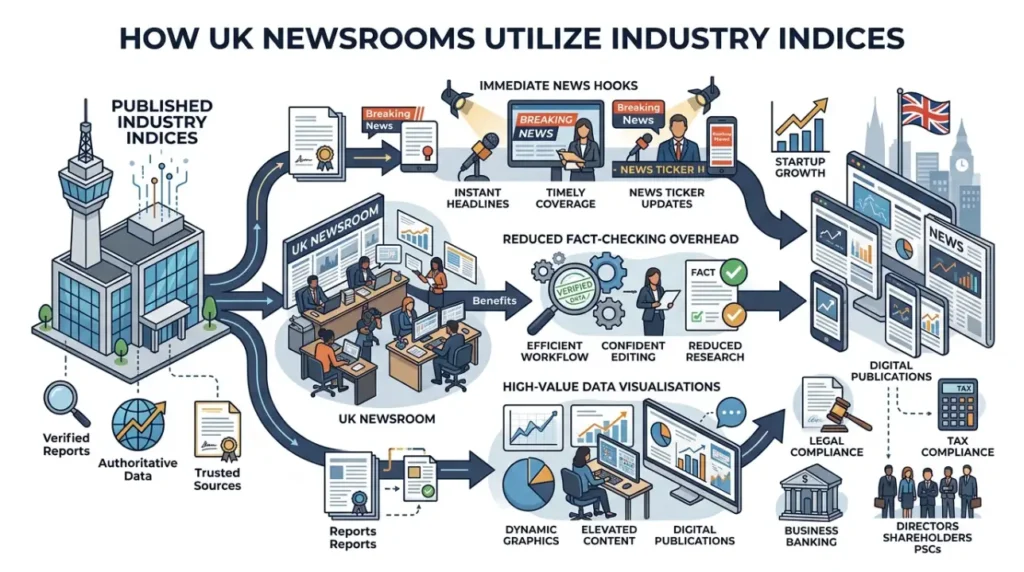
Media Utility Drivers
- Pre-Vetted Factuality: Indices undergo rigorous pre-publication auditing, minimising legal liability and retraction risks for publishing houses.
- Geographical Relevance: Data segmented by UK regions allows local newsrooms to highlight regional economic champions and high-growth employers.
- Visual Readiness: Structured tables and charts integrate seamlessly into digital news layouts and broadcast graphics.
What economic impact do industry rankings have on featured businesses?
Industry rankings create direct economic impact by boosting corporate visibility, validating creditworthiness for institutional investors, and accelerating client acquisition cycles for top-performing firms. Inclusion in a high-profile league table serves as an objective third-party endorsement that signals operational stability and financial health to prospective enterprise clients, commercial landlords, and talent recruitment agencies.
Commercial Outcomes for Ranked Entities
- Investor Attraction: Venture capital firms and private equity investors utilise indices to source high-performing acquisition targets.
- Employer Branding: High positions within reputable league tables enhance graduate recruitment conversion rates and employee retention metrics.
- Procurement Validation: Enterprise buyers reference independent industry rankings to satisfy vendor due diligence requirements.
How do stakeholders evaluate the credibility of an index report?
Stakeholders evaluate the credibility of an index report by examining the transparency of the data sources, the independence of the research organisation, and the reproducibility of the scoring methodology. Credible reports disclose their exact calculation formulas, cite regulatory databases such as the London Stock Exchange or Companies House, and maintain clear independence from commercial sponsorship influences.
Markers of Methodological Integrity
- Audited Inputs: Reliance on statutory filings rather than self-reported promotional claims.
- Clear Exclusion Rules: Explicit definition of why certain market segments or non-compliant firms remain excluded from the final tables.
- Editorial Independence: Separation of research compilation teams from commercial sales or advertising departments.