
Display advertising helps SaaS companies attract new users through visual ads placed across websites, apps, and digital platforms. These ads increase product visibility, educate target audiences, and guide potential users toward product discovery through structured messaging, audience targeting, and repeated exposure across online environments.
Display advertising is a digital marketing method that uses banners, responsive visuals, interactive creatives, and multimedia placements to promote software products. SaaS companies use display campaigns to introduce products to people actively researching software solutions or operational challenges.
A SaaS company targets businesses, teams, or professionals with software delivered through cloud-based subscriptions. User acquisition refers to the process of attracting and converting new users into active product visitors, free trial users, or subscribers.
Display ads appear on technology blogs, business publications, productivity platforms, video websites, mobile applications, and industry-specific digital environments. Common formats include leaderboard banners, sidebar placements, native display ads, and responsive display creatives.
Display advertising supports awareness-stage marketing. TOFU marketing focuses on audiences learning about operational problems, software categories, or workflow improvements for the first time.
Readers exploring educational advertising strategies can also review:
How Tech Startups Educate Prospects Using Solution-Based Banner Ads for solution-focused campaign structures designed for informed prospects.
How do SaaS companies use display advertising to attract users?
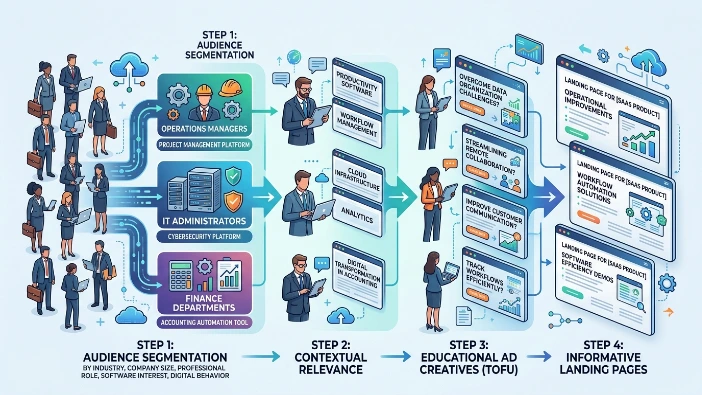
SaaS companies attract users by identifying target audiences, creating educational ad creatives, selecting relevant publishing networks, and directing traffic toward informative landing pages. The process increases product discovery among professionals researching operational improvements, workflow automation, or software-based efficiency solutions.
The process starts with audience segmentation. SaaS advertisers divide audiences by industry, company size, professional role, software interest, and digital behavior.
A project management platform targets operations managers. A cybersecurity platform targets IT administrators. An accounting automation tool targets finance departments. Each audience receives different ad messaging based on operational needs.
Display campaigns rely on contextual relevance. Ads appear beside content related to productivity software, cloud infrastructure, workflow management, analytics, or digital transformation.
Educational messaging remains central in TOFU campaigns. Headlines focus on explaining challenges, introducing categories, or highlighting measurable operational concepts. Examples include data organization, remote collaboration, customer communication, or workflow tracking.
Landing pages connected to display campaigns provide structured educational information instead of direct sales pressure. These pages explain software categories, industry problems, and workflow inefficiencies using factual content.
SaaS companies also use retargeting to reconnect with previous website visitors. Retargeting campaigns show ads to users who visited educational pages but left without further interaction.
Why does display advertising work for SaaS awareness campaigns?
Display advertising works for SaaS awareness campaigns because it delivers repeated visual exposure across digital environments where business audiences consume information. Repetition improves recognition, reinforces software categories, and increases familiarity with operational problems connected to cloud-based software solutions.
SaaS buying journeys involve long research cycles. Business users compare software categories, investigate operational gaps, and review process improvements before evaluating products directly.
Display advertising supports this extended learning process by maintaining visibility during research activity.
Visual consistency strengthens recognition. Repeated use of the same design elements, messaging structures, and educational terminology helps audiences remember software categories and workflow concepts.
Audience targeting improves campaign efficiency. SaaS companies focus on professionals already consuming relevant digital content. This increases exposure among audiences connected to operational decision-making.
Display advertising also supports scalable reach. A single campaign can appear across thousands of websites, mobile applications, and business content platforms simultaneously.
Performance tracking improves optimization accuracy. SaaS marketers monitor impressions, click-through rates, audience engagement, bounce rates, and session duration to understand which educational messages attract attention.
Display campaigns also support multi-device exposure. Professionals research software on desktop computers during work hours and continue browsing on mobile devices after work.
This cross-platform visibility expands audience reach throughout the research process.
What types of display ads do SaaS companies use?
SaaS companies use banner ads, responsive display ads, native ads, retargeting ads, and video display formats to support user acquisition. Each format serves different educational purposes, audience behaviors, and visibility requirements across business-focused digital environments and research-driven browsing sessions.
Banner ads are the most common format. These static or animated placements appear at the top, side, or middle sections of websites.
Responsive display ads automatically adjust layouts, dimensions, and visual structures based on available ad inventory across advertising networks.
Native display ads blend into editorial layouts while maintaining sponsored labeling. These ads match the appearance of surrounding content to improve visibility without interrupting reading behavior.
Retargeting ads reconnect with users who previously interacted with educational resources, software guides, or comparison pages.
Video display ads explain workflows, dashboards, operational processes, or productivity concepts using short visual demonstrations.
Interactive display formats also appear in SaaS advertising ecosystems. These ads include expandable sections, hover interactions, or embedded product walkthrough previews.
Each format supports different stages of user education. Awareness campaigns prioritize clarity, category explanation, and operational relevance over direct conversion pressure.
Readers interested in conversion-focused advertising structures can explore:
How Tech Startups Turn Solution Seekers Into Qualified Leads Using Conversion Banner Ads for lead-generation campaign approaches connected to qualified software interest.
How do SaaS companies target the right audience with display ads?
SaaS companies target audiences using demographic filters, behavioral data, contextual placement, professional interests, and website interaction signals. These targeting systems increase advertising relevance by matching educational software content with audiences researching related operational or technological subjects online.
Behavioral targeting tracks browsing activity connected to business software research. Users visiting productivity blogs, analytics platforms, cybersecurity publications, or workflow management resources become eligible for related display campaigns.
Contextual targeting places ads beside relevant editorial content. A workflow automation advertisement appears beside operational efficiency articles. A cloud storage campaign appears beside remote collaboration content.
Interest-based targeting uses long-term digital behavior patterns to identify professionals connected to business operations, information technology, finance, marketing, or customer support.
Geographic targeting supports regional relevance. SaaS companies create campaigns specific to countries, industries, or local business regulations.
Device targeting also influences campaign delivery. Desktop campaigns focus on workplace browsing behavior, while mobile campaigns support continuous exposure outside office environments.
Audience exclusion improves efficiency. Existing customers, inactive audiences, or irrelevant demographic groups are removed from campaigns to reduce unnecessary advertising costs.
Frequency controls prevent excessive exposure. Advertising platforms limit the number of times users see identical ads within specific time periods.
These targeting systems improve campaign precision while maintaining educational relevance for awareness-focused SaaS marketing.
What role do landing pages play in SaaS display advertising?
Landing pages convert advertising attention into educational engagement by providing structured information related to software categories, operational challenges, and workflow improvements. Effective landing pages align directly with display ad messaging and maintain consistent informational context throughout the visitor experience.
A display ad introduces a topic. The landing page expands that topic with deeper educational content.
Consistency between ad messaging and landing page structure improves engagement accuracy. If an ad discusses workflow automation, the landing page explains workflow inefficiencies, automation benefits, and software-related operational structures.
Educational landing pages include clear headlines, structured explanations, operational examples, platform screenshots, and industry-focused use cases.
Information architecture remains important. Visitors scan content quickly. SaaS landing pages organize sections using concise paragraphs, logical flow, and contextual relevance.
Loading speed affects engagement rates. Slow-loading pages increase abandonment during early research stages.
Mobile responsiveness also affects user acquisition performance. Business professionals often interact with educational software content across multiple devices.
Analytics tools track visitor behavior after ad clicks. SaaS marketers monitor session duration, content engagement, scroll depth, and interaction patterns to improve future campaigns.
Landing pages also support audience qualification. Educational engagement helps marketers identify visitors with higher interest in operational solutions or software-related improvements.
Explore More Expert Insights:
How SaaS Businesses Retarget Website Visitors Using Banner Ads
How SaaS Platforms Increase Demo Requests Using Banner Ad Campaigns
How do SaaS companies measure display advertising performance?
SaaS companies measure display advertising performance using impressions, click-through rates, engagement metrics, return on ad spend, conversion tracking, and audience behavior analysis. These measurements help marketers identify effective educational messaging, audience relevance, and campaign efficiency across acquisition channels.
Impressions measure how often ads appear across websites and applications.
Click-through rate measures how frequently users interact with display creatives after viewing them.
Cost per click tracks advertising efficiency by calculating spending relative to engagement activity.
Bounce rate measures how many visitors leave landing pages without additional interaction.
Session duration tracks how long users engage with educational content after clicking advertisements.
Conversion tracking measures actions connected to user acquisition goals. These actions include newsletter signups, webinar registrations, educational resource downloads, and free account creation.
Retargeting performance measures repeated engagement among returning visitors exposed to follow-up advertising campaigns.
Attribution systems identify which display campaigns contribute to future conversions during long SaaS buying journeys.
Audience segmentation reports also improve optimization accuracy. SaaS marketers analyze performance differences between industries, professional roles, geographic regions, and behavioral groups.
Performance analysis supports campaign refinement. Underperforming creatives are replaced. High-performing audience segments receive additional budget allocation. Messaging structures evolve based on engagement data.
How does display advertising support long-term SaaS growth?
Display advertising supports long-term SaaS growth by increasing category visibility, strengthening audience familiarity, and maintaining continuous exposure during extended software research cycles. Consistent educational advertising builds awareness among future buyers before active purchasing or vendor evaluation begins.
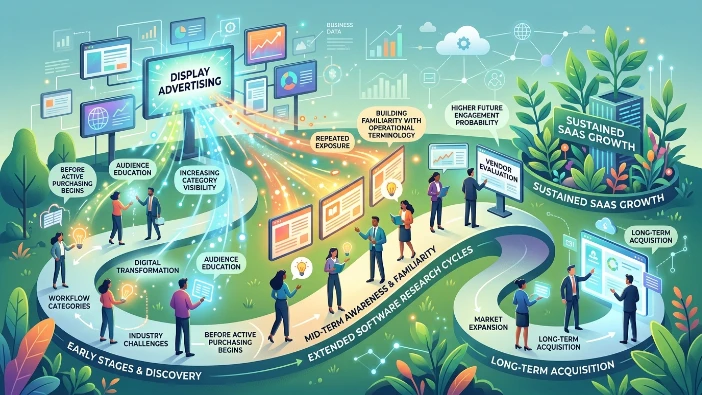
SaaS growth depends on sustained audience education. Many business users first encounter software categories months before active evaluation starts.
Display advertising keeps software concepts visible during this early research stage.
Repeated exposure improves familiarity with operational terminology, workflow categories, and digital transformation concepts. Familiarity increases future engagement probability during software comparison stages.
Educational display campaigns also support market expansion. Emerging SaaS categories gain recognition through continuous informational advertising across business-focused publishing networks.
Display advertising contributes to broader content ecosystems. Users exposed to banners later search for educational articles, comparison resources, webinars, or operational guides connected to the same topic.
This interconnected research behavior strengthens long-term user acquisition pathways.
TOFU campaigns establish awareness. MOFU campaigns expand understanding. BOFU campaigns focus on conversion-driven engagement.
Readers progressing through this educational sequence can continue for deeper funnel-stage analysis connected to SaaS advertising strategy.