
Product awareness ads introduce specific food products to target customers with clear facts about features, benefits, and availability in a measurable format.
Product awareness ads define a single product, present its attributes (ingredients, portion size, price), and state where customers can buy it. They use measurable audience segments such as age group 18–34, location by postcode, or purchase history. Ad formats include display banners, short video clips, social feed cards, and sponsored search listings. Campaign objectives focus on metrics such as view-through rate, ad recall lift, and aided awareness percentage.
How food brands structure product messages depends on the product category. For packaged snacks, messages list weight in grams, calorie count, and pack count. For chilled ready meals, messages list serving size, cook time in minutes, and UPC or SKU for store lookup. For beverages, messages list volume in millilitres and ABV if applicable. Regulators require factual claims to match product labels and avoid unverified health statements.
How do brands select audiences for product awareness ads?
Brands select audiences by combining demographic filters, purchase data, and behavioural signals to reach groups most likely to notice a new product.
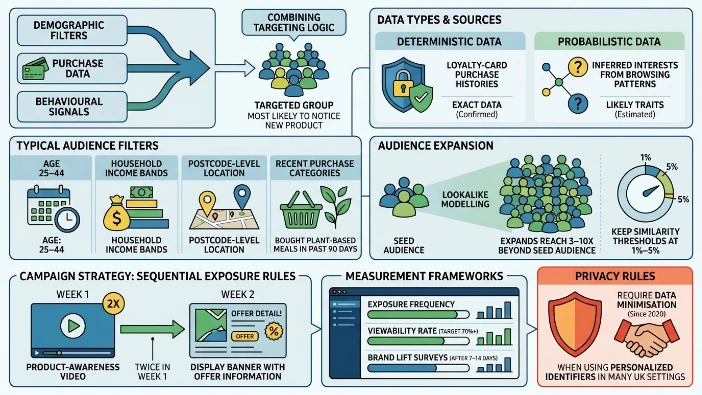
Audience selection uses deterministic data such as loyalty-card purchase histories and probabilistic data such as inferred interests from browsing patterns. Typical filters include age (e.g., 25–44), household income bands, postcode-level location, and recent purchase categories (e.g., bought plant-based meals in past 90 days). Brands also use lookalike modelling to expand reach by 3–10x beyond seed audiences while keeping similarity thresholds at 1%–5%.
Campaigns use sequential exposure rules. For example, show a product-awareness video twice in week 1, then display a banner with offer information in week 2. Measurement frameworks track exposure frequency, viewability rate (target 70%+), and brand lift surveys after 7–14 days. Privacy rules require data minimisation and, since 2020, explicit consent when using personalised identifiers in many UK settings.
How do brands design creative for product awareness ads?
Creative design prioritises one clear product fact per ad, a high-contrast product image, and a concise benefit statement limited to 10–12 words.
Design elements include a single primary image of the product on a neutral background, a headline containing the product name and variant, and a secondary line with one metric (price, pack size, or preparation time). Video length is kept to 6–15 seconds for social feeds; pre-roll slots use 6–10 seconds when skippable. Typography uses at least 18px equivalent for legibility on mobile. Colour contrast follows accessibility ratios of at least 4.5:1 for text.
Examples: a chilled soup ad lists “400g, serves 2, ready in 4 minutes”; a snack pack lists “120g, 10 portions”; a ready meal lists “single-serve, 550 kcal, microwave 5 min”. Creative must mirror on-pack claims and nutritional panels where applicable. Legal review checks for regulated terms such as “low sugar” or “high protein” against UK advertising standards.
How do brands measure the effectiveness of product awareness ads?
Brands measure awareness using mix of view metrics, brand lift studies, and store-level uplift in product searches or LAI (local availability index).
Primary metrics include impressions, unique reach, view-through rate (VTR), and ad recall lift from surveys. Secondary metrics include search volume increase for the SKU or product name, website product-page views, and in-store scan data showing units sold per store. A standard test uses a control group and exposed group across matched areas; expected short-term ad recall lift benchmarks range from 3%–8% for new products in national campaigns.
Attribution uses time windows: measure search uplift within 7 days of first exposure and sales uplift within 14–28 days. When loyalty-card data is available, brands calculate incremental sales per exposed household. Statistical significance tests use p < 0.05 for lift claims. Reporting layers include weekly dashboards for reach/frequency and monthly brand-lift reports.
How do product awareness ads fit into a marketing funnel?
Product awareness ads occupy the mid-funnel by converting general interest into product familiarity and prompting targeted consideration actions.
At the top of funnel, channels deliver broad category education. Product awareness ads then deliver specific facts that differentiate one product variant from category peers. These ads prepare audiences for lower-funnel activations such as price promotions or in-store sampling. Brands set frequency caps to avoid oversaturation: common caps are 6–12 impressions per user over 28 days.
Campaign staging example: Phase 1 raises awareness with a video explaining the product’s unique feature; Phase 2 runs targeted display creative emphasising availability and pack sizes; Phase 3 sends voucher codes to those who viewed product pages. Each phase uses separate KPIs: recall for Phase 1, search uplift for Phase 2, redemption rate for Phase 3. This staged approach keeps messaging factual and focused.
What channels deliver product awareness ads effectively in the UK?
Effective channels include social platforms for reach, programmatic display for contextual targeting, connected TV for high-impact visuals, and search ads for reactive discovery.
Social platforms generate broad reach and short-form video performance with view rates above 40% for 6–15 second clips. Programmatic display allows postcode-level delivery and contextual targeting aligned to food-related content. Connected TV delivers sight, sound, and motion for 15–30 second spots with higher recall rates, particularly for family-targeted products. Search ads capture intent when users query product names or ingredients; branded search impressions indicate rising consumer interest.
Retail media networks provide direct in-store discovery metrics such as bidirectional SKU-level impressions and on-site conversion rates. Retail media connects ad exposure to add-to-basket events and actual sales scans. Use privacy-safe measurement with aggregated reporting and on-device modelling to comply with UK privacy frameworks.
What content components must appear in product awareness ads?
Mandatory components include the clear product name, factual attribute(s) (weight, volume, price or prep time), availability information (store or online), and legal disclaimers when applicable.
Label information such as net weight in grams, total calories, and allergen statements must match on-pack text. Price statements must include currency and be accurate for the ad’s valid period. Availability uses specific store names or “available nationwide” only when verifiable. All claims about health or function require substantiation from product documentation and must comply with Advertising Standards Authority rules.
Example component list in order: product name; primary attribute (e.g., 400g); brief benefit (e.g., ready in 4 minutes); where to buy (e.g., selected supermarkets by postcode); promotional timeframe (dates). If the ad includes a promotional price, include terms in legible font.
What are the measurable benefits of product awareness ads?
Product awareness ads increase aided recall, raise SKU-level search volume, and generate short-term purchase intent measurable through uplift in store scans or online add-to-cart events.
Measured outcomes include a 3%–8% lift in ad recall, a 15%–60% increase in search queries for the product name within 7 days, and a 5%–20% incremental sales uplift in stores exposed to the campaign for regional pilots. Other benefits include faster time-to-first-purchase for new product lines and higher conversion rates for follow-up promotional messages. Retail media reporting links impressions to on-site conversions, enabling direct ROI calculations.
What use cases show product awareness ads work?
Use cases include new product launches, variant extensions, seasonal limited editions, and reformulation communications where factual product differences matter to customers.
New product launches use awareness ads to seed product facts before wider distribution. Variant extensions (e.g., introducing a gluten-free variant) rely on ads to communicate the specific attribute that differentiates the SKU. Seasonal editions use timed campaigns around defined windows (e.g., 4–6 weeks prior to season). Reformulation communications use ads to inform customers about ingredient changes and updated nutrition facts to prevent confusion at point of purchase.
Real example: a national rollout tested a regional pilot in 150 stores, ran a programmatic awareness campaign for 21 days, and measured a 12% SKU search uplift and 7% sales lift in pilot stores versus control stores.
Explore More Expert Insights:
How Cafes Build Visit Intent Using Local Banner Advertising
How Restaurants Increase Food Consideration Using Display Campaigns
How should brands test and iterate product awareness ads?
Brands run randomised control tests, compare exposed vs. control cohorts, and iterate creative and audience segments based on measured lift and sales data.
Testing uses geo-controlled experiments or user-level randomisation. Set a primary metric (ad recall or SKU sales uplift) and a test period of 21–28 days. Compare exposed areas with matched control areas. If the exposed group shows <3% lift in recall, change one variable: creative, frequency, or audience composition. Repeat tests with sample sizes large enough to reach statistical power (minimum sample size depends on baseline rates; commonly 10,000+ impressions per cohort for national campaigns).
Adjustments include swapping headlines, shortening video to 6 seconds, or moving from broad demographic targeting to behaviour-based segments. Use incremental lift tests for promotional follow-ups to isolate the awareness effect from offers.
How do product awareness ads interact with offers and promotions?
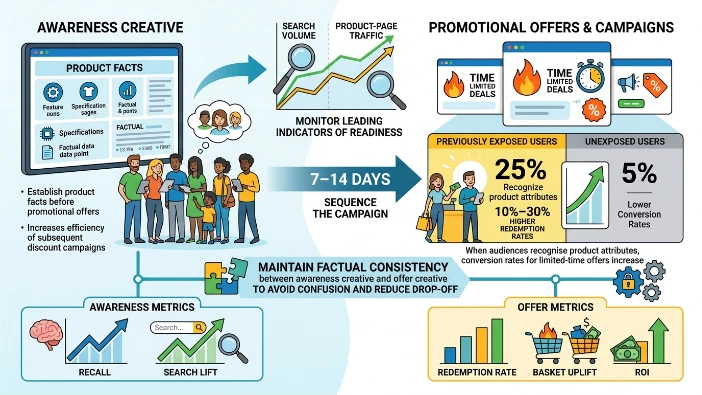
Product awareness ads prepare audiences by establishing product facts before promotional offers appear, increasing the efficiency of subsequent discount campaigns.
When audiences already recognise product attributes, conversion rates for limited-time offers increase. Sequence the campaign so that awareness creative runs 7–14 days before the promotional offer. Monitor search volume and product-page traffic as leading indicators of readiness. Offer campaigns that follow awareness exposure typically show 10%–30% higher redemption rates among previously exposed users compared with unexposed.
Learn More Here:
How Food Brands Promote Offers Using Banner Campaigns
Awareness uses recall and search lift, offer stage uses redemption rate, basket uplift, and ROI. Maintain factual consistency between awareness creative and offer creative to avoid confusion and reduce drop-off.
Discover More Insights:
Food Brand Awareness Ads That Convert Product Interest Into Purchase Intent